


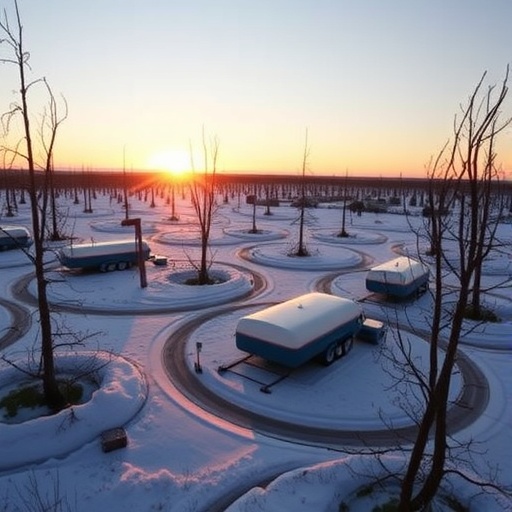
The Arctic is warming faster than the global average, and Siberia is emerging as one of the most important—and least understood—fronts in the climate system. As permafrost thaws, wetlands become more biologically active, and wildfires intensify, the region is releasing increasing quantities of methane (CH₄), a greenhouse gas far more potent than carbon dioxide over the short term. New research published in Science shows that Siberian methane emissions rose sharply between 2010 and 2023, revealing a climate feedback that could undermine global efforts to slow warming.
The international study, led by Prof. Yi Liu of the Institute of Atmospheric Physics at the Chinese Academy of Sciences, estimates that annual methane emissions from Siberia increased by 12.0 ± 1.9 teragrams during the study period. That represents an average annual increase of 1.1 ± 0.1 teragrams. The scale of the increase is striking: it is equivalent to approximately 92% of the growth in methane emissions from wetlands worldwide, even though Siberia contributes only about 5% of global methane emissions.
The findings were made possible by combining several independent sources of atmospheric information. Researchers used observations from the Greenhouse Gases Observing Satellite, or GOSAT, together with measurements from a global network of ground-based monitoring stations, including tall towers located across Siberia. These data were analyzed using a methane flux inversion system developed by Dr. Sihong Zhu of the Institute of Atmospheric Physics. In an atmospheric inversion, measured methane concentrations are mathematically combined with transport models to estimate where emissions originated and how large they must have been. The approach reduced uncertainty in both the estimated emissions and their long-term trend to roughly 10%.
The study addresses a long-standing problem in climate science. Siberia covers an enormous area, but monitoring stations are sparse, and its landscapes are extraordinarily complex. Frozen soils, wetlands, lakes, rivers, forests and burned areas all emit methane through different physical and biological processes. Permafrost soils can preserve carbon accumulated over thousands of years. When thawing exposes organic matter to waterlogged, oxygen-poor conditions, microorganisms known as methanogens convert that material into methane. In contrast, wildfires can rapidly release stored carbon and alter soils in ways that influence methane production for years after a fire.
The researchers found that the Yenisei River separates two increasingly distinct climate regimes. Western Siberia is becoming wetter, while eastern Siberia is becoming warmer and drier. Although both regions are experiencing rising methane emissions, the mechanisms behind the increase are different. This regional contrast demonstrates why treating Siberia as a single, uniform source of greenhouse gases can conceal the processes driving its transformation.
In western Siberia, the principal influence is a winter atmospheric circulation pattern known as the Scandinavian pattern. Changes in this circulation can transport additional heat and moisture into the region, raising land-surface temperatures and modifying the water balance of permafrost and wetland ecosystems. Warmer, wetter conditions can deepen the seasonally thawed active layer above permafrost and create environments favorable to methanogenesis. The resulting increase in methane emissions was estimated at 0.4 ± 0.1 teragrams per year squared, indicating that the contribution is accelerating rather than remaining constant.
Eastern Siberia presents a different and more volatile picture. There, methane growth is closely linked to high-pressure anomalies associated with the Arctic Oscillation. These atmospheric systems can produce persistent warm and dry conditions, reducing soil moisture and increasing the likelihood that vegetation will ignite. Once fires begin, strong winds and dry fuels can allow them to spread across vast areas. Fire-related methane emissions in eastern Siberia increased at an estimated rate of 0.7 ± 0.1 teragrams per year squared, making wildfire the dominant driver of the regional trend.
The analysis also revealed that Siberian methane emissions respond to temperature extremes in an accelerating, weakly nonlinear way. In other words, emissions do not simply rise by the same amount for every additional degree of warming. At higher temperature maxima, biological activity, permafrost thaw and fire risk can intensify disproportionately. This finding is particularly important for climate projections because models that assume a simple linear relationship between temperature and methane may underestimate future emissions during extreme warming events.
To improve those projections, the researchers applied an emergent constraint approach. This method compares observable relationships in the present climate—such as the link between temperature extremes and methane release—with the behavior of multiple climate models. If models that better reproduce observed relationships tend to produce similar future outcomes, observations can be used to narrow the range of projections. Under the high-emissions SSP5-8.5 scenario, the study projects that Siberian methane emissions in 2050 could increase by an amount comparable to the expected rise in global wetland methane emissions relative to the 2010–2023 average. Eastern Siberia is expected to account for most of that increase.
The consequences extend beyond the Arctic. The projected rise could offset about 20% of the anthropogenic methane reductions required to meet international climate targets. Methane remains in the atmosphere for less time than carbon dioxide, but it traps substantially more heat over a 20-year period, making rapid reductions especially valuable for slowing near-term warming. The new findings suggest that natural sources may weaken some of the benefits achieved through cuts in fossil-fuel, agricultural and waste-sector emissions. “If we ignore these regional, nonlinear feedbacks, estimates of the global methane budget could be seriously biased,” Prof. Liu said. The study therefore calls for climate assessments to incorporate regional thresholds, wildfire dynamics and warming-driven ecosystem changes when evaluating the future of the global methane cycle.
News Publication Date: 6-Aug-2026
Web References: https://doi.org/10.1126/science.aea5828
References: Science article, DOI: 10.1126/science.aea5828; related 2020 Nature study, DOI: 10.1038/s41586-020-2849-9
Keywords
Siberia, methane emissions, Arctic warming, permafrost thaw, wildfires, wetlands, methanogenesis, climate change, atmospheric circulation, Arctic Oscillation, Scandinavian pattern, greenhouse gases, methane budget
Cite Scienmag News
Bethany Barker. (August 6, 2026). Siberia’s Rising Methane Threat Could Erase 20% of Global Cuts by 2050. Scienmag. https://scienmag.com/siberias-rising-methane-threat-could-erase-20-of-global-cuts-by-2050/
Bethany Barker. "Siberia’s Rising Methane Threat Could Erase 20% of Global Cuts by 2050." Scienmag, 6 August 2026, https://scienmag.com/siberias-rising-methane-threat-could-erase-20-of-global-cuts-by-2050/. Accessed 4 September 2026.
Bethany Barker. "Siberia’s Rising Methane Threat Could Erase 20% of Global Cuts by 2050." Scienmag. August 6, 2026. https://scienmag.com/siberias-rising-methane-threat-could-erase-20-of-global-cuts-by-2050/


