


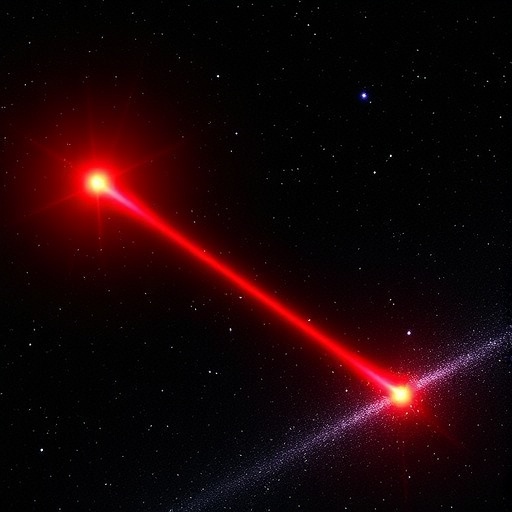
A blazar located about 1.5 billion light-years away has challenged one of astronomy’s most widely used explanations for how these extreme cosmic objects shine. After examining nearly two decades of observations, a Polish-German research team has found that the blazar PKS 2155-304 cannot be fully described by the simple models that have successfully explained many short-lived flares. Instead, its long-term behaviour points to multiple emission regions and more than one physical process operating inside its relativistic jet.
Blazars are among the most energetic objects in the observable Universe. They are active galaxies powered by matter spiralling into a supermassive black hole. As gas and dust fall inward, part of the gravitational energy released can drive narrow jets of plasma from the region around the black hole’s poles. When one of these jets happens to point almost directly toward Earth, the galaxy can appear as a brilliant, star-like point of light. Relativistic motion within the jet amplifies the radiation through a phenomenon known as Doppler boosting, making the source appear far brighter and more rapidly variable than it would from another viewing angle.
PKS 2155-304 lies in the southern sky, in the direction of the constellation Piscis Austrinus. It emits radiation across an enormous range of wavelengths, from radio waves and visible light to ultraviolet radiation, X-rays and gamma rays. The new study combines data collected by two NASA space observatories: the Neil Gehrels Swift Observatory, which monitors the optical, ultraviolet and X-ray bands, and the Fermi Gamma-ray Space Telescope, which observes the highest-energy gamma rays. Together, these observations provide a more complete picture of the blazar’s activity than measurements obtained in only one part of the spectrum.
The data set covers almost 20 years, a timespan that is unusually valuable for studying an object whose brightness can change dramatically. Blazars are often observed during brief campaigns lasting a few days or weeks, typically when they undergo an especially powerful flare. Such snapshots can reveal intense short-term changes, but they may miss slower variations or transitions between different states of activity. By analysing observations spread across two decades, the researchers were able to test whether relationships seen during individual flares remain valid over much longer periods.
Their results indicate that they do not. The most commonly used one-zone models assume that radiation is produced in a single region of the jet by one population of high-energy electrons. In these models, electrons accelerated to relativistic speeds radiate synchrotron emission as they spiral through magnetic fields, producing much of the light observed at lower energies. The same electrons may then transfer energy to photons through inverse Compton scattering, boosting those photons into the X-ray or gamma-ray range. This framework can reproduce some short-term changes in PKS 2155-304, but it fails to account for the complete long-term pattern.
One important missing relationship involves the optical and X-ray bands. If both forms of radiation were generated by the same electron population in the same region, a substantial change in one band would generally be expected to coincide with a change in the other, perhaps after a short delay caused by particle cooling or the travel time of disturbances through the jet. Yet the long-term observations showed no consistent correlation between optical and X-ray activity. The result suggests that separate regions, particle populations or emission mechanisms may contribute to the light detected at different energies.
The X-ray spectrum also revealed an unexpected departure from a familiar pattern. During many blazar flares, the increase in brightness is stronger at higher X-ray energies, meaning that the spectrum becomes harder as the source brightens. PKS 2155-304 displayed this behaviour during some shorter observing periods, but it was not sustained across the full 20-year record. The changing slopes of the spectral variations imply that different outbursts may be driven by different physical conditions, such as changes in the electron energy distribution, magnetic field strength, particle acceleration or the geometry of the emitting region.
The broad spectrum of a blazar usually contains two prominent peaks separated by a trough. The lower-energy peak is generally attributed to synchrotron radiation from relativistic electrons. The origin of the higher-energy peak is more uncertain. It may result from inverse Compton scattering, in which energetic electrons collide with lower-energy photons and transfer energy to them. Another possibility is that hadrons, including protons, participate in the process. In hadronic scenarios, high-energy protons can interact with photons or magnetic fields, producing secondary particles and potentially generating gamma rays, neutrinos and other radiation.
Particularly intriguing evidence appeared in two observations from 2012, when the spectrum of PKS 2155-304 contained an additional statistically significant dip despite the absence of a major outburst. Such an inflection could indicate that an extra process temporarily altered the balance between radiation components. The researchers say theoretical considerations make a hadronic contribution a plausible explanation, although the data do not yet establish it conclusively. If hadrons were indeed involved, the source could also be capable of producing high-energy neutrinos, offering a possible connection to one of the major unsolved questions in astrophysics: where cosmic neutrinos originate.
Neutrinos are electrically neutral, extremely light particles that pass through ordinary matter with remarkable ease. That same property makes them exceptionally difficult to detect. Some of the highest-energy neutrinos observed on Earth appear to come from deep space, but their sources remain uncertain. The identification of a neutrino arriving from the direction of another blazar during a powerful flare has already shown that blazar jets can be connected to neutrino production. The long-term behaviour of PKS 2155-304 now strengthens the case for more complex models in which electrons and hadrons share responsibility for the radiation. Continued monitoring across the electromagnetic spectrum, combined with future neutrino detections, may reveal whether this distant jet is also a cosmic particle accelerator producing messengers that cross the Universe to reach Earth.
News Publication Date: 6 August 2026
Web References: https://doi.org/10.1016/j.jheap.2026.100688
References: A. Wierzcholska and M. Zacharias, “20 years of monitoring: PKS 2155-304 and PKS 1510-089 in the eyes of Swift and Fermi. I. The case of PKS 2155-304,” Journal of High Energy Astrophysics, 2026, 54, 100688. DOI: 10.1016/j.jheap.2026.100688
Keywords
Blazar, PKS 2155-304, active galaxy, supermassive black hole, relativistic jet, gamma rays, X-rays, Swift Observatory, Fermi Space Telescope, neutrinos, hadronic processes, astrophysics, cosmic particle acceleration
Cite Scienmag News
Grant Pearson. (August 6, 2026). Two Decades of Blazar Observations Reveal More Mysteries Than Answers. Scienmag. https://scienmag.com/two-decades-of-blazar-observations-reveal-more-mysteries-than-answers/
Grant Pearson. "Two Decades of Blazar Observations Reveal More Mysteries Than Answers." Scienmag, 6 August 2026, https://scienmag.com/two-decades-of-blazar-observations-reveal-more-mysteries-than-answers/. Accessed 3 September 2026.
Grant Pearson. "Two Decades of Blazar Observations Reveal More Mysteries Than Answers." Scienmag. August 6, 2026. https://scienmag.com/two-decades-of-blazar-observations-reveal-more-mysteries-than-answers/


