


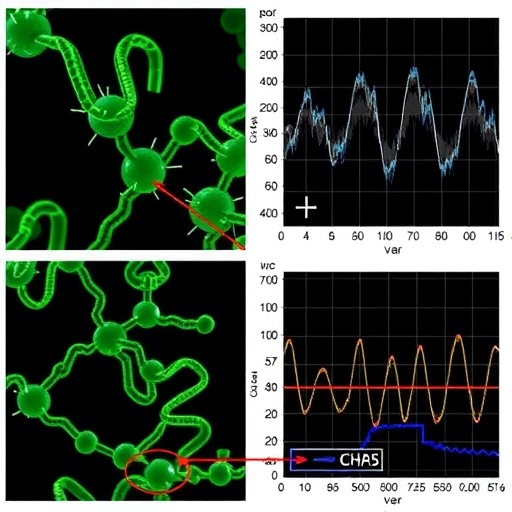
In a groundbreaking advancement poised to redefine our understanding of enzymatic processes, researchers have pioneered a method to monitor enzymatic catalytic dynamics in real time at the single-molecule level through electrical signals. This novel technique offers an unprecedented window into the fleeting molecular events that drive the biochemical reactions essential for life. By leveraging cutting-edge nanotechnology and sophisticated electrical measurement tools, the team has achieved direct observation of catalytic events, an achievement that could revolutionize fields as diverse as drug development, synthetic biology, and bioengineering.
Enzymes, the biological catalysts central to countless cellular reactions, have traditionally been studied through averaged bulk assays, which provide only indirect or time-averaged snapshots of activity. These approaches, while valuable, obscure the intricate, stochastic behaviors and transient intermediate states characteristic of individual enzymatic molecules. Capturing the real-time fluctuations and heterogeneity among single enzyme molecules has remained a formidable challenge due to the minuscule scales and rapid kinetics involved.
The research led by Fan, Chen, Gong, and colleagues presents a formidable leap beyond these constraints by integrating ultra-sensitive electrical detection strategies with single-molecule enzymology. At the core of their achievement lies an exquisitely designed nanoscale electrical sensor that interfaces directly with individual enzyme molecules. This sensor records subtle changes in electrical conductance that arise as the enzyme undergoes conformational rearrangements and catalytic turnover cycles, effectively translating molecular motions into quantifiable electrical signals.
The device architecture capitalizes on nanogap electrodes functionalized to tether single enzymes, thereby localizing the measurement environment and enhancing signal-to-noise ratios. This approach enables the detection of discrete catalytic steps with temporal resolution fine enough to monitor rapid enzymatic cycles in situ. Importantly, the system operates under physiologically relevant conditions, preserving enzyme functionality and providing insight into native catalytic dynamics.
One of the pivotal technical achievements was the development of signal processing algorithms capable of deconvoluting the complex electrical noise inherent to such measurements. By employing advanced statistical tools and machine learning methods, the team extracted meaningful kinetic parameters and identified transient intermediate states within individual enzymatic reaction trajectories. This granular temporal mapping offers an unprecedented look at how enzymes transition between conformations during catalysis.
The implications of this work are profound. Understanding enzyme dynamics at the single-molecule scale can illuminate fundamental principles governing catalytic efficiency and specificity. For example, heterogeneity in enzymatic rates can be directly correlated to structural fluctuations or binding events that are invisible to ensemble measurements. These insights may, in turn, inform the rational design of enzyme inhibitors or activators, accelerating pharmaceutical discovery efforts targeting enzymatic dysfunction in diseases.
Moreover, the electrical monitoring platform offers scalability and integrability into lab-on-a-chip systems, promising new avenues for high-throughput screening of enzyme libraries or assessment of catalytic activity under various environmental conditions. This capability could transform industrial biocatalysis processes by enabling rapid optimization of enzyme performance and stability.
The technique also paves the way for exploring enzyme evolution and adaptation by allowing detailed observation of catalytic dynamics in genetically or chemically modified variants. Insights into how single amino acid substitutions influence enzyme kinetics and conformational landscapes could deepen our understanding of molecular evolution and facilitate the engineering of novel catalytic functions.
Furthermore, the electrical nature of the detection unlocks possibilities for real-time feedback control in synthetic biology applications, where enzymatic pathways can be finely tuned through external inputs to optimize metabolic fluxes or biosynthetic yields. This feedback mechanism resembles natural cellular regulatory circuits but operates through technologically mediated electrical signals.
The interdisciplinary methodology employed draws from quantum electronics, nanofabrication, enzymology, and computational analysis, exemplifying the collaborative spirit driving modern scientific innovation. Such convergence of fields is enabling biochemistry to be studied with a precision previously reserved for physics and engineering disciplines.
Despite its remarkable potential, the approach does pose challenges that future research must address to broaden applicability. For instance, ensuring the generalizability of the platform to diverse enzyme classes with varying sizes and catalytic mechanisms will require tailored sensor modifications. Additionally, improving temporal resolution to capture even faster transient states remains an ongoing pursuit.
Nevertheless, this pioneering work underscores the transformative power of merging nanotechnology with molecular biology, offering a template for future explorations into the dynamic molecular machinery of life. By shifting the lens from ensemble averages to single-molecule realities, scientists are now equipped to unravel the fundamental principles that govern biological catalysis with unmatched clarity.
In conclusion, the real-time electrical monitoring of individual enzymatic molecules represents a quantum leap in our ability to dissect the biochemical processes that underpin health, disease, and biotechnology. As this nascent technology matures, it will undoubtedly catalyze new scientific discoveries and technological innovations, heralding a new era in enzyme research and molecular medicine.
Fan, Z., Chen, Z., Gong, Z. et al. Real-time electrical monitoring of enzymatic catalytic dynamics at the single-molecule level. Nat Commun (2026). https://doi.org/10.1038/s41467-026-74020-0
Cite Scienmag News
Drew Townsend. (June 5, 2026). Real-Time Electrical Tracking of Single Enzyme Activity. Scienmag. https://scienmag.com/real-time-electrical-tracking-of-single-enzyme-activity/
Drew Townsend. "Real-Time Electrical Tracking of Single Enzyme Activity." Scienmag, 5 June 2026, https://scienmag.com/real-time-electrical-tracking-of-single-enzyme-activity/. Accessed 3 September 2026.
Drew Townsend. "Real-Time Electrical Tracking of Single Enzyme Activity." Scienmag. June 5, 2026. https://scienmag.com/real-time-electrical-tracking-of-single-enzyme-activity/


