


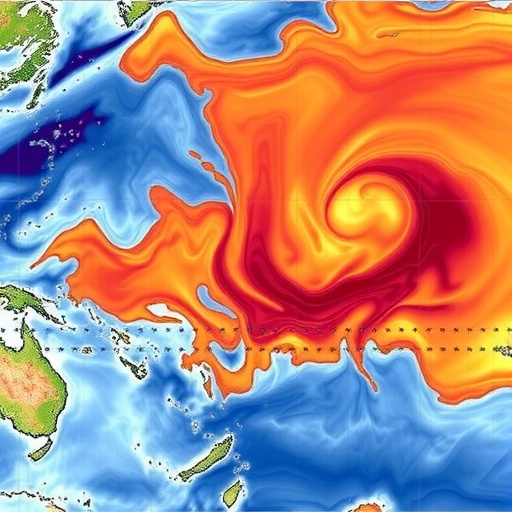
A new study published in Communications Earth & Environment points to a powerful connection between the tropical Pacific and the North Pacific that may help explain why ocean conditions can shift dramatically over periods of several years to decades. The research, led by A. Capotondi, T. Xu, M. Newman and colleagues, examines how these distant regions of the Pacific interact and how their relationship shapes large-scale climate variability, including the occurrence of marine heatwaves.
The Pacific Ocean is not a single, uniform climate system. It contains several interacting regions where winds, ocean currents, temperature patterns and atmospheric pressure influence one another. Changes in the tropical Pacific are well known for producing El Niño and La Niña events, which can alter rainfall, storms and temperatures across the planet. Yet the North Pacific also has its own slowly evolving patterns, including variations in sea-surface temperature that can persist for many years. The new research focuses on the coupling between these regions at “decadal timescales”—meaning climate fluctuations that unfold over roughly ten years or longer.
This timescale is crucial because it occupies the space between short-term weather events and long-term climate change. A marine heatwave may develop over weeks or months, but the background conditions that make such an event more likely can be established years in advance. Warmer or cooler ocean states can affect atmospheric circulation, modify ocean currents and change the way heat is transported across entire basins. By investigating tropical and North Pacific coupling, the researchers are addressing a central question in climate science: how can gradual, basin-wide changes prepare the ocean for sudden and extreme temperature events?
The study’s central finding, reflected in its title, is that interactions between the tropical Pacific and the North Pacific help shape variability across the Pacific basin. This coupling means that climate signals do not remain confined to the region where they first emerge. A change in tropical Pacific temperatures can influence atmospheric winds, while those winds can alter surface currents and ocean mixing farther north. In turn, conditions in the North Pacific may feed back into the broader ocean-atmosphere system, affecting how heat is stored, redistributed or released.
The physical mechanism involves several linked processes. Sea-surface temperatures influence the atmosphere by changing the amount of heat and moisture transferred from the ocean into the air. These changes can modify pressure patterns and wind fields. Winds then push surface waters, alter evaporation and control the depth of the ocean’s mixed layer—the upper zone where winds stir heat, salt and nutrients. When the mixed layer becomes unusually shallow, solar energy can be concentrated in a smaller volume of water, allowing surface temperatures to rise rapidly. When it deepens, heat can be mixed downward, temporarily shielding the surface from extreme warming.
These processes are especially important for marine heatwaves, which are prolonged periods of unusually warm ocean temperatures. Marine heatwaves can disrupt fisheries, stress coral reefs, reduce oxygen levels and force marine species to move into unfamiliar habitats. They can also affect coastal economies and intensify heat and drought on nearby land. Although individual events may appear sudden, their intensity and persistence can depend on pre-existing ocean conditions. The study highlights how decadal Pacific variability can influence that background state, potentially changing the likelihood, duration or geographical reach of future marine heatwaves.
The research also challenges the idea that Pacific climate variability can be understood by examining one region in isolation. Climate models and forecasting systems often divide the ocean into specialized zones, but the atmosphere and ocean do not respect those boundaries. Signals can travel through atmospheric teleconnections, ocean currents and changes in the distribution of heat below the surface. A pattern that begins in the tropics may later appear as altered temperature conditions in the North Pacific, while northern changes may modify the atmospheric circulation that connects back to the tropics.
Understanding these connections could improve climate prediction beyond the familiar seasonal outlook. Forecasts of El Niño and La Niña typically focus on timescales of months to a few years, while decadal prediction aims to anticipate broader shifts in the climate system. If the state of one Pacific region provides information about what may happen in another, scientists could use those relationships to improve early warnings for marine heatwaves and other ocean extremes. Such predictions would not determine the exact location or timing of every event, but they could identify periods when ecosystems and coastal communities face elevated risk.
The findings also carry implications for interpreting recent ocean warming. Human-driven climate change is raising global ocean temperatures, but natural variability can temporarily amplify or mask that long-term trend in particular regions. Decadal coupling between the tropical and North Pacific may help explain why some parts of the ocean experience unusually rapid warming while others warm more slowly for a time. Separating these natural fluctuations from the underlying rise caused by greenhouse gases is essential for detecting climate change accurately and planning effective adaptation.
By showing that tropical and North Pacific dynamics are closely linked on decadal timescales, Capotondi, Xu, Newman and their co-authors provide a broader framework for understanding Pacific climate behavior. The message is both technically important and highly relevant to a warming world: the next major marine heatwave may be influenced not only by conditions at the location where it develops, but also by ocean-atmosphere interactions unfolding thousands of kilometers away years earlier. As marine extremes become more consequential, mapping these hidden connections could become one of the most valuable tools for anticipating how the ocean will change next.
Cite Scienmag News
Violet Maxwell. (August 7, 2026). Tropical–North Pacific Decadal Coupling Shapes Basin Variability and Marine Heatwaves. Scienmag. https://scienmag.com/tropical-north-pacific-decadal-coupling-shapes-basin-variability-and-marine-heatwaves/
Violet Maxwell. "Tropical–North Pacific Decadal Coupling Shapes Basin Variability and Marine Heatwaves." Scienmag, 7 August 2026, https://scienmag.com/tropical-north-pacific-decadal-coupling-shapes-basin-variability-and-marine-heatwaves/. Accessed 3 September 2026.
Violet Maxwell. "Tropical–North Pacific Decadal Coupling Shapes Basin Variability and Marine Heatwaves." Scienmag. August 7, 2026. https://scienmag.com/tropical-north-pacific-decadal-coupling-shapes-basin-variability-and-marine-heatwaves/


