


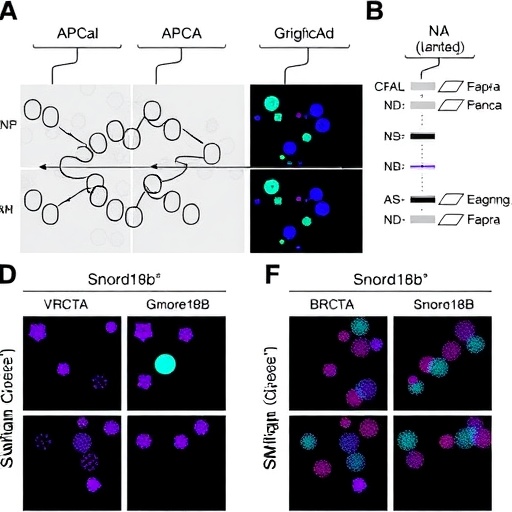
Colorectal cancer cells appear to have evolved an unexpected molecular partnership that helps them repair one of the most dangerous forms of DNA damage. A study published in Cell Death Discovery reports that two small nucleolar RNAs, SNORD18B and SNORD18C, work together with the ribosomal protein gene RPL23A to promote production of the DNA-repair protein BRCA1. By strengthening homologous recombination, a high-fidelity pathway for repairing broken chromosomes, this regulatory circuit may help cancer cells survive treatments designed to destroy their genomes.
The findings place SNORD18B and SNORD18C in a role that extends far beyond their conventional classification as small nucleolar RNAs, or snoRNAs. These short RNA molecules are traditionally associated with chemical modification and maturation of ribosomal RNA, the molecular scaffold used to build ribosomes. Ribosomes translate messenger RNA into proteins, and their activity can strongly influence how cancer cells grow, adapt and resist therapy. The new research suggests that SNORD18B and SNORD18C can participate in a larger regulatory complex involving RPL23A, a ribosomal protein, to control the translation of a critical DNA-repair factor.
BRCA1 is best known as a tumor-suppressor protein because inherited or acquired defects in the BRCA1 gene can dramatically increase the risk of breast, ovarian, pancreatic and prostate cancers. At the molecular level, BRCA1 helps coordinate the response to DNA double-strand breaks, among the most lethal lesions a cell can experience. When both strands of the DNA helix are severed, the cell must either restore the original sequence accurately or risk chromosome rearrangements, mutations and cell death. BRCA1 contributes to the selection and execution of homologous recombination repair, a process that uses an intact, matching DNA template—usually the sister chromatid—to reconstruct the damaged region.
Lin, He, Wu and colleagues investigated whether the SNORD18B/SNORD18C-RPL23A axis affects this repair system in colorectal cancer cells. Their work indicates that the two snoRNAs cooperate with RPL23A to enhance BRCA1 translation, meaning that the key effect occurs after the BRCA1 messenger RNA has already been produced. This distinction is important. Gene expression is controlled at several stages, including DNA transcription, messenger RNA stability and protein synthesis. A cancer cell can therefore maintain normal or even modest BRCA1 RNA levels while changing how efficiently that RNA is converted into functional protein. The reported mechanism identifies protein production as a decisive control point.
The proposed pathway also illustrates how the machinery that builds proteins can be repurposed to protect malignant cells. RPL23A is a component of the ribosome, but ribosomal proteins are increasingly recognized as regulators with functions beyond structural support. In this case, RPL23A appears to help connect SNORD18B and SNORD18C with the translational apparatus, allowing the complex to favor BRCA1 synthesis. The result is not simply more RNA, but a stronger supply of BRCA1 protein at the moment when a tumor cell is under genotoxic stress.
That capability could have major consequences for treatment. Many colorectal cancer therapies work by creating DNA lesions or by blocking the enzymes cancer cells need to repair them. Radiation, platinum-based drugs and several targeted agents can become more effective when homologous recombination is weakened. Conversely, a tumor that efficiently restores DNA breaks may withstand treatment and continue dividing. By increasing BRCA1 protein production, the SNORD18B/SNORD18C-RPL23A pathway could provide colorectal cancer cells with a molecular shield against therapies that depend on overwhelming their repair capacity.
The findings may also help explain why cancers with similar BRCA1 gene status can respond differently to treatment. Clinicians often assess mutations or expression changes in DNA-repair genes, but the amount of protein actually available inside a tumor can be shaped by post-transcriptional mechanisms that are not captured by genetic testing alone. If the snoRNA-RPL23A circuit is active in a subset of colorectal tumors, measuring its components might eventually help identify cancers with unusually robust homologous recombination. Such information could contribute to treatment selection, although clinical validation will be essential before the pathway can be used as a biomarker.
The study raises the possibility of targeting this repair-supporting circuit directly. In principle, suppressing SNORD18B or SNORD18C, disrupting their interaction with RPL23A, or interfering with the relevant translational machinery could reduce BRCA1 protein levels and make tumor cells more vulnerable to DNA-damaging treatment. However, translating that concept into a safe therapy will be challenging. Ribosomes and snoRNAs are involved in fundamental processes in healthy tissues, particularly in rapidly dividing cells such as those in the bone marrow and intestinal lining. Any future drug would need to selectively disable the cancer-associated pathway without broadly impairing normal protein synthesis.
The work also underscores the complexity of drug resistance in colorectal cancer. Tumors do not rely only on mutations in classical oncogenes or tumor suppressors; they can rewire RNA biology, translation and DNA repair as interconnected systems. The SNORD18B/SNORD18C-RPL23A mechanism offers a possible explanation for how a cancer cell can preserve a functional BRCA1 response without necessarily altering the BRCA1 gene itself. Further studies in patient-derived tumors, organoids and animal models will be needed to determine how frequently this pathway operates, whether it predicts resistance to specific treatments and whether its inhibition can improve therapeutic responses without unacceptable toxicity. For now, the research identifies a previously underappreciated molecular link between small RNAs, ribosome-associated regulation and the repair of damaged cancer genomes.
Cite Scienmag News
Nathaniel Bowman. (August 7, 2026). SNORD18B/SNORD18C-RPL23A Promotes Homologous Recombination Through BRCA1 Translation in Colorectal Cancer. Scienmag. https://scienmag.com/snord18b-snord18c-rpl23a-promotes-homologous-recombination-through-brca1-translation-in-colorectal-cancer/
Nathaniel Bowman. "SNORD18B/SNORD18C-RPL23A Promotes Homologous Recombination Through BRCA1 Translation in Colorectal Cancer." Scienmag, 7 August 2026, https://scienmag.com/snord18b-snord18c-rpl23a-promotes-homologous-recombination-through-brca1-translation-in-colorectal-cancer/. Accessed 3 September 2026.
Nathaniel Bowman. "SNORD18B/SNORD18C-RPL23A Promotes Homologous Recombination Through BRCA1 Translation in Colorectal Cancer." Scienmag. August 7, 2026. https://scienmag.com/snord18b-snord18c-rpl23a-promotes-homologous-recombination-through-brca1-translation-in-colorectal-cancer/


