


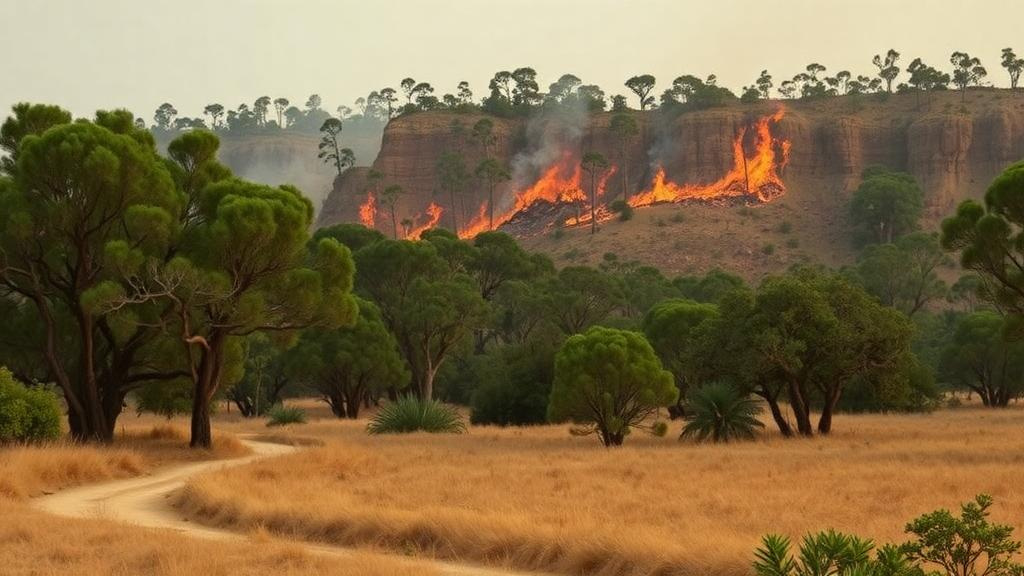
Australia’s escalating bushfire emergency has long been framed as a story about climate change, but a landmark new study published in Nature argues that the deeper origins of the crisis lie in a transformation that began more than a century before industrial warming: the abrupt end of Indigenous fire management after British colonisation. By reconstructing a full millennium of vegetation, fire and erosion history in Croajingolong National Park in East Gippsland, Victoria, researchers from the University of Melbourne, working in collaboration with the Gunaikurnai Land and Waters Corporation, have produced one of the most detailed long-term environmental records ever assembled for southeastern Australia’s fire-prone eucalypt forests. Their findings reveal that the dense, fuel-laden forests now burning catastrophically across the region are not an ancient natural condition but a colonial artefact, one that has effectively handed control of fire to the climate.
The research team turned to lake sediments preserved within Croajingolong National Park, one of the most repeatedly burnt landscapes in southeastern Australia, to read the region’s environmental past. Lake sediments accumulate in annual and seasonal layers, trapping charcoal particles, pollen grains and eroded soil that together form a continuous archive of what grew on the land, how hot fires burned and how severely the ground eroded across centuries. By extracting cores from the lakebed and analysing these preserved signals layer by layer, the scientists reconstructed the past 1000 years of ecological change with enough resolution to distinguish the pre-colonial period, when Gunaikurnai people actively managed the landscape, from the post-colonial era, when that management ceased. The technique allowed the researchers to separate the influence of climate variability from the influence of land use, a distinction that shorter records spanning only the industrial era cannot reliably make.
What the sediment record revealed was a cascading sequence of changes that began with fire itself. Infrared spectroscopy of charcoal fragments preserved in the sediments provided a proxy for past fire temperatures, distinguishing the cool, low-intensity burns characteristic of cultural fire practice from the hot wildfires that followed. The record shows that after colonisation, fire temperatures rose sharply. Those hotter fires came first in the sequence, and they drove a four-fold surge in eucalypt cover, transforming what had been maintained as open woodland for centuries into dense, closed forest. As the canopy thickened and fuel accumulated on the forest floor, soil erosion in the catchment increased, providing independent physical evidence that the landscape had crossed into a fundamentally more disturbed state.
Critically, the researchers demonstrated that this ecological transformation predates human-driven climate change. Dangerous fire weather is not new to East Gippsland: climate records show that seasons comparable to those that produced the Ash Wednesday fires of 1983 and the Black Saturday fires of 2009 occurred repeatedly in the region before colonisation. Yet during those earlier episodes of severe fire weather, the open woodland maintained by Gunaikurnai cultural burning did not produce catastrophic fire. The fuel loads were simply too low. It was only after colonisation ended that active management, allowing forests to expand and thicken across the region, that the same dangerous weather conditions began translating into landscape-scale disaster. In the authors’ framing, colonisation loaded the landscape with fuel, and it is that loaded landscape that has handed control of fire to the climate.
Lead author Professor Michael-Shawn Fletcher, of the School of Geography, Earth and Atmospheric Sciences at the University of Melbourne, said the work provides scientific evidence for the value of cultural burning and the need to integrate Indigenous knowledge into contemporary fire management. When Country is cared for, he noted, climate does not dictate wildfire. For thousands of years, Gunaikurnai people cared for Country in what is now Croajingolong National Park through cultural burning, keeping much of the landscape as open woodland. The study’s conclusion is that most discussion of Australia’s wildfire crisis stops at climate change, but the new evidence shows what actually set the stage for it: forest expansion and thickening that loaded the landscape with fuel long before the climate began to shift.
The findings carry significant weight for Gunaikurnai Traditional Owners, whose fire practice, known as towera, is understood within their culture as an interrelationship embedded in the practical daily life of the Old Peoples on Country. Uncle Russell Mullett, a Gunaikurnai elder from the Gunaikurnai Land and Waters Corporation, explained that Country not treated with towera becomes extremely dangerous for Gunaikurnai people, animals and plants alike. He welcomed the study as firm scientific evidence supporting towera land management initiatives, giving Traditional Owners a powerful empirical basis for reinstating practices that colonial displacement interrupted. The collaboration between the university researchers and the Gunaikurnai Land and Waters Corporation itself models the kind of partnership the paper argues is essential, combining Western palaeoecological methods with Indigenous ecological knowledge accumulated over millennia.
Beyond its immediate implications for fire policy, the study mounts a direct challenge to one of environmentalism’s most influential ideas: the concept of wilderness. Croajingolong National Park has long been treated as pristine wilderness, land largely untouched by human hands, and that framing has shaped how it is protected. Yet the sediment record shows the opposite. The forest now cherished as natural is, in Professor Fletcher’s words, a product of colonisation, and it is that legacy that now imperils the forest’s very survival. The park is today one of the most fire-prone and repeatedly burnt parts of southeastern Australia, a status the research attributes not to its natural condition but to the absence of the management that once sustained it. Protecting landscapes by excluding the people who shaped them, the study suggests, may be an ecological strategy that actively undermines the ecosystems it aims to preserve.
The technical strength of the work lies in its multi-proxy approach. By combining charcoal morphology to identify fire occurrence, infrared spectroscopy of charred material to reconstruct fire intensity, pollen analysis to track vegetation composition and sediment accumulation rates to quantify erosion, the researchers built a mutually reinforcing picture of cause and effect across a full millennium. The sequencing matters: because the rise in fire temperature precedes the eucalypt expansion in the record, the data support a causal chain in which hotter fires promoted denser forest, denser forest increased fuel loads, and increased fuel loads amplified subsequent fire behaviour. This feedback loop, once initiated by the cessation of cultural burning, converted a fire-resilient open woodland into a fire-vulnerable forest, and it did so before atmospheric greenhouse gas concentrations began their modern rise.
The paper concludes that restoring cultural burning and supporting Traditional Owners to care for Country is an essential component of mitigating wildfire risk, not a cultural gesture but a practical, evidence-based intervention. As southeastern Australian forests face intensifying fire weather under a warming climate, the research suggests that reducing the vulnerability of these landscapes requires addressing the colonial land-use legacies that made them combustible in the first place. The message from Croajingolong is stark and, for fire management agencies, potentially transformative: the current crisis is not solely a climate story, and the tools for rewriting it have been present on Country for thousands of years, waiting to be returned to use.
Subject of Research: Long-term palaeoecological reconstruction linking colonial cessation of Indigenous cultural burning to increased wildfire risk in southeastern Australian forests
Article Title: Australia's wildfire crisis linked to colonial land-use change
Article References: Australia's wildfire crisis linked to colonial land-use change. (n.d.). Original publication
Image Credits: AI Generated
DOI: Not provided
Keywords: bushfires, cultural burning, Indigenous land management, Gunaikurnai, Croajingolong National Park, eucalypt forests, palaeoecology, lake sediments, colonisation, climate change, fire management, Nature
Cite Scienmag News
Russell Cooper. (October 7, 2026). Colonial land-use change set the stage for Australia’s bushfire crisis. Scienmag. https://scienmag.com/colonial-land-use-change-set-the-stage-for-australias-bushfire-crisis/
Russell Cooper. "Colonial land-use change set the stage for Australia’s bushfire crisis." Scienmag, 7 October 2026, https://scienmag.com/colonial-land-use-change-set-the-stage-for-australias-bushfire-crisis/. Accessed 27 October 2026.
Russell Cooper. "Colonial land-use change set the stage for Australia’s bushfire crisis." Scienmag. October 7, 2026. https://scienmag.com/colonial-land-use-change-set-the-stage-for-australias-bushfire-crisis/


