

Monday, July 27, 2026
Science
No Result
View All Result
  • Login
  • HOME
  • SCIENCE NEWS
  • CONTACT US
  • HOME
  • SCIENCE NEWS
  • CONTACT US
No Result
View All Result
Scienmag
No Result
View All Result
Home Science News Earth Science

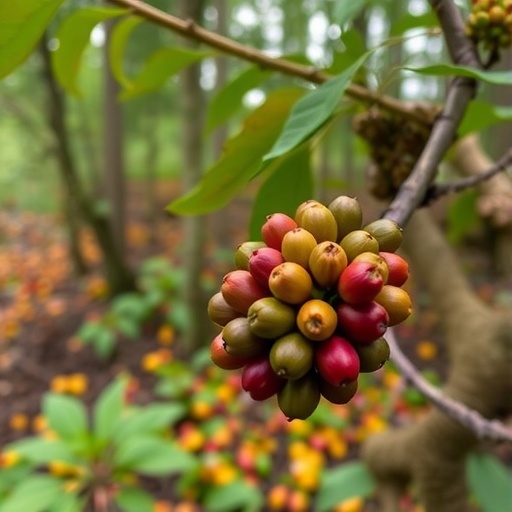
Coffee creates fungal spillover from fields to forests in Costa Rica

July 27, 2026
in Earth Science
Reading Time: 2 mins read
0
Coffee creates fungal spillover from fields to forests in Costa Rica

Coffee creates fungal spillover from fields to forests in Costa Rica

65
SHARES
587
VIEWS
Share on FacebookShare on Twitter
ADVERTISEMENT

A new viral science release from researchers in Costa Rica links coffee plantations to a previously underappreciated ecological phenomenon: fungal “spillover” from fields into adjacent forests. The study reports that coffee’s cultivated edge can alter the direction and impact of airborne and soil-associated fungal communities, effectively turning field boundaries into biologically active interfaces.

Using field sampling along forest margins bordering coffee, the team compared fungal presence on both sides of the transition zone. They focused on how fungal taxa shift with distance from coffee cover, allowing them to test whether spillover behaves like a classic edge effect—where conditions at habitat boundaries reshape community composition and function.

The results indicate that fungi associated with the coffee production landscape can move into forest microhabitats, increasing the detection and relative abundance of specific fungal groups in forest plots closest to plantations. Notably, the strongest signatures appeared near the boundary, consistent with a gradient shaped by exposure, dispersal, and local environmental buffering by vegetation.

Technically, the researchers combined culture-independent sequencing approaches with spatial analyses to map community turnover. By integrating distance-to-edge variables with microbial community metrics, they modeled whether fungal assemblages show abrupt boundary-driven changes rather than gradual, area-wide shifts.

Because fungi can act as pathogens, mutualists, or decomposers, the spillover signal matters beyond taxonomy. The work suggests that even when forests remain intact, surrounding coffee can create a microbial pressure that propagates into forest ecosystems. Such pressures may influence seedling health, leaf litter dynamics, and nutrient cycling, depending on which functional guilds are mobilized across the boundary.

The authors interpret the pattern as a “biotic edge effect,” emphasizing that the mechanism is driven by living organisms and their propagules—not just by abiotic factors like light or moisture gradients. In this framing, coffee plantations become active sources of fungal propagules, which then filter through forest environmental conditions.

Importantly, the study highlights that agricultural land-use can reshape forest microbiomes without clear visible signs. This is consistent with the idea that ecosystem change can begin at the microscopic scale, preceding larger-scale shifts in plant communities.

The findings arrive as global coffee production expands and landscapes become more fragmented. If similar fungal spillover occurs in other regions, forest edges near coffee may experience repeated microbial boundary effects, potentially altering resilience to stressors and changing disease risk landscapes.

Overall, the research reframes coffee edge habitats as ecological corridors for fungi. In a world where climate variability and land-use change increasingly converge, microbial spillover may be a key driver of fast, boundary-mediated ecological responses—making this study timely, viral, and consequential.

Subject of Research: Field-to-forest fungal spillover and biotic edge effects of coffee plantations in Costa Rica.

Article Title: Field-to-forest fungal spillover is a biotic edge effect of coffee in Costa Rica.

Article References: Lackmann, J.A., Bachelot, B., Lindell, C. et al. Field-to-forest fungal spillover is a biotic edge effect of coffee in Costa Rica. Nat Commun (2026). https://doi.org/10.1038/s41467-026-75178-3

DOI: 10.1038/s41467-026-75178-3

Keywords: Fungal spillover; edge effects; coffee plantations; forest microbiomes; biotic interfaces; microbial dispersal.

Tags: airborne and soil fungal community dynamicsCoffee plantation fungal spilloverculture-independent sequencing of fungal communitiesecological boundary effects in forestsecological impact of coffee-fungus interactionsedge effects on microbial community compositioneffects of coffee cultivation on forest microbiomesfungal dispersal from coffee fields to forestsfungal pathogen spread in agroecosystemshabitat boundary influence on fungal taxaimpact of agricultural edges on microbial diversitymicrobial community spatial analysis in agroforestry
Share26Tweet16
Previous Post

Hospital Padrino Program Linked to Lower Perinatal Mortality in Colombia’s Pacific

Next Post

Macrophage Adenylyl Cyclase 7 Shields Male Mice From Ischemia-Reperfusion Injury

Related Posts

Groundbreaking Findings Show Magma Rising Beneath Laguna del Maule, Chile
Earth Science

Groundbreaking Findings Show Magma Rising Beneath Laguna del Maule, Chile

July 27, 2026
China study assesses national plan effectiveness against antimicrobial resistance in soil
Earth Science

China study assesses national plan effectiveness against antimicrobial resistance in soil

July 27, 2026
Renewables Ease Energy, Water, and Ecological Strains in Yellow River Basin
Earth Science

Renewables Ease Energy, Water, and Ecological Strains in Yellow River Basin

July 27, 2026
Davemaoite Shows Limited Water Incorporation Under Lower-Mantle Conditions
Earth Science

Davemaoite Shows Limited Water Incorporation Under Lower-Mantle Conditions

July 27, 2026
Soil Prophage Enzymes Boost Global Carbon Cycling Potential by Breaking Down Carbohydrates
Earth Science

Soil Prophage Enzymes Boost Global Carbon Cycling Potential by Breaking Down Carbohydrates

July 27, 2026
Planetary trapped waves link South America and Africa through ocean teleconnections
Earth Science

Planetary trapped waves link South America and Africa through ocean teleconnections

July 27, 2026
Next Post
Connectome gradient changes linked to rumination and altered in depression

Connectome gradient changes linked to rumination and altered in depression

  • Mothers who receive childcare support from maternal grandparents show more

    Mothers who receive childcare support from maternal grandparents show more parental warmth, finds NTU Singapore study

    27656 shares
    Share 11059 Tweet 6912
  • University of Seville Breaks 120-Year-Old Mystery, Revises a Key Einstein Concept

    1061 shares
    Share 424 Tweet 265
  • Bee body mass, pathogens and local climate influence heat tolerance

    682 shares
    Share 273 Tweet 171
  • Researchers record first-ever images and data of a shark experiencing a boat strike

    546 shares
    Share 218 Tweet 137
  • Groundbreaking Clinical Trial Reveals Lubiprostone Enhances Kidney Function

    531 shares
    Share 212 Tweet 133
Science

Embark on a thrilling journey of discovery with Scienmag.com—your ultimate source for cutting-edge breakthroughs. Immerse yourself in a world where curiosity knows no limits and tomorrow’s possibilities become today’s reality!

RECENT NEWS

  • New Research Charts Paths to Reduce Inequality
  • AI app identifies birds offline by recording animal sounds on your phone
  • Invasive Rats Reshape Coral Reef Food Webs, Favoring Some Species
  • Climate Change Reshapes Carbon Sink Across Northern Eurasia

Categories

  • Agriculture
  • Anthropology
  • Archaeology
  • Athmospheric
  • Biology
  • Biotechnology
  • Blog
  • Bussines
  • Cancer
  • Chemistry
  • Climate
  • Earth Science
  • Editorial Policy
  • Marine
  • Mathematics
  • Medicine
  • Pediatry
  • Policy
  • Psychology & Psychiatry
  • Science Education
  • Social Science
  • Space
  • Technology and Engineering

Subscribe to Blog via Email

Enter your email address to subscribe to this blog and receive notifications of new posts by email.

Join 5,146 other subscribers

© 2025 Scienmag - Science Magazine

Welcome Back!

Login to your account below

Forgotten Password?

Retrieve your password

Please enter your username or email address to reset your password.

Log In
No Result
View All Result
  • HOME
  • SCIENCE NEWS
  • CONTACT US

© 2025 Scienmag - Science Magazine

Discover more from Science

Subscribe now to keep reading and get access to the full archive.

Continue reading
