


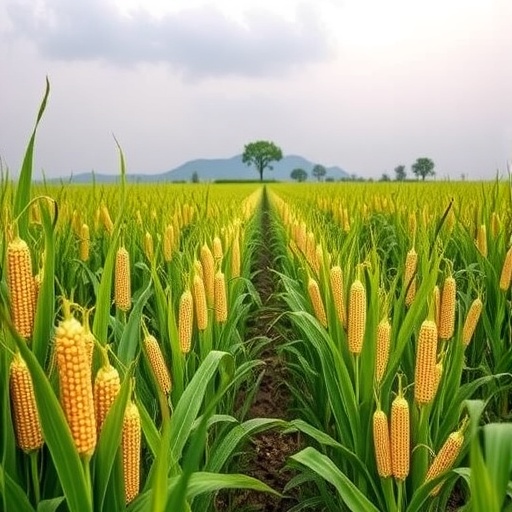
China’s maize harvest is entering a new era of uncertainty, and a new study suggests that the country’s biggest opportunity may lie not in expanding farmland, but in helping existing fields reach the yields they are already capable of producing. Published in npj Sustainable Agriculture, the research examines how irrigation-limited yield gaps—the difference between what farmers harvest and what crops could produce under improved water conditions—may be closed as climate change reshapes the country’s growing seasons.
Maize is central to China’s food system, supporting livestock production, industrial uses and household consumption. Yet the crop is grown across environments that range from humid and rain-fed regions to dry agricultural zones where production depends heavily on irrigation. In these water-constrained areas, yield is controlled by a combination of rainfall, soil moisture, heat, crop management and access to irrigation. The study by Liao, Niu, Wu and colleagues focuses on the portion of the yield gap caused specifically by insufficient water, a problem expected to become more severe as rising temperatures increase atmospheric demand for moisture.
The researchers distinguish between potential yield and attainable yield. Potential yield represents the maximum production possible when crops experience favorable conditions and are protected from major stresses, while attainable yield accounts for practical limitations such as local climate, soil properties and realistic farm management. The irrigation-limited yield gap is the remaining difference between attainable production with adequate water and the yield achieved when maize experiences water stress. This distinction matters because adding irrigation is not automatically the same as adding harvest: water must be available at the right time, delivered efficiently and coordinated with crop development.
Climate change complicates that calculation. Warmer air can accelerate maize development, shortening the period during which plants capture sunlight and build biomass. Higher temperatures also increase evapotranspiration, the combined loss of water through soil evaporation and plant transpiration. Even if annual rainfall remains stable, a crop can face more intense water stress if precipitation arrives outside the critical growing stages or if hotter conditions rapidly deplete soil moisture. Heat waves can further damage pollination, while drought during flowering and grain filling can sharply reduce the number and size of kernels.
The study’s central message is that China’s irrigation-limited maize yield gaps are not fixed. They vary across regions and change as climate conditions evolve. Some areas may experience greater demand for irrigation because warming intensifies evaporative losses, while others may receive shifts in seasonal rainfall that alter when water is available. This creates a moving target for agricultural planning. A strategy that works under today’s climate may deliver smaller benefits in the future if it ignores changing temperature patterns, rainfall timing and the growing frequency of extreme events.
Closing the gap therefore requires more than simply increasing irrigation infrastructure. Efficient water management is essential. Irrigation scheduled around crop water requirements can protect maize during sensitive stages while avoiding unnecessary applications. Soil-water monitoring, improved irrigation systems and techniques that reduce evaporation can help farmers produce more grain per unit of water. The timing of planting and the selection of varieties with suitable maturity periods may also allow crops to avoid the most damaging heat and drought conditions.
Crop genetics and agronomy are especially important because irrigation alone cannot eliminate climate risk. Maize varieties with deeper or more vigorous root systems may access water stored lower in the soil profile. Other traits, including improved heat tolerance, earlier flowering or greater efficiency in converting water into biomass, could help stabilize yields under volatile conditions. Conservation practices that increase soil organic matter and improve water-holding capacity may provide an additional buffer by allowing fields to retain rainfall for longer. The most effective solutions are likely to combine these approaches rather than rely on a single intervention.
The findings also carry a warning about water policy. In regions where rivers, reservoirs and aquifers are already under pressure, attempting to close every yield gap through expanded irrigation could intensify competition among agriculture, cities, industry and ecosystems. The value of additional irrigation must therefore be evaluated alongside its water cost. Identifying locations where modest, well-timed water inputs can produce large yield gains may be more sustainable than supplying unlimited water to fields with low efficiency or poor adaptation potential.
For farmers and policymakers, the research points toward more targeted climate adaptation. Regional yield-gap maps can help identify where water shortages are suppressing production most severely and where investments in irrigation modernization, drought-resilient seed and soil management are likely to have the greatest impact. Such assessments can also reveal areas where closing the gap is technically possible but environmentally expensive. That information is crucial for designing food-security strategies that raise production without accelerating groundwater depletion or placing additional stress on already fragile agricultural landscapes.
The broader significance is that climate-smart agriculture is becoming a problem of precision rather than simple expansion. China may be able to recover a substantial share of lost maize production by matching water, genetics and management to local conditions, but the pathway will differ from one region to another. The study presents irrigation-limited yield gaps as both a threat and an opportunity: climate change is likely to widen water-related constraints, yet better targeting of scarce water could prevent those constraints from becoming an unavoidable limit on food production. As global demand for grain grows, the fields that matter most may be the ones where every drop is engineered to count.
Cite Scienmag News
Alan Morgan. (August 3, 2026). China Can Close Irrigation-Limited Maize Yield Gaps Despite Climate Change. Scienmag. https://scienmag.com/china-can-close-irrigation-limited-maize-yield-gaps-despite-climate-change/
Alan Morgan. "China Can Close Irrigation-Limited Maize Yield Gaps Despite Climate Change." Scienmag, 3 August 2026, https://scienmag.com/china-can-close-irrigation-limited-maize-yield-gaps-despite-climate-change/. Accessed 3 September 2026.
Alan Morgan. "China Can Close Irrigation-Limited Maize Yield Gaps Despite Climate Change." Scienmag. August 3, 2026. https://scienmag.com/china-can-close-irrigation-limited-maize-yield-gaps-despite-climate-change/


