


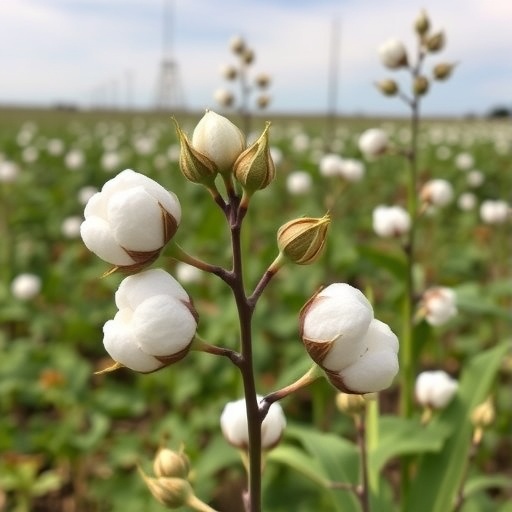
For decades, cotton breeders transformed a tropical, sun-calibrated plant into a crop that flowers on schedule anywhere on Earth — without ever knowing precisely which genes they had rewired. Now a team at the U.S. Department of Agriculture’s Agricultural Research Service has narrowed the search to a single genomic neighborhood. By resequencing the complete genomes of a day-neutral commercial cultivar, a nematode-resistant breeding line with photoperiod-sensitive ancestry, and 40 recombinant inbred lines descended from their cross, the researchers exposed a sharp signature of artificial selection on chromosome D07 — a compact stretch of DNA housing two genes that function as molecular gatekeepers of day-length-dependent flowering. The study, published in Theoretical and Applied Genetics, points to components of the PAF1 transcriptional elongation complex as priority candidates for controlling day-neutrality in upland cotton and opens a concrete path toward marker-assisted breeding of photoperiod-insensitive cultivars. For a crop whose entire geography outside the tropics rests on this one trait, the map has just become dramatically clearer.
Photoperiod sensitivity is the ancestral condition of cotton. Wild and semi-wild races of Gossypium hirsutum, such as the marie-galante and latifolium forms collected across the Caribbean basin and Central America, behave as classic short-day plants: they grow vegetatively until day length falls below a critical threshold, and only then do they switch to reproductive development. Mechanistically, leaves measure day length through the circadian clock, which gates the expression of photoperiod pathway genes such as CONSTANS; these in turn control FLOWERING LOCUS T, whose protein — the mobile florigen signal — travels from leaf to shoot apex to initiate flowering. The strategy is well suited to tropical latitudes, where the seasonal decline in day length is a reliable calendar, but it is ruinous for agriculture in temperate zones, where a plant that waits for short days runs out of growing season before it ever sets a boll. Beginning in the 1950s, the classical geneticists Lewis and Richmond showed through crosses between wild cotton races and cultivated upland varieties that flowering response in cotton is heritable and genetically complex, establishing the foundation for systematic day-neutral breeding. Modern upland cotton cultivars are day-neutral: they initiate squares and flowers on an internal developmental schedule, indifferent to photoperiod, which is why cotton can be planted and harvested on fixed calendars across the southern United States, China’s Yangtze valley, and Central Asia.
How breeders accomplished this conversion has long been clear in practice but murky in mechanism. USDA breeding programs spent decades running day-neutral conversion projects, repeatedly selecting tropical landrace accessions that flowered earliest under long days until the photoperiod requirement had been reliably bred out of otherwise exotic germplasm. Genome-wide association studies and quantitative trait locus analyses have since flagged intervals associated with flowering time and photoperiod sensitivity on several cotton chromosomes, and recent fine-mapping work has implicated specific loci controlling photoperiod-sensitive flowering. The stakes of pinning down the mechanism are high: thousands of photoperiod-sensitive landrace accessions sit in germplasm collections worldwide, representing a deep reservoir of variation for fiber quality, stress tolerance, and disease resistance that elite cultivars lack — but that diversity can only be exploited if the photoperiod barrier can be stripped away predictably. Until now, the actual molecular targets of decades of selection remained largely unidentified.
The new study turned breeding history itself into a genetic instrument. A team led by Ganesh Pinnika and Gregory N. Thyssen of the USDA-ARS Cotton Fiber Bioscience and Utilization Research Unit in New Orleans, together with Martin J. Wubben and Jack C. McCarty of the Genetics and Sustainable Agriculture Research Unit in Starkville, Mississippi, performed whole-genome resequencing of three genetic materials: the day-neutral upland cultivar DP61, the germplasm line MT2468 Ren1, and 40 recombinant inbred lines generated from their cross, every one of which had been selected for day-neutral flowering. The design exploits an important quirk of pedigree. MT2468 Ren1 was developed from a population that included the photoperiod-sensitive accession T2468 as a parent, so the line still carries residual allelic variation in genes that influence photoperiodism even though it flowers day-neutrally. That residual variation gave the researchers precisely what they needed: segregating variants at flowering genes that directional selection could either capture or eliminate across the recombinant inbred panel.
The analytical logic, known as selection mapping, is elegantly brutal. The two parents differ at 1,092,427 single nucleotide polymorphisms scattered across cotton’s large allotetraploid genome, which combines ancestral A-genome and D-genome chromosome sets in a single nucleus. If a SNP sits close to a gene required for photoperiod-sensitive flowering, then any recombinant inbred line inheriting the sensitive allele would flower late or fail to flower under long days — and would have been discarded when the population was advanced for day-neutrality. SNPs tightly linked to day-neutral alleles contributed by DP61 should therefore be fixed for the DP61 state in all 40 lines, while unlinked markers should segregate randomly, exactly as Mendelian recombination dictates. Scanning the more than one million parental polymorphisms, the researchers found 23,961 SNPs — roughly two percent of the total — fixed for the DP61 allele across every single RIL. Those fixed sites are the genomic footprint of directional selection, the same class of signature population geneticists use to detect selective sweeps in natural populations, here applied to decades of deliberate human selection.
Most fixed SNPs were scattered thinly across the genome, but they clustered overwhelmingly in one place: a 1.25-megabase window on chromosome D07, spanning positions 1.20 to 2.45 megabases, that contains 433 fixed SNPs — the single dominant peak produced by the selection. A selective sweep tells you where the important gene lives, but not which gene it is, so the team next annotated every variant inside the interval for its predicted functional consequence, distinguishing synonymous changes that leave proteins untouched from missense mutations that alter amino acid sequences. That screen yielded 17 missense variants distributed across 16 genes. Two of the sixteen carried the combination the researchers were hunting for: non-synonymous substitutions that differentiate the day-neutral and photoperiod-influenced parents, flanked by nearby small insertions and deletions that could affect how the genes are regulated.
The first candidate, Gohir.D07G014500, is orthologous to the Arabidopsis gene ELF8/VIP6 (AT2G06210); the second, Gohir.D07G013300, is orthologous to VIP3/SKI8 (AT4G29830). Both encode components of the PAF1 complex — RNA polymerase II-associated factor 1 — an evolutionarily conserved transcriptional elongation machinery, first characterized in yeast, that travels with RNA polymerase II along transcribed genes and coordinates the histone modifications that keep chromatin in a transcriptionally permissive state, including monoubiquitination of histone H2B and methylation of histone H3. In Arabidopsis, the PAF1 complex sits at the center of the flowering decision: it is required to install the histone methylation marks that permit expression of FLOWERING LOCUS C, or FLC, the MADS-box transcription factor that holds flowering in check until winter cold epigenetically silences it. Loss-of-function mutations in ELF8 or VIP3 collapse FLC expression, producing plants that flower early and ignore photoperiod — precisely the day-neutral behavior cotton breeders have spent generations selecting for. In cotton, orthologs of MADS-box flowering regulators are known to participate in floral transition, making the Arabidopsis logic a plausible template for what selection rewired on D07. The two cotton genes differ between the parents at the protein level, and both sit near small indels, so both their products and their regulation diverge between the day-neutral and sensitive backgrounds.
The coding changes may be only half of the mechanism. Structural variant detection uncovered a 16.5-kilobase deletion on chromosome D07 carried by the MT2468 Ren1 parent, positioned upstream of the two candidate genes. Deletions of this kind frequently remove cis-regulatory elements — enhancers, proximal promoter motifs, and transcription factor binding sites that dictate where, when, and how strongly a gene is transcribed. If the missing segment carries regulatory DNA that normally drives expression of the PAF1 components in the leaf or shoot tissues that measure day length, the deletion could weaken the floral repression pathway without touching the protein-coding sequence at all. The juxtaposition is striking: missense variants inside both genes and a large regulatory deletion immediately upstream suggest that selection may have acted on both the proteins and their expression control, layering coding and regulatory change in a single genomic neighborhood.
For breeders, the payoff is convertibility into markers. Once the causative variants are pinned down, they can be translated into inexpensive DNA assays — of the kind routinely deployed in crop improvement through platforms such as KASP genotyping — that identify day-neutral seedlings in a cross without waiting a full season to see which plants flower. That capability matters most precisely where this study’s population came from. MT2468 Ren1 carries resistance to the reniform nematode, a root parasite that inflicts substantial yield losses on cotton, with the resistance introgressed from the wild relative Gossypium longicalyx. Combining such imported resistance with elite day-neutral backgrounds is exactly the scenario where unwanted photoperiod alleles can slip silently through a cross, resurfacing as late-flowering progeny only after seasons of field evaluation have been wasted. Flanking markers for the D07 region would let breeders retain the nematode resistance, purge day-length sensitivity, and compress that selection into a single genotyping step.
The authors are careful to frame the D07 genes as candidates rather than conclusions. Selection mapping identifies where selection acted; it does not, by itself, prove that the missense variants or the upstream deletion causally reprogram flowering, and orthology to Arabidopsis photoperiod genes, however compelling, is inference rather than demonstration in cotton. The team explicitly designates the PAF1 complex as a priority candidate warranting further investigation as a source of markers for introgressing reduced photoperiod sensitivity. The logical next steps are the classical ones re-armed with modern tools: profiling the expression of the two genes under different photoperiods, haplotyping the D07 region across diverse day-neutral and photoperiod-sensitive germplasm, and ultimately testing gene function directly in cotton through knockout and complementation experiments. If the PAF1 connection holds, the study will have tied a half-century of empirical breeding to a concrete molecular mechanism — and handed cotton breeders their first high-resolution map of the trait that made temperate-zone cotton farming possible. The work was carried out by USDA-ARS scientists in New Orleans and Mississippi State and appears in Theoretical and Applied Genetics as volume 139, article 248.
Cite Scienmag News
Juliet Wilcox. (August 30, 2026). Selection mapping uncovers candidate genes for day-neutral flowering in cotton. Scienmag. https://scienmag.com/selection-mapping-uncovers-candidate-genes-for-day-neutral-flowering-in-cotton/
Juliet Wilcox. "Selection mapping uncovers candidate genes for day-neutral flowering in cotton." Scienmag, 30 August 2026, https://scienmag.com/selection-mapping-uncovers-candidate-genes-for-day-neutral-flowering-in-cotton/. Accessed 3 September 2026.
Juliet Wilcox. "Selection mapping uncovers candidate genes for day-neutral flowering in cotton." Scienmag. August 30, 2026. https://scienmag.com/selection-mapping-uncovers-candidate-genes-for-day-neutral-flowering-in-cotton/


