


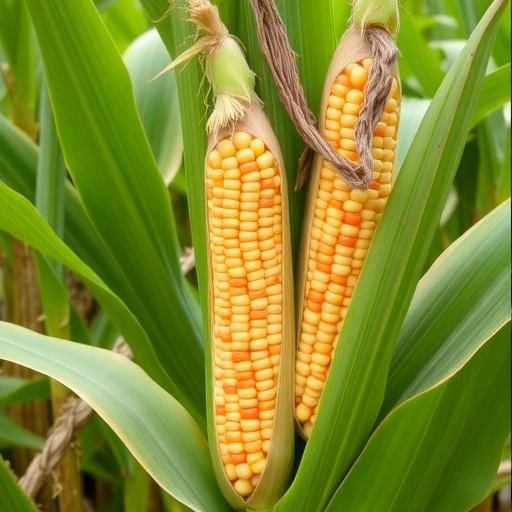
Twenty maize genotypes. Five unforgiving environments. One deceptively simple question: can tropical maize be trusted to deliver consistently nutritious animal feed no matter where it grows? For a twelve-member research team led by plant scientist John Bosco Ssempiira, working with colleagues including Julius Pyton Sserumaga, Swidiq Mugerwa and Phinehas Tukamuhabwa, that question demanded a demanding program of field trials and laboratory chemistry. Their answer, published on 29 August 2026 in the open-access journal Discover Plants, is a carefully qualified but genuinely encouraging yes. By evaluating twenty tropical maize genotypes across five distinct environments for the nutritional composition of their silage, the team documented significant genetic variation in the traits that determine feed quality — and, crucially, identified stable candidate lines that held their nutritional ground across locations. In a region where livestock productivity is throttled by poor forage, that may sound like a technical footnote. It is anything but.
Silage is, at first glance, an unglamorous commodity: whole-plant maize harvested at a precise stage of maturity, chopped, compacted into airtight silos and left to ferment into a shelf-stable feed. Yet this pickled forage is the metabolic engine of intensive dairy and beef production, and maize is its undisputed global king. The crop is the leading silage source worldwide and a major energy source in animal diets, prized for towering biomass yields, abundant water-soluble carbohydrates and a low buffering capacity that makes fermentation unusually predictable. The problem in much of Sub-Saharan Africa is that the maize being grown was never designed for the job. Most varieties cultivated in the region were selected for grain, not for the nutritional value of the entire plant. According to the researchers, the production of low nutritional composition silage among livestock farmers is partly attributed to the absence of specialized, stable silage-tailored maize lines from which superior hybrids could be developed — a gap that has left one of the continent’s fastest-growing agricultural sectors feeding its animals on feed of unreliable quality.
Understanding why that matters requires descending into the chemistry of the silo. When chopped maize is sealed away, residual oxygen is exhausted within hours and anaerobic lactic acid bacteria take over, fermenting plant sugars into organic acids. As acid accumulates, pH falls into a range of roughly 3.8 to 4.2 — low enough to suppress the clostridia, molds and yeasts that would otherwise rot the crop — and the forage is effectively pickled, its nutrients locked in for months. But fermentation only preserves what the plant already contains. It cannot create crude protein where none exists, cannot manufacture energy the crop never captured, and cannot dissolve the lignin that walls off otherwise digestible carbohydrates. This is the central insight behind the new study: the ceiling on silage quality is set in the field, by the genetics of the standing crop at harvest, not in the silo by the skill of the operator. Breeders, in other words, hold the keys — provided they know which traits to chase.
To quantify quality, the researchers measured a suite of eight nutritional traits that together describe what a ruminant can actually extract from fermented maize. Crude protein — determined from nitrogen content and converted using the conventional factor of 6.25 — supplies the amino acids and rumen-degradable nitrogen on which milk synthesis and microbial protein production depend. Ether extract captures the lipid fraction, an energy-dense component that delivers roughly 2.25 times as much energy per gram as carbohydrate. Metabolizable energy, expressed in megajoules per kilogram of dry matter, represents the energy remaining after fecal, urinary and gaseous losses — the figure on which every ration formulation ultimately turns. Neutral detergent fiber bundles hemicellulose, cellulose and lignin into the structural fraction that fills the rumen and, in excess, physically caps how much a cow can eat; acid detergent fiber strips away hemicellulose and tracks digestibility, falling as the digestible portion of the forage rises. Ash indexes total mineral content, dry matter captures the water balance that governs fermentation dynamics, and crude fiber provides a legacy estimate of structural carbohydrate. pH, treated not as a nutritional trait but as a fermentation adequacy check, confirmed whether each sample had ensiled properly.
The experimental architecture reflects a hard-won lesson of modern plant breeding: a genotype evaluated in a single location tells you almost nothing about its commercial worth. The twenty genotypes were grown across five environments — sites differing in soils, rainfall, temperature and management — because tropical agriculture is a patchwork of agro-ecologies rather than a uniform canvas. Statistical geneticists describe the resulting complication as genotype-by-environment interaction: the phenomenon by which a variety that excels in one setting can slump in another because the genes governing a trait respond differently to different conditions. By running a combined analysis of variance across all five sites, the team could partition the variation observed in crude protein, ether extract, metabolizable energy, the fiber fractions, ash, dry matter and crude fiber into components attributable to environments, to genotypes and to the interplay between the two. The analysis revealed statistically significant variation among environments, confirming that the testing locations genuinely pushed the plants in different directions — and, critically, significant genetic variation among the twenty genotypes in their silage nutritional composition.
That genetic signal is the study’s most consequential finding, because heritable variation is the raw currency of breeding. If differences among maize lines in protein content, fiber fractions or energy density were purely environmental artifacts, selection would be futile: no amount of crossing could accumulate favorable alleles, and no hybrid could outperform its parents. Instead, the researchers identified genotypes whose nutritional profiles remained stable across the testing environments — lines whose protein and energy content a farmer can reasonably predict in advance, season after season, field after field. The value of that predictability is difficult to overstate. Dairy nutritionists formulate rations on the assumption that a known quantity of silage contains a known concentration of nutrients; a forage that swings unpredictably between harvests forces costly supplementation, silent losses in milk yield, or both. In smallholder systems, where purchased concentrates are scarce or prohibitively expensive, the difference between a stable silage maize and an erratic one can decide whether a dairy enterprise is profitable at all.
The road map that emerges is familiar in the developed world but has been conspicuously incomplete in the tropics. Across North America and Europe, specialized silage hybrids — bred and marketed specifically for whole-plant nutritional value rather than grain yield alone — are standard tools of the dairy industry. Tropical Africa has largely made do with dual-purpose grain varieties, and the new study supplies the missing starting point: documented, exploitable variation in exactly the traits a silage-specific breeding program would target. Breeders can now cross the stable, nutritionally superior lines to assemble hybrids that combine high biomass with optimal protein, energy and fiber profiles, while retaining the robustness tropical conditions demand. The significant environmental effects documented in the trial carry their own warning, however. Because nutritional traits responded to growing conditions, breeding programs will need either broadly adapted varieties or deliberate targeting of specific hybrids to specific agro-ecological zones — a strategic choice that will shape hybrid development pipelines across the region for years to come.
What makes the problem technically thorny is that silage quality is a multi-trait optimization exercise, not a single number to maximize. Pushing a maize line toward higher dry matter can complicate fermentation and sealing; reducing neutral detergent fiber can lift voluntary intake but, taken too far, sacrifices the structural biomass that makes silage maize productive in the first place; harvesting earlier to raise protein concentration undermines the dry matter accumulation that sound fermentation requires. Breeders must therefore balance several traits simultaneously while keeping every one of them stable across unpredictable growing conditions. This is precisely the territory where information has been scarcest: the researchers note a scarcity of data on genetic variation and plant–environment relationships in silage nutritional composition traits among tropical maize germplasm, even as demand for quality silage keeps climbing on the back of introduced and genetically improved livestock breeds. Those animals are capable of far more than local forages allow — and without better feed, their potential simply goes unrealized.
The stakes extend well beyond the dairy shed. Livestock production across Sub-Saharan Africa is expanding rapidly, propelled by population growth, urbanization and rising incomes that lift demand for milk and meat, yet animal productivity remains among the lowest in the world, and feed quality is routinely identified as the binding constraint. Better silage would convert abundant sunlight and land into storable, high-density feed, buffering the brutal seasonal gap between wet-season abundance and dry-season scarcity that forces farmers to watch body condition and milk yields collapse each year. It would also reduce dependence on imported concentrates that drain scarce foreign exchange from economies that can ill afford the loss. In that sense, the unglamorous chemistry of detergent fiber and crude protein becomes an instrument of food security, rural income and economic resilience — a reminder that in agriculture, the most consequential breakthroughs are often measured not in headlines but in megajoules per kilogram of dry matter.
The stable candidate genotypes flagged in the trial now face the next stage of scrutiny: advanced evaluation and integration into breeding programs aimed at developing silage-specific hybrids for Sub-Saharan Africa. Because the study appears in the open-access journal Discover Plants, its findings are available to public breeding programs across the continent rather than locked behind a paywall — a small but meaningful detail in a field where publicly funded breeders do most of the work. No single trial will transform African livestock production, and the researchers are careful to position their results as a foundation for further evaluation rather than a finished solution. But the study establishes something that was previously missing: hard evidence that tropical maize germplasm carries exploitable genetic variation for the traits that determine silage quality, and that a meaningful share of that variation is stable enough to build on. For a continent whose dairy ambitions are rising faster than its feed quality, that may prove the most valuable harvest of all.
Cite Scienmag News
Alan Morgan. (August 31, 2026). Tropical Maize Germplasm Shows Genetic Variation in Silage Nutritional Quality Across Environments. Scienmag. https://scienmag.com/tropical-maize-germplasm-shows-genetic-variation-in-silage-nutritional-quality-across-environments/
Alan Morgan. "Tropical Maize Germplasm Shows Genetic Variation in Silage Nutritional Quality Across Environments." Scienmag, 31 August 2026, https://scienmag.com/tropical-maize-germplasm-shows-genetic-variation-in-silage-nutritional-quality-across-environments/. Accessed 3 September 2026.
Alan Morgan. "Tropical Maize Germplasm Shows Genetic Variation in Silage Nutritional Quality Across Environments." Scienmag. August 31, 2026. https://scienmag.com/tropical-maize-germplasm-shows-genetic-variation-in-silage-nutritional-quality-across-environments/


