


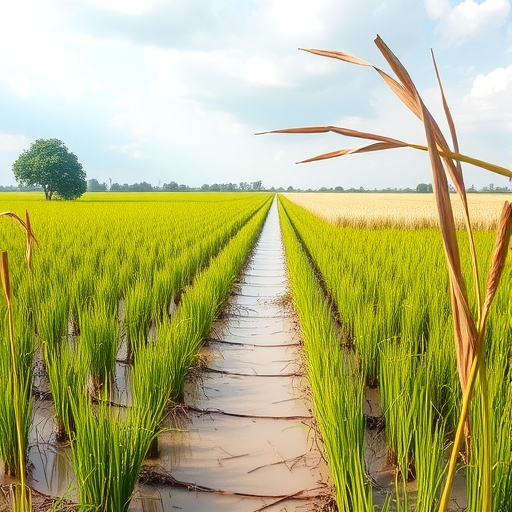
In the flooded fields that feed half of humanity, an unexpected subterranean drama is coming into focus. Climate warming, long cast as the great plunderer of soil carbon, can actually add carbon to the deeper layers of rice paddies even as it strips carbon away from the surface, and the decisive players in this two-front battle are not plants but fungi and bacteria. A four-year field experiment reported in the journal Plant and Soil shows that straw incorporation and asymmetric warming reshape soil organic carbon through fundamentally different pathways at different depths: warming boosted the carbon stored in the subsoil by 6.2 percent while draining 6.1 percent from the topsoil, and returned crop straw largely offset that surface loss. Led by researchers at the Zhejiang Academy of Agricultural Sciences in Hangzhou, China, the study goes further than most previous work in tracing, molecule by molecule, how plant-derived and microbial-derived carbon pools diverge layer by layer when farmland simultaneously faces residue management and a warming climate.
Soil is the largest active carbon reservoir on land, holding more carbon than the atmosphere and all living vegetation combined, and soil organic carbon, the decomposing remains of plants, animals and microbes, determines whether farmland acts as a net sink or a net source of carbon dioxide. Yet most measurements, models and carbon-accounting schemes concentrate on the top 20 to 30 centimeters of the profile. The layers beneath, where mineral surfaces and oxygen-poor conditions slow decay, store a large share of terrestrial carbon but respond to climate change in ways that remain poorly constrained, and deep soil carbon, often centuries old, is routinely overlooked in national greenhouse-gas inventories. Paddy soils are a special case: centuries of seasonal flooding and residue return have made rice paddies among the most carbon-rich croplands on Earth, and in Asia they underpin the food supply of billions of people. Whether warming will unlock that carbon, or quietly accumulate more of it below the plow layer, carries direct consequences for climate projections and for the sustainability of intensive rice cultivation.
To resolve the question, the team ran a four-year experiment crossing straw incorporation with asymmetric warming in a rice–wheat rotation paddy, a double-cropping system in which flooded rice is followed by upland wheat. Asymmetric warming mimics the uneven signature of real-world climate change, in which night-time and cooler-season temperatures rise faster than daytime and summer ones, rather than applying a uniform increase. After four growing seasons, the researchers sampled two contrasting layers, the organic-rich topsoil from 0 to 20 centimeters and the subsoil from 20 to 40 centimeters, and quantified soil organic carbon in each. The design allowed them to disentangle three effects that are usually confounded in field data, the effect of straw, the effect of warming, and the effect of the two acting together, and to test whether each of these effects changed with depth. The results, published in Plant and Soil on 28 August 2026, show that they change dramatically.
The study’s power lies in its molecular bookkeeping. Rather than treating soil carbon as a black box, the team separated its two great origins. Lignin phenols, the aromatic building blocks of vascular plant cell walls, served as fingerprints of plant-derived carbon, material that enters soil directly as straw and root residues and was long assumed to dominate stable soil organic matter. Amino sugars, compounds such as glucosamine and muramic acid that persist after microbial cells die, served as fingerprints of microbial necromass, the corpses of bacteria and fungi now recognized as a major and often dominant contributor to long-lived soil carbon. Living microbial biomass was tracked with phospholipid fatty acids, membrane molecules that distinguish fungal from bacterial communities, while a suite of carbon-acquiring enzymes gauged the soil’s capacity to decompose organic matter, from simple hydrolytic enzymes to oxidative enzymes such as phenol oxidase and peroxidase that attack tough lignin. A random forest analysis then ranked which factors best predicted each carbon pool in each layer.
In the topsoil, straw emerged as the decisive force. Incorporating straw raised soil organic carbon by 8.8 percent, while warming alone stripped out 6.1 percent; crucially, when the two treatments were combined, a significant interaction offset the warming-induced loss, indicating that returned residues can buffer surface carbon against a warming climate. The biomarkers explain why. Straw application increased total lignin phenols by 24.1 percent, the direct signature of added plant residue, and lifted microbial necromass carbon by 26.6 percent, evidence that fresh straw is not merely accumulating but is rapidly assimilated into microbial cells that later become stable soil organic matter. The finding aligns with the microbial carbon-use efficiency framework, in which more of the carbon microbes consume ends up in their bodies, and eventually in necromass, when growth conditions are favorable. Fungal necromass increased more than bacterial necromass, consistent with evidence that fungi, with their carbon-dense cell walls and sprawling hyphal networks, are especially efficient at converting crop residues into persistent soil carbon.
The subsoil told the opposite story. Straw, delivered at the surface and barely mixed downward, left the 20-to-40-centimeter layer essentially untouched. Warming, however, raised subsoil organic carbon by 6.2 percent, a counterintuitive result that resolved into two mechanisms. First, warming increased subsoil lignin phenols by 23.3 percent, not because more plant carbon arrived but because its decomposition slowed: the oxidative enzymes that normally shred lignin and related aromatics were suppressed in the warmed deeper layer, effectively locking plant-derived carbon in place. Because lignin phenols resist degradation and are considered a relatively stable component of soil organic matter, their accumulation signals a genuine slowdown of the terminal steps of plant-residue decay. Second, warming increased subsoil microbial necromass carbon by 12.4 percent, and the surge came almost entirely from bacteria, whose necromass jumped by 53.4 percent. In the dark, oxygen-limited depths, a warmer soil evidently stimulated bacterial growth and turnover, and the dead bacterial cells, rich in nitrogen and adhesive cell-wall polymers, accumulated faster than they could be recycled.
The findings hinge on the asymmetric character of the warming. Because night-time and cool-season temperatures rise disproportionately under climate change, the treatment perturbed soil microbes in ways a uniform temperature increase would not, shifting the balance between the carbon microbes invest in growth and the carbon they respire away. In the subsoil, the suppression of oxidative decomposition echoes the well-known enzymic latch concept, in which inhibited lignin-degrading oxidases preserve carbon-rich aromatic compounds; at depth, warming appears to have slowed the very process capable of dismantling plant lignin. The bacterial boom fits a broader pattern in which nitrogen-rich bacterial residues accumulate when substrate and nutrient conditions favor fast-growing opportunists. The team’s random forest models crystallized the depth divide: in the topsoil, the soil organic carbon-to-total nitrogen ratio and fungal biomass were the strongest predictors of carbon storage, whereas in the subsoil oxidative enzyme activity and bacterial biomass took over. One soil profile, two different microbial economies.
For carbon modelers, the message is that soil is not a single vault with a single lock. Simulations that represent soil organic carbon as one homogeneous pool, or that assume warming uniformly accelerates decomposition, will miss both the straw-driven fungal carbon pump in the topsoil and the warming-driven bacterial carbon pump in the subsoil. The authors argue that plant-derived and microbial-derived carbon formation pathways must be integrated, and resolved by depth, if paddy carbon budgets are to be projected credibly under future climates. For farmers and policymakers, the results give straw return a sharper identity: not merely waste disposal or a modest fertility boost, but an active management lever that sustains surface soil carbon precisely where warming does its damage. With China alone generating hundreds of millions of tonnes of crop residues each year, and straw return already promoted across its croplands, the finding ties a routine agronomic practice to the machinery of climate mitigation.
Caveats bound the conclusions. Four years is a short window in the life of soil carbon, and the gains at depth, driven by suppressed decomposition rather than added inputs, could prove temporary if prolonged warming eventually reactivates oxidative enzymes or shifts communities toward lignin-capable decomposers. Necromass accumulation also depends on continued residue inputs and nitrogen availability, and the interaction observed in the topsoil deserves longer observation, since residue quality, microbial succession and nutrient dynamics evolve over decades rather than years. The rice–wheat rotation, with its annual flooding cycle, is also a chemically distinctive environment in which iron oxides, low oxygen and repeated wet–dry swings shape carbon stabilization in ways that upland soils do not share. Extending the depth-resolved, biomarker-based approach across sites, soil types and longer warming histories is the obvious next step, and the researchers state that their data will be made available on request to support such efforts.
What remains is a vivid reframing of the ground beneath rice. In the plow layer, the carbon future rests on fungi quietly converting straw into long-lived necromass; twenty to forty centimeters down, bacteria and slowed lignin decay govern whether warming banks carbon or burns it. Surface and subsurface are not two versions of the same soil but two distinct carbon economies, each with its own currencies, regulators and sensitivities. As nights warm faster than days across the rice-growing heartlands of Asia, that split economy will increasingly decide how much of the carbon that farms borrow from the atmosphere is repaid to the soil, and how much escapes to the sky. For the paddies that feed billions, the difference between a fungal topsoil and a bacterial subsoil may help determine whether cropland becomes part of the climate solution or part of the climate problem.
Cite Scienmag News
Alan Morgan. (August 30, 2026). Straw and warming reshape soil carbon formation pathways in paddy fields. Scienmag. https://scienmag.com/straw-and-warming-reshape-soil-carbon-formation-pathways-in-paddy-fields/
Alan Morgan. "Straw and warming reshape soil carbon formation pathways in paddy fields." Scienmag, 30 August 2026, https://scienmag.com/straw-and-warming-reshape-soil-carbon-formation-pathways-in-paddy-fields/. Accessed 3 September 2026.
Alan Morgan. "Straw and warming reshape soil carbon formation pathways in paddy fields." Scienmag. August 30, 2026. https://scienmag.com/straw-and-warming-reshape-soil-carbon-formation-pathways-in-paddy-fields/


