


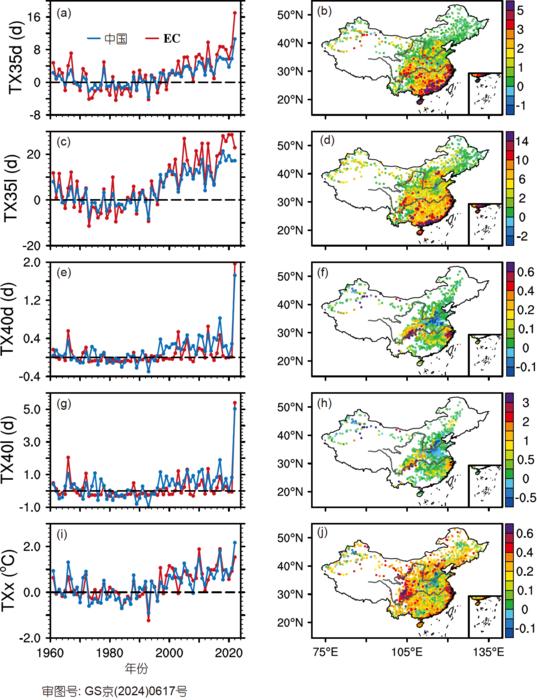
Recently, the Science China Earth Sciences published online research results from the team led by Ying Sun from China National Climate Center, including authors Master Yuxia Zhang and Researcher Ting Hu. The team investigated the observed and climate model projected changes in extreme high temperature warning indicators across China. They found approximately linear increase in the intensity of extreme high temperatures exceeding 35°C and 40°C with global warming, while the number of high temperature days and length of season were projected to increase non-linearly. The climate models showed more severe increase in extreme high temperature changes than the raw projections after the annual cycle was bias corrected. The start date of high temperatures will occur earlier and the end date will be delayed, thereby the high temperature season will become longer. The geographical extent affected by high temperatures will continue to expand.

Credit: ©Science China Press
Recently, the Science China Earth Sciences published online research results from the team led by Ying Sun from China National Climate Center, including authors Master Yuxia Zhang and Researcher Ting Hu. The team investigated the observed and climate model projected changes in extreme high temperature warning indicators across China. They found approximately linear increase in the intensity of extreme high temperatures exceeding 35°C and 40°C with global warming, while the number of high temperature days and length of season were projected to increase non-linearly. The climate models showed more severe increase in extreme high temperature changes than the raw projections after the annual cycle was bias corrected. The start date of high temperatures will occur earlier and the end date will be delayed, thereby the high temperature season will become longer. The geographical extent affected by high temperatures will continue to expand.
The researchers focused on the fixed threshold indices closely related to human health in high temperature warning indicators. They investigated the number of days, intensity, length of season and impacted area of extreme high temperatures with daily maximum temperature reaching or exceeding 35°C and 40°C. They found that from 1961 to 2022, the number of days and length of season with temperatures exceeding 35°C and 40°C in the summer half year of China showed an increasing trend, and the area affected by high temperatures has been continuously expanding. In 2022, there was a sudden increase in high temperatures exceeding 40°C, with the number of days in Eastern China increasing by about 2 days, and the season extending by over 5 days.
Based on the model results that participated in the Coupled Model Intercomparison Project Phase 6 (CMIP6), the team utilized the model climate sensitivity combined with the annual temperature cycle bias correction method to project the future changes in extreme high temperature warning indicators over China under different global warming levels. The results show that after bias correction, the increasing trends for the number of days and length of season with temperatures exceeding 35°C and 40°C become more pronounced. “This indicates that the increase in these indicators will be more severe than originally anticipated” they said.
As global warming intensifies, the high temperature days and length of season are projected to increase non-linearly, while the intensity of high temperatures is expected to increase linearly. “For every 1°C increase in global temperature, the intensity of high temperatures is projected to rise by approximately 1.4°C” they said.
Meanwhile, as global warming, the area affected by high temperatures is expanding, with the major hotspot for China located in the eastern and northwestern regions. In the middle and lower reaches of the Yangtze River, when the global temperature rises by 1.5°C, the number of days with temperatures exceeding 40°C will increase by about 0.5 days. However, at a 2°C level, this increase could reach 2-4 days, and at a 3°C level, it could even reach 6-8 days. This means that extreme temperatures above 40°C, which have been rare in the past, may become common in the future with global warming. At a global temperature rise of 5 ° C, parts of China are likely to experience extreme high temperatures for most of the year.
See the article:
Zhang Y, Sun Y, Hu T. 2024. Changes in extreme high temperature warning indicators over China under different global warming levels. Science China Earth Sciences, 67(6): 1895–1909,
Journal
Science China Earth Sciences
Cite Scienmag News
Violet Maxwell. (May 28, 2024). Changes in extreme high-temperature warning indicators over China under different global warming levels. Scienmag. https://scienmag.com/changes-in-extreme-high-temperature-warning-indicators-over-china-under-different-global-warming-levels/
Violet Maxwell. "Changes in extreme high-temperature warning indicators over China under different global warming levels." Scienmag, 28 May 2024, https://scienmag.com/changes-in-extreme-high-temperature-warning-indicators-over-china-under-different-global-warming-levels/. Accessed 4 September 2026.
Violet Maxwell. "Changes in extreme high-temperature warning indicators over China under different global warming levels." Scienmag. May 28, 2024. https://scienmag.com/changes-in-extreme-high-temperature-warning-indicators-over-china-under-different-global-warming-levels/

