


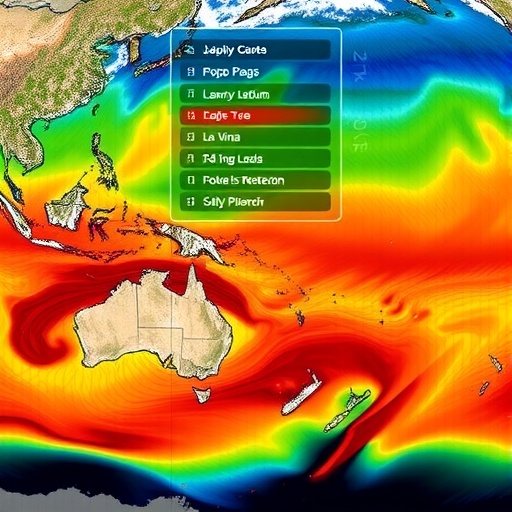
In a groundbreaking study that promises to redefine our understanding of climatic phenomena, researchers have uncovered a pivotal mechanism by which phytoplankton influence the persistence and evolution of multi-year La Niña events. This revelation not only deepens scientific insight into ocean-atmosphere interactions but also opens new pathways for predicting and mitigating extreme climate impacts associated with prolonged La Niña conditions.
La Niña, characterized by anomalous cooling of the central and eastern tropical Pacific Ocean, is a critical driver of global weather patterns. Traditionally, the onset and duration of La Niña events have been attributed primarily to oceanic and atmospheric processes such as sea surface temperature anomalies, trade wind variations, and oceanic wave dynamics. However, this new research identifies a vital biogeophysical component — the role of phytoplankton-induced radiative effects — that modulates these physical drivers over multiple years.
Phytoplankton, microscopic marine plants, are crucial actors in the Earth’s biosphere due to their role in carbon fixation and oxygen production. Their ability to absorb and scatter solar radiation alters the optical properties of the ocean surface. The study demonstrates that dense phytoplankton blooms can influence the amount of sunlight penetrating the ocean, which in turn affects sea surface temperature (SST) profiles crucial for La Niña’s persistence. These radiation effects, previously underestimated, initiate feedback loops that help sustain cooler SST anomalies over successive years.
Employing a sophisticated combination of satellite observations, oceanic biogeochemical modeling, and radiative transfer simulations, the research team meticulously quantified how variable phytoplankton concentrations alter the radiation budget of the upper ocean layers. The subtle but cumulative shifts in radiation absorption contribute to changes in thermodynamic conditions vital for maintaining the cold SST anomalies characteristic of La Niña. This marks a paradigm shift wherein biological processes are recognized as integral components of large-scale climatic variability.
The study meticulously disentangles the complex interactions between phytoplankton and surface radiation, revealing that phytoplankton blooms enhance ocean albedo in ways that diminish incoming solar radiation absorption. This subtle dimming effect leads to a net cooling of surface waters, reinforcing the ocean-atmosphere feedback mechanisms that naturally favor the prolongation of La Niña events. By reshaping the radiation budget, phytoplankton act as biological amplifiers, modulating the strength and duration of La Niña phases beyond what physical models alone could predict.
These bio-radiative interactions have profound implications for climate modeling and prediction. Current climate models often treat biological components as passive players or simplify their radiative influences. The findings underscore the necessity for integrating dynamic biological feedbacks, especially those involving phytoplankton radiation effects, into coupled ocean-atmosphere models used for seasonal-to-decadal climate forecasts. This integration can enhance model accuracy, improving preparedness and risk management for climatic extremes triggered by multi-year La Niña events.
Furthermore, the study highlights a synergistic feedback mechanism where La Niña conditions promote nutrient upwelling that supports phytoplankton growth, which in turn intensifies radiative cooling, thereby prolonging the La Niña state. This positive feedback loop represents a self-sustaining cycle mediated by living organisms, challenging the long-held notion that biotic factors play a negligible role in climate system evolution on interannual timescales.
A key aspect of the research involves the evaluation of phytoplankton community composition and its heterogeneous impacts on radiative fluxes. Different phytoplankton species exhibit distinct pigment profiles and optical properties, influencing how they absorb and scatter sunlight. The study reveals that shifts in phytoplankton assemblages during La Niña events can alter the intensity and spatial extent of the radiation-driven feedback, adding layers of complexity to the biological-climate interplay.
Moreover, the investigation underscores the critical spatial variability of phytoplankton radiative effects. Regions of intense biological activity correspond to hotspots of modified radiation absorption, which subsequently affect localized ocean warming and cooling patterns. This spatial heterogeneity suggests that fine-scale biogeochemical processes must be resolved in models to accurately capture their climatic implications, particularly in the Pacific basin where La Niña dynamics are most prominent.
This pioneering research also calls attention to the potential influence of anthropogenic changes on these biological feedback systems. Climate-induced alterations in ocean nutrient cycles, stratification, and acidification may disrupt phytoplankton distributions and functions, thereby modifying their radiative roles in unpredictable ways. Understanding these interactions is vital to anticipate future regimes of La Niña behavior under global warming scenarios.
The interdisciplinary nature of this study — bridging marine biology, atmospheric physics, and climate science — exemplifies the integration necessary to unravel the complexities of Earth system processes. By combining observational data with advanced modeling frameworks, the researchers provide robust evidence for the ecological-climatic nexus governing multi-year La Niña events.
Ultimately, the identification of phytoplankton-induced radiation effects as a critical reshaping factor in La Niña evolution opens exciting avenues for both fundamental and applied climate science. It suggests new parameters to monitor in Earth observation campaigns and new targets for intervention strategies aimed at mitigating adverse impacts of prolonged climate anomalies.
As global climate patterns become increasingly erratic, with extreme events posing significant societal challenges, understanding the full spectrum of natural modulators — including the microscopic yet mighty phytoplankton — will be essential. This research marks a pivotal step towards a more holistic and accurate portrayal of the climate system, integrating the roles of biology and physics in shaping our planet’s future.
Scientists and policymakers alike stand to benefit from this enhanced perspective, which underscores the interconnectedness of marine ecosystems and atmospheric dynamics. Future research building on these findings could revolutionize predictive climate models and inspire innovative approaches to climate resilience.
In conclusion, the revelation that phytoplankton-induced radiative effects substantially influence the duration and intensity of multi-year La Niña phenomena reshapes the conventional understanding of climate variability. This biological feedback introduces a novel driver, emphasizing that Earth’s climate system is a complex mosaic where living organisms and physical forces coalesce to determine global climatic outcomes.
Cite Scienmag News
Gavin Prescott. (May 25, 2026). Phytoplankton Influence Multi-Year La Niña Evolution. Scienmag. https://scienmag.com/phytoplankton-influence-multi-year-la-nina-evolution/
Gavin Prescott. "Phytoplankton Influence Multi-Year La Niña Evolution." Scienmag, 25 May 2026, https://scienmag.com/phytoplankton-influence-multi-year-la-nina-evolution/. Accessed 3 September 2026.
Gavin Prescott. "Phytoplankton Influence Multi-Year La Niña Evolution." Scienmag. May 25, 2026. https://scienmag.com/phytoplankton-influence-multi-year-la-nina-evolution/


