


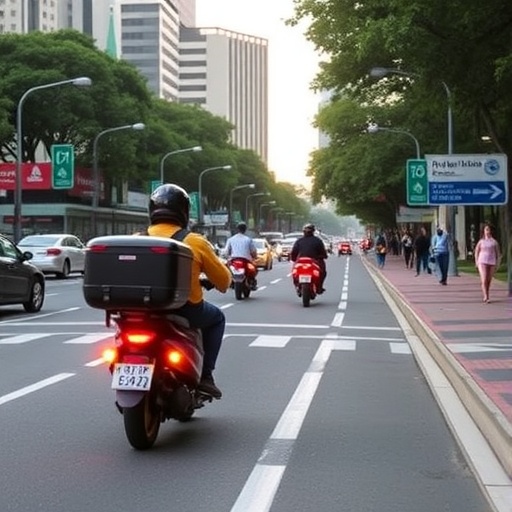
Road injuries cost Singapore an estimated 9,680 years of healthy life in 2023, according to a new analysis led by the Institute for Health Metrics and Evaluation in collaboration with the Yong Loo Lin School of Medicine at the National University of Singapore. The figure captures more than the number of people killed or treated after crashes: it measures the combined human toll of premature death and long-term disability. Published in The Lancet Public Health, the study is the most comprehensive assessment to date of road injuries across 204 countries and territories, tracking changes from 1990 through 2023. Its findings show that Singapore has made substantial progress in reducing road trauma, but also that crashes remain a major threat, particularly for young people and vulnerable road users.
Of the healthy years lost in Singapore, 4,786 resulted from premature deaths, while 4,894 were attributed to years lived with disability. Researchers calculate these outcomes using the disability-adjusted life year framework, commonly known as DALYs. One DALY represents one lost year of healthy life and combines two different effects: years of life lost when a person dies earlier than expected, and years lived with health limitations after surviving an injury. The first component is estimated by comparing the age at death with a standard life expectancy. The second incorporates the duration and severity of disability, meaning that a serious brain injury, spinal cord injury, or disabling fracture can generate a substantial health burden even when the victim survives.
Singapore’s long-term trend is encouraging. After adjusting for changes in the population’s age structure, the country’s road-injury rate fell by 54.8% between 1990 and 2023, while its road-injury death rate declined by 82.3%. Age standardisation is important because populations change over time: a country with more older people may experience different injury patterns than a younger country, even if its underlying safety conditions remain unchanged. By applying a common age structure, researchers can compare trends more fairly across decades and between nations. Yet the decline has not eliminated the danger. In 2023, road injuries remained the second-leading cause of death among Singaporeans aged 15 to 29 and the third-leading cause of injury-related death across the national population.
The pattern of injury varied according to how people travelled. Motor-vehicle occupants and cyclists represented the most frequently injured road-user groups in Singapore, while motorcyclists accounted for the greatest share of road deaths. Among non-fatal cases, minor injuries made up 43.3%, followed by fractures at 35.9%. Fractures represented more than 40% of injuries among both pedestrians and motorcyclists, a finding that reflects the limited physical protection available to people outside enclosed vehicles. Motorcyclists also face greater exposure to direct impact and road-surface contact, making crashes more likely to produce severe trauma. The study’s results suggest that road-safety policy must address not only deaths but also the large and often less visible population living with pain, restricted movement, neurological damage, or reduced ability to work.
Cycling is also reshaping the road-injury landscape in wealthier Asia-Pacific countries. In settings such as Singapore and Japan, cyclist injuries now constitute the largest share of road-injury cases among road-user groups. The shift reflects changing transport habits, including increased cycling for commuting, exercise, and short-distance travel. It also creates new safety challenges because road systems designed around cars and motorcycles may not adequately protect people travelling on bicycles. Even relatively low-speed collisions can produce serious head, chest, or limb injuries when cyclists are thrown onto hard surfaces or struck by larger vehicles. The researchers argue that safety strategies must evolve alongside mobility patterns rather than relying on historic assumptions about who uses roads and how.
The global picture is considerably more severe. In 2023, road injuries caused an estimated 50.9 million injuries and 1.34 million deaths worldwide, generating approximately 75.3 million years of healthy life lost through early death or disability. Road injuries were the leading cause of death among males aged 10 to 39 globally and accounted for about one in five deaths among males aged 20 to 24. These numbers reflect the interaction of mobility, exposure, economic conditions, enforcement, and access to medical care. Young men are disproportionately represented in many high-risk driving and riding activities, while people in low- and middle-income countries often face more dangerous roads, less protective vehicles, weaker enforcement, and longer delays before reaching trauma services.
Motorcyclists were especially vulnerable worldwide. Although they accounted for 13.2% of road-injury cases, they represented 23.8% of road deaths and had the highest proportion of head injuries among the main road-user groups. The difference between their share of injuries and deaths indicates that motorcycle crashes are more likely to be fatal or produce severe trauma than many other road incidents. Helmets can reduce the risk of fatal head injury, but their effectiveness depends on proper design, certification, fit, and consistent use. Vehicle speed, road design, visibility, protective barriers, and the behaviour of surrounding drivers also influence outcomes. Treating motorcycle safety as a matter of individual responsibility alone therefore overlooks the wider system in which crashes occur.
Global progress has been sharply unequal. Although road-injury and death rates have generally fallen since 1990, low-income countries recorded approximately 44 road-injury deaths per 100,000 people in 2023, nearly six times the rate reported in high-income countries. More than 90% of road deaths occurred in low- and middle-income countries. The disparity is not explained by behaviour alone. Safer vehicle fleets, divided roads, controlled speeds, functioning traffic signals, reliable emergency communications, and advanced trauma care are unevenly distributed. After a collision, minutes can determine whether a survivable injury becomes fatal; the availability of ambulances, blood supplies, surgery, intensive care, and rehabilitation can therefore alter national death rates even when crash frequency is similar.
The study’s authors say the most effective response is a “safe system” approach, in which roads and transport networks are designed to limit the consequences of human error. Speed management is central because the kinetic energy involved in a collision rises rapidly as speed increases, making even modest reductions capable of changing injury outcomes. Safer junctions, protected crossings, traffic-calming measures, effective helmet and seatbelt enforcement, stronger vehicle standards, and action against drink- and drug-driving can work together to prevent crashes or reduce their severity. In Singapore, the researchers identify continued protection of motorcyclists, cyclists, pedestrians, and older people as priorities, alongside better data to locate high-risk areas and faster emergency response, trauma treatment, and rehabilitation.
The researchers emphasise that their analysis describes the burden of road injuries rather than measuring the effect of any single policy. However, previous evidence indicates that the greatest and most sustained gains occur when enforcement is combined with infrastructure improvements, safer vehicles, public education, and high-quality post-crash care. The findings arrive as countries work toward the United Nations target of halving road deaths and injuries by 2030, a goal that will require substantial additional investment. The World Bank estimates that at least US$200 billion may be needed to support that effort. Singapore’s dramatic decline demonstrates that road trauma can be reduced, but its remaining burden shows why prevention cannot stop at lower death counts: a truly safer transport system must also prevent the disabling injuries that continue to consume thousands of healthy years each year.
News Publication Date: 20-Jul-2026
Web References: https://www.thelancet.com/journals/lanpub/article/PIIS2468-2667(26)00141-6/fulltext
References: The Lancet Public Health; DOI: 10.1016/S2468-2667(26)00141-6
Cite Scienmag News
Courtney Benton. (August 20, 2026). Road injuries cost Singapore nearly 9,700 healthy years in 2023, study finds. Scienmag. https://scienmag.com/road-injuries-cost-singapore-nearly-9700-healthy-years-in-2023-study-finds/
Courtney Benton. "Road injuries cost Singapore nearly 9,700 healthy years in 2023, study finds." Scienmag, 20 August 2026, https://scienmag.com/road-injuries-cost-singapore-nearly-9700-healthy-years-in-2023-study-finds/. Accessed 4 September 2026.
Courtney Benton. "Road injuries cost Singapore nearly 9,700 healthy years in 2023, study finds." Scienmag. August 20, 2026. https://scienmag.com/road-injuries-cost-singapore-nearly-9700-healthy-years-in-2023-study-finds/


