


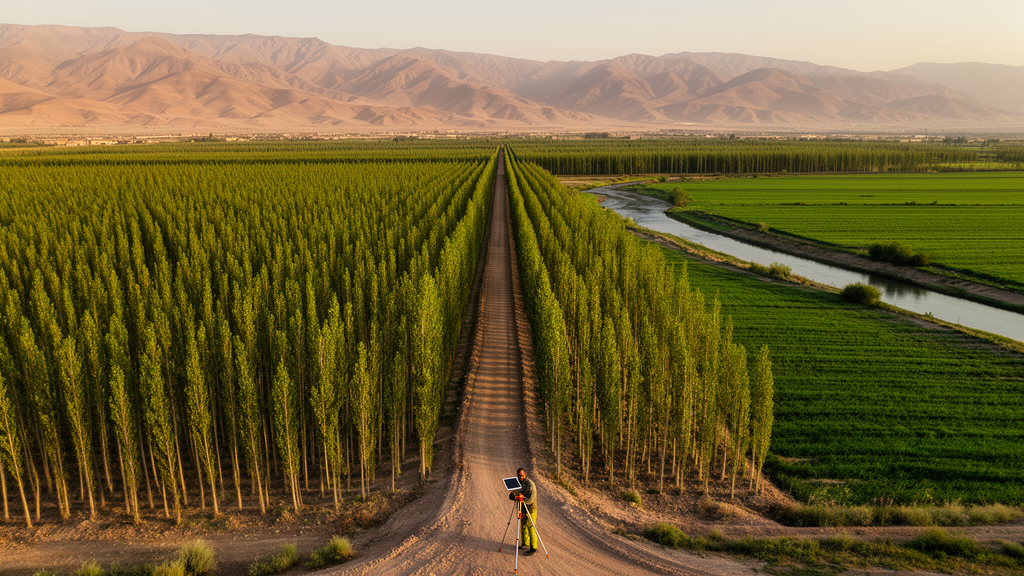
Researchers have completed what they describe as the first province-wide, fully enumerated inventory of poplar plantations in Gilan Province, northern Iran, combining a ground census of every identified plantation section with biometric measurements, satellite-assisted mapping and a survey of more than 300 forestry specialists. The survey counted 16,250 plantation sections covering 12,179 hectares and holding 13,861,723 trees, with a total standing timber volume of 6.78 million cubic meters. The work, published in Discover Environment, was carried out by Fatemeh Ahmadloo of the Research Institute of Forests and Rangelands together with colleagues including Pete Bettinger and Xiaodi Zhao, with field measurements conducted from September 2023 to March 2026.
The scale of the enumeration distinguishes the study from typical plantation assessments, which usually rely on sampling. Rather than selecting a subset of sites, the team conducted a complete census of all identified poplar plantation sections in the province, excluding mixed stands dominated by native species such as alder because of legal and ecological constraints. Within each section, individual trees were selected for detailed measurement using a stepwise procedure in which the number of measured trees increased with section area, starting at a minimum of nine trees for sections up to 0.2 hectares and rising by nine for each additional 0.2-hectare class. In total, 514,702 trees were measured for diameter at breast height, total height and age, using calipers and a Blume-Leiss hypsometer, with records captured on electronic forms.
Spatially, the plantations are strikingly concentrated. Sowme’eh Sara County alone accounted for 57.01 percent of the provincial plantation area, or 6,944 hectares, 55.66 percent of all enumerated trees, and 50.31 percent of the total standing volume, about 3.41 million cubic meters. In that county, 11.82 percent of municipal land is allocated to poplar farming, with plantations averaging 4.42 years in age, 13 centimeters in diameter at breast height and 12.58 meters in height. By contrast, eastern and southern counties such as Talesh and Rudbar held far smaller shares of area, 0.096 percent and 0.020 percent respectively, yet carried much older and larger trees, with mean ages of 19.05 and 19.45 years, diameters of 42 and 39 centimeters, and heights of 31.40 and 31.54 meters. Provincial means across all sections were 7.47 years, 21 centimeters and 17.66 meters.
To test whether these county-level differences were statistically meaningful, the researchers applied robust methods suited to their uneven and heterogeneous data. Brown-Forsythe tests indicated significant heterogeneity of variances for all measured variables, so the team used Welch’s ANOVA as the primary comparison, confirmed by Kruskal-Wallis tests. County-level differences were significant for plantation section area, tree age, diameter, height, single-tree volume, tree number and total section volume. Effect sizes were small to moderate, with omega-squared values ranging from 0.05 for total tree volume to 0.104 for single-tree volume, and approximate intra-class correlation coefficients between 0.063 and 0.128 indicated that part of the variability was associated with county-level clustering.
The team also fitted power-function regression models to 17,074 valid section-level records. In the tree-count model, section area was the dominant predictor, with an exponent of 0.9842, while diameter at breast height carried a small negative exponent and age a small positive one; tree height was not statistically significant and was dropped. The final model explained 97.78 percent of the variation on the log-transformed scale, and ten-fold cross-validation gave a root mean square error of 1,496.55 trees per section and a mean absolute error of 92.17 trees. The volume model, built on height, diameter and tree number, showed an exponent close to 2 for diameter, consistent with the roughly quadratic relationship between stem diameter and volume, and a near-unit exponent for tree number. Its cross-validated root mean square error was 74.03 cubic meters per section. The authors caution that diameter, age and height are biologically interrelated, with variance inflation factors as high as 44.8, so the coefficients describe predictive associations rather than independent causal effects.
Two relative indicators were then derived. The Forest Productivity Index, calculated as volume per hectare divided by average tree age, ranged widely: Fuman showed the lowest county mean at 15.76, followed by Astara at 26.70 and Sowme’eh Sara at 27.51, while Amlash reached 87.31, Rudbar 114.63 and Talesh 129.89. The Forest Management Efficiency index compared each section’s observed productivity against a regression-based benchmark fitted to the same dataset. Across 17,074 sections the overall mean was 0.737, with county means ranging from 0.5579 in Lahijan to 0.9965 in Talesh. The authors stress that these are benchmark-dependent, study-specific indicators: values near 1.0 mean a section performs close to the fitted regional expectation, not that management is optimal, and the indices do not directly quantify inputs such as irrigation, fertilization or silvicultural operations.
A notable methodological finding concerns mapping. The ground-based census identified 12,179 hectares of poplar plantations, whereas earlier remote-sensing-based estimates for the province had ranged from 40,485 to 80,783 hectares. The authors attribute this discrepancy to the difficulty of distinguishing poplar in heterogeneous agricultural landscapes, particularly where trees occur in mixed land-use systems or linear planting configurations, and argue that medium-resolution image interpretation alone may overestimate plantation extent. They do not dismiss satellite approaches, citing work showing Sentinel-2 time series can map poplar plantations with local F-scores of 89.5 to 99.3 percent, but they conclude that field-based inventory remains essential for accurate provincial estimation, and they built a georeferenced database linking the 16,250 sections with KMZ spatial layers to support future updates.
The socioeconomic component drew on a structured questionnaire administered by purposive sampling to a target population of 3,138 experts, yielding 320 valid responses, predominantly from male specialists, 73.8 percent, most holding doctoral or master’s degrees and 40 percent with more than twenty years of professional experience. Respondents rated items on a five-point scale in which lower scores indicated greater importance. Land constraints ranked as the most important dimension, with a mean of 1.59, followed by policy solutions and opportunities at 1.72; institutional and extension support ranked least important at 3.06. At the item level, small landholdings that push farmers toward short-term cash crops and land fragmentation limiting large-scale plantations scored 1.03 and 1.04, the strongest perceived barriers, while inadequate price information and lack of direct market access scored 4.22 and 4.13, the weakest.
The survey results sit within a national context the authors describe in detail. Iran’s pulp and paper industry demands roughly 6.69 million cubic meters of raw wood annually, about 18 percent of it imported, and poplar plantations, with typical productivity of 15 to 20 cubic meters per hectare per year against roughly 2.5 for natural forests, are a central part of the domestic timber-farming strategy. Iran’s logging moratorium on commercial harvesting in natural forests does not apply to plantations, reinforcing their role as an alternative supply source. Gilan hosts more than 892 wood-processing workshops reliant on poplar timber, which the authors note makes the sector vulnerable to regional imbalances in raw material supply given the concentration of production in a few counties.
The authors conclude that the future of poplar cultivation in Gilan depends less on total plantation extent than on the interaction of ecological suitability, stand structure and socioeconomic feasibility. The largest plantation area did not correspond to the highest relative productivity or efficiency, and they attribute this to heterogeneity in site conditions, stand ages, clone composition and management history within larger counties, while emphasizing that these are comparative patterns rather than demonstrated causal relationships. Land fragmentation, small holdings and market concentration among intermediaries emerged as the principal perceived constraints on expansion, and the authors argue that policies focused only on increasing planted area are unlikely to succeed without improved land organization, access to finance, technical extension and stronger links between growers and wood-processing markets.
Subject of Research: A province-wide census and socioeconomic survey of poplar plantations in Gilan Province, Iran
Article Title: Integrated ecological and socioeconomic assessment of poplar cultivation using biometric and GIS data for sustainable management in Gilan Province, Iran
Article References: Ahmadloo, F., Bettinger, P., Bayat, M., & Zhao, X. (2026). Integrated ecological and socioeconomic assessment of poplar cultivation using biometric and GIS data for sustainable management in Gilan Province, Iran. Discover Environment, 4(1), Article 604. https://doi.org/10.1007/s44274-026-01165-6
Image Credits: AI Generated
DOI: 10.1007/s44274-026-01165-6
Keywords: poplar plantations, Gilan Province, Iran, forest inventory, GIS mapping, biometric analysis, Forest Productivity Index, socioeconomic survey, land fragmentation, timber supply, agroforestry, sustainable forest management
Cite Scienmag News
Violet Maxwell. (October 27, 2026). Census of 16,250 poplar plantations maps Iran’s wood heartland. Scienmag. https://scienmag.com/census-of-16250-poplar-plantations-maps-irans-wood-heartland/
Violet Maxwell. "Census of 16,250 poplar plantations maps Iran’s wood heartland." Scienmag, 27 October 2026, https://scienmag.com/census-of-16250-poplar-plantations-maps-irans-wood-heartland/. Accessed 27 October 2026.
Violet Maxwell. "Census of 16,250 poplar plantations maps Iran’s wood heartland." Scienmag. October 27, 2026. https://scienmag.com/census-of-16250-poplar-plantations-maps-irans-wood-heartland/


