


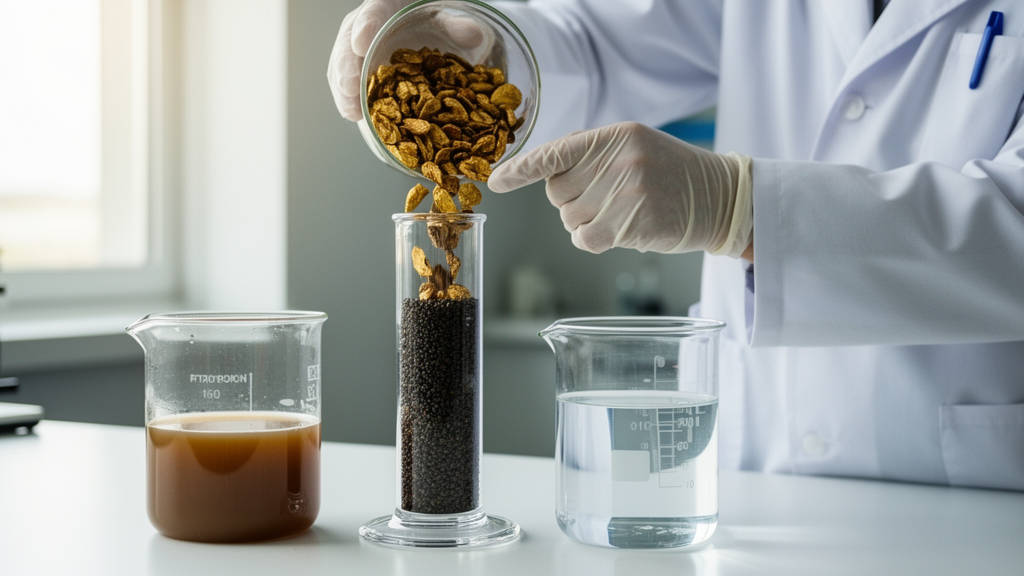
Coffee is one of the most widely traded commodities in the world, and processing it generates substantial volumes of both solid and liquid waste. The liquid stream, known as coffee processing wastewater (CPWW), is a recognized source of environmental pollution, and managing it has proved difficult. A new study reports an integrated treatment approach that pairs batch adsorption with ozonation, using a waste product from the same industry—coffee husk—as the adsorbent material.
The work, published in Applied Water Science by Gayathri Mohan and S. Shanthakumar, was carried out on real CPWW rather than a synthetic substitute, which matters because effluents from actual mills contain a complex and variable mixture of organic pollutants. The circular design of the process is its central idea: a solid by-product of coffee production is used to clean up the liquid waste that coffee production also creates.
To optimize the adsorption step, the researchers used response surface methodology, specifically a central composite design, with contact time and adsorbent dosage as the operational parameters.
The optimum was found at a contact time of 120 minutes and an adsorbent dosage of 5 grams. Under these conditions, the coffee husk removed 54.9% of the chemical oxygen demand (COD), a standard measure of the organic pollutant load in water, and 66.6% of the color. Those figures are meaningful on their own, but the study’s real advance lies in what followed.
To understand how the pollutants were taken up, the team fitted the experimental data to several kinetic models: the pseudo-first-order and pseudo-second-order models, the Weber-Morris intraparticle diffusion model, the Elovich model, and Bangham’s pore diffusion model. The pseudo-second-order model gave the best fit, suggesting that the adsorption process is best described by that kinetic framework.
Because adsorption alone left a considerable share of the organic load and color in the wastewater, the researchers then applied ozonation to the adsorption-treated effluent. Ozonation ran for 120 minutes at an ozone dosage of 15 grams per hour. In this stage, pollutant degradation proceeded through two pathways: direct oxidation by molecular ozone and indirect oxidation by hydroxyl radicals, the latter being a highly reactive species capable of breaking down a broad range of organic compounds.
The results of the combined sequence were substantially better than adsorption alone. Ozonation after adsorption achieved 82.3% COD removal and 93.7% color removal.
The study also examined the environmental implications of the approach, framing it as a sustainable solution for CPWW treatment.
As with any bench-scale optimization study, the reported efficiencies come from controlled batch experiments with defined contact times, dosages and ozone inputs, and performance on full-scale, continuously variable mill effluents would need separate verification. Nevertheless, the work offers a concrete demonstration of how an industry’s own waste stream can be turned into a tool for treating another, in a single integrated sequence.
Subject of Research: Integrated adsorption and ozonation treatment of coffee processing wastewater using coffee husk as an adsorbent
Article Title: Consecutive adsorption and ozonation treatment of real coffee processing wastewater with coffee husk adsorbent—a circular approach
Article References: Mohan, G., & Shanthakumar, S. (2026). Consecutive adsorption and ozonation treatment of real coffee processing wastewater with coffee husk adsorbent—a circular approach. Applied Water Science. https://doi.org/10.1007/s13201-026-02990-z
Image Credits: AI Generated
DOI: 10.1007/s13201-026-02990-z
Keywords: coffee processing wastewater, coffee husk, adsorption, ozonation, COD removal, color removal, response surface methodology, circular economy, pseudo-second-order kinetics, water treatment, Consecutive, treatment
Cite Scienmag News
Violet Maxwell. (October 27, 2026). Coffee Husk Turns Waste Into Wastewater Treatment in Circular Process. Scienmag. https://scienmag.com/coffee-husk-turns-waste-into-wastewater-treatment-in-circular-process/
Violet Maxwell. "Coffee Husk Turns Waste Into Wastewater Treatment in Circular Process." Scienmag, 27 October 2026, https://scienmag.com/coffee-husk-turns-waste-into-wastewater-treatment-in-circular-process/. Accessed 27 October 2026.
Violet Maxwell. "Coffee Husk Turns Waste Into Wastewater Treatment in Circular Process." Scienmag. October 27, 2026. https://scienmag.com/coffee-husk-turns-waste-into-wastewater-treatment-in-circular-process/


