


Deep beneath the Peruvian Andes, stalagmites have been quietly keeping a diary of the sky. A team of researchers led by E. J. Olson of Union College has now read that diary across an astonishing span of Earth history: 450,000 years of shifting tropical rainfall, stretching back through four glacial cycles. Their new study, published in Nature, offers the most detailed record yet of how the South American Summer Monsoon has swung in lockstep with, and sometimes in direct opposition to, its Northern Hemisphere counterpart, the Asian monsoon. The findings carry a provocative message for climate scientists: the global monsoon system, which delivers freshwater to billions of people, can abruptly reorganize itself when planetary boundary conditions change fast enough.
Monsoons are the great seasonal engines of tropical climate. In summer, intense solar heating of land relative to ocean draws in moisture-laden air, producing concentrated rainfall that sustains ecosystems and agriculture across South America, Africa and Asia. Milankovitch theory predicts that slow, periodic wobbles in Earth’s orbit, which alter the seasonal and latitudinal distribution of incoming solar energy, should pace these systems over tens of thousands of years. But the theory alone cannot capture the whole picture. Internal climate factors, including the extent of continental ice sheets, sea surface temperatures and atmospheric greenhouse gas concentrations, also push the monsoon around. Testing which factors matter most has been hampered by a stubborn data gap: records of Southern Hemisphere monsoon variability across multiple glacial cycles have been vanishingly rare, leaving half the planet’s monsoon machinery poorly documented.
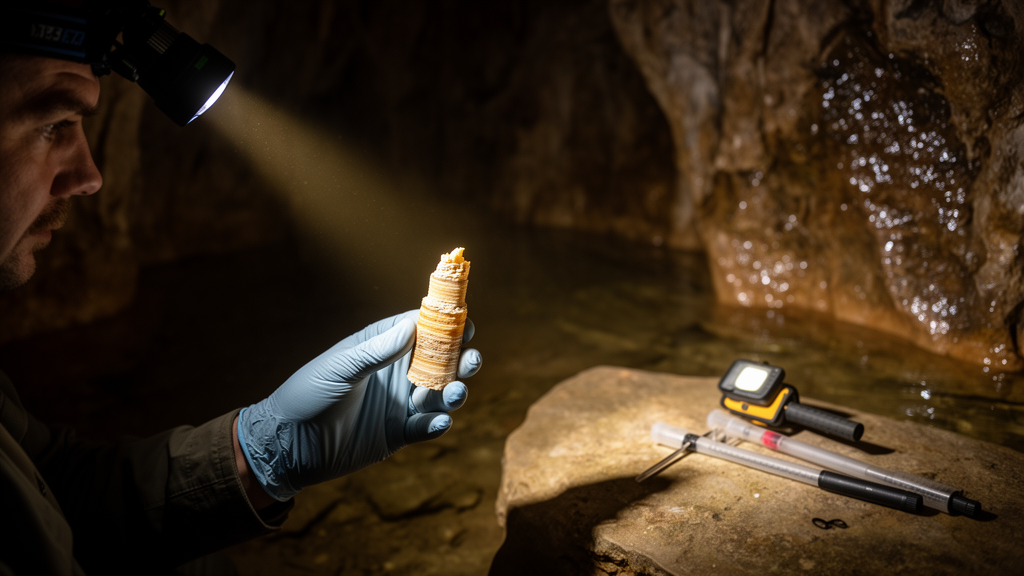
The new record fills that gap using speleothems, the collective term for cave deposits such as stalagmites and stalactites. These formations grow as mineral-laden water drips into caves, precipitating calcite layer by layer. The oxygen isotope composition of that calcite, reported as the δ18O ratio relative to a standard, acts as a proxy for the isotopic composition of rain that fell above the cave, which in turn reflects the intensity of monsoon precipitation. Heavier rainfall tends to produce lower δ18O values, a phenomenon known as the amount effect. Crucially, speleothems can be dated with exceptional precision using the decay of uranium isotopes to thorium, the uranium-thorium dating method, which anchors each layer to an absolute timeline with errors often of only a few thousand years, and far less for younger samples.
The team recovered stalagmites from caves in the Peruvian Andes, including Huagapo and Pacupahuain in the Junín region, sites that sit squarely in the heart of the South American Summer Monsoon system. Careful modern cave monitoring proved essential for interpreting the ancient signal. Weekly measurements of precipitation isotopes outside Huagapo Cave showed that rainfall δ18O is strongly anticorrelated with rainfall amount, and drip water collected by automated samplers registered an invariant monsoon-season value of about minus 14 per mil, matching the monsoon-weighted average of summer precipitation almost exactly. In other words, the water dripping into the caves today faithfully integrates the monsoon signal, validating the archive the researchers hoped to exploit.
Reconstructing a regional monsoon signal from a single cave site is never straightforward, because local effects can contaminate the record. The authors tackled this by combining their speleothem δ18O data with an independently derived glacial index from the nearby Lake Junín sediment record, which tracks Andean glaciation. By removing the local component, the glacial signal embedded in both series, they isolated a regional SASM index robust to site-specific noise. Statistical checks, including phase-randomization tests and sensitivity analyses that shifted the age models within their uncertainties, confirmed that the alignment and the resulting monsoon reconstruction are not artefacts of dating error. Replication between contemporary stalagmites from different caves was strong for oxygen isotopes, further bolstering confidence in the composite record.
When the team compared their 450,000-year South American record with the celebrated Asian monsoon speleothem records from Chinese caves, the dominant pattern was a striking see-saw. For most of the past half-million years, the two hemispheres’ summer monsoons have been out of phase: when the Asian monsoon strengthened, the South American monsoon tended to weaken, and vice versa. This antiphasing is precisely what orbital-scale insolation forcing would predict, since precession of Earth’s axis shifts peak summer heating between hemispheres on a roughly 21,000-year cycle. The record thus provides some of the first direct evidence that Milankovitch pacing governs the Southern Hemisphere’s tropical rain belt across multiple ice ages, not merely the better-sampled north.
But the story took an unexpected turn. At certain intervals, the neat see-saw broke down. Using both a running Pearson correlation over 10,000-year windows and a simpler comparison of the mean of the two records, the researchers identified a synchronicity threshold that was exceeded during ten distinct events, including during glacial terminations, the abrupt episodes when the planet lurched out of an ice age. During these windows, the two monsoons moved together rather than in opposition. The events occurred during intervals of rapidly changing planetary boundary conditions, moments when ice sheets were collapsing, greenhouse gas concentrations were climbing and ocean circulation was being shaken.
What forced the synchrony? Comparison with palaeoclimate forcing records points to a coalition of suspects. Elevated greenhouse gas concentrations, shifts in the cross-equatorial thermal gradient, the temperature difference between the tropical Atlantic’s northern and southern sectors that steers the position of the Intertropical Convergence Zone, and anomalous sea surface temperatures in both the Atlantic and Pacific Oceans all appear to have influenced the synchronous events. The team also turned to model simulations from the North Atlantic Hosing Model Intercomparison Project, which examine what happens to tropical precipitation when the Atlantic Meridional Overturning Circulation, the ocean’s great heat conveyor, collapses. Those simulations reproduce patterns of tropical rainfall reorganization consistent with the cave record’s most dramatic anomalies, linking abrupt high-latitude ocean changes to simultaneous disruption of monsoons on both sides of the equator.
The implications extend well beyond palaeoclimate curiosity. The global monsoon supplies the freshwater underpinning much of Earth’s biota and a large share of humanity, so any mechanism capable of synchronously reorganizing rainfall across hemispheres deserves close attention. The new record suggests that the monsoon system is not a rigid machine slavishly following orbital clocks; it is a coupled, adaptive circulation that can flip into different modes when boundary conditions, ice, carbon dioxide, ocean temperatures, cross fast enough. In a world where greenhouse gas concentrations are now rising faster than at almost any point in the past 450,000 years, and where the Atlantic overturning circulation is itself a subject of urgent concern, the caves of the Peruvian Andes offer a sobering natural experiment in what rapid forcing can do to the planet’s rainfall architecture.
For the researchers, the next steps involve continuing to interrogate the mechanisms behind the ten synchronous events and integrating the new Andean composite with the growing global database of speleothem records. All of the study’s data will be archived publicly at the NOAA National Centers for Environmental Information, and the analysis code is openly available, reflecting a broader push toward reproducibility in palaeoclimate science. Whatever the details, the central lesson of the stalagmites is already clear: Earth’s tropical rain belt keeps a remarkably faithful memory of past climates, and that memory warns that the monsoons we depend on are capable of far more dramatic reorganization than a simple orbital rhythm alone would ever suggest.
Subject of Research: Reconstruction of interhemispheric global monsoon variability over the past 450,000 years using Andean speleothem oxygen isotope records.
Article Title: Interhemispheric monsoon dynamics over the past 450,000 years
Article References: Interhemispheric monsoon dynamics over the past 450,000 years. (n.d.). https://doi.org/10.1038/s41586-026-11166-3
Image Credits: AI Generated
DOI: 10.1038/s41586-026-11166-3
Keywords: paleoclimate, monsoon, speleothems, South American Summer Monsoon, Asian monsoon, Milankovitch forcing, uranium-thorium dating, glacial terminations, Intertropical Convergence Zone, Atlantic Meridional Overturning Circulation, oxygen isotopes, Peruvian Andes
Cite Scienmag News
Denise Maddox. (October 15, 2026). Cave Stones Reveal 450,000 Years of See-Sawing Global Monsoons. Scienmag. https://scienmag.com/cave-stones-reveal-450000-years-of-see-sawing-global-monsoons/
Denise Maddox. "Cave Stones Reveal 450,000 Years of See-Sawing Global Monsoons." Scienmag, 15 October 2026, https://scienmag.com/cave-stones-reveal-450000-years-of-see-sawing-global-monsoons/. Accessed 15 October 2026.
Denise Maddox. "Cave Stones Reveal 450,000 Years of See-Sawing Global Monsoons." Scienmag. October 15, 2026. https://scienmag.com/cave-stones-reveal-450000-years-of-see-sawing-global-monsoons/


