


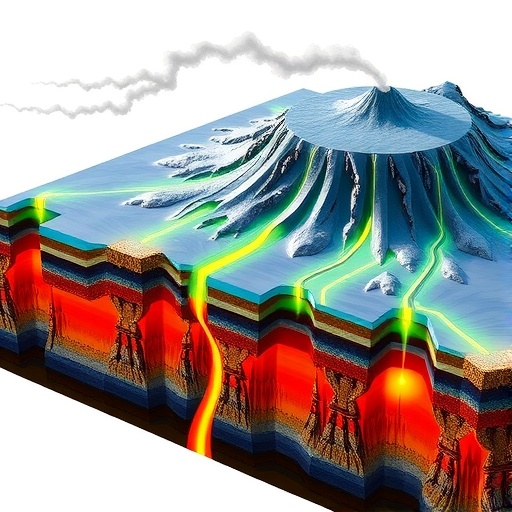
In a groundbreaking study poised to reshape our understanding of volcanic systems and carbon cycling, researchers have unveiled a novel mechanism by which carbonate-capped seamounts significantly enhance the ascent rate of carbon dioxide (CO2)-rich magmas in subduction zones. The findings, published in Nature Communications, highlight the intricate interactions between subducting seafloor topography and volatile-rich magma dynamics beneath volcanic arcs, offering fresh insights into both geophysical processes and climate implications.
Traditionally, subduction zones—where one tectonic plate dives beneath another—are known for generating arc volcanism through the melting of subducted oceanic crust and mantle wedge materials. Magmas ascending through these regions often contain varying amounts of volatiles, including water and CO2, which critically influence eruption style, magma viscosity, and gas release. However, the role of subducted seafloor relief, particularly carbonate-capped seamounts, in modulating these magmatic properties has remained elusive until now.
The research team, led by Huang et al., carried out an integrative approach combining geochemical analyses, seismic imaging, and advanced numerical modeling to investigate how carbonate-rich seamounts impact magma generation and ascent. Through these methods, they were able to simulate the subduction of topographically elevated, carbonate-laden features and observe their effect on volatile release and magma buoyancy in unprecedented detail.
One of the study’s core revelations is that carbonate caps on seamounts act as focused sources of CO2 during subduction. These carbonate layers, composed primarily of calcium carbonate and associated minerals, begin to thermally decompose at depths where the subducting slab heats up, releasing substantial amounts of CO2 into the overlying mantle wedge. This influx of CO2 lowers the mantle melting point and modifies the chemistry of ascending magmas, resulting in enhanced volatile concentration.
Furthermore, the liberated CO2 is implicated in creating overpressure zones that accelerate magma ascent rates. Normally, magmatic rise is controlled by a balance between buoyancy forces and resistance posed by the surrounding rock, but an increased volatile content—particularly from CO2—decreases magma density and viscosity. The study’s models show that the presence of CO2-rich fluids reduces this resistance, allowing magmas to reach the surface faster and with more volatiles preserved.
This acceleration of CO2-rich magma ascent may amplify both eruption explosivity and CO2 outgassing from arcs, with profound implications for volcanic hazards as well as for the global carbon cycle. Rapid magma rise limits the degassing of CO2 at depth, meaning more greenhouse gases can be released during eruptions, potentially influencing atmospheric composition over geological time scales.
Moreover, the spatially heterogeneous presence of carbonate-capped seamounts on the subducting plate may explain variations in magmatic composition and volatile output observed along arc volcanic chains worldwide. Regions underlain by such features might produce magmas with distinctly higher CO2 content and eruptive signatures compared to segments lacking these structures. This could be pivotal for volcanic hazard assessments and for interpreting geochemical proxies in volcanic rocks.
The researchers also emphasize the feedback mechanisms involved. As ascending CO2-rich magmas intrude into the crust, they may contribute to further carbonate dissolution, hydrothermal alteration, and metasomatism, processes that influence crustal rheology and fluid pathways, potentially facilitating subsequent volcanic activity. This complex interplay underscores the dynamic nature of subduction zone magmatism.
Seismic tomography data presented in the study corroborate the presence of anomalous zones of partial melt and volatile release above subducting seamounts, lending observational support to the modeling results. The integration of geophysical imaging with geochemical signatures strengthens the argument that topographic features on the slab significantly influence arc magmatism.
The implications of these findings extend beyond volcanology. Since subduction zones act as major conduits for carbon transfer from the surface to the deep Earth, understanding how carbonate-bearing seamounts modulate CO2 fluxes helps refine models of long-term carbon cycling. This knowledge contributes to better predictions of Earth’s carbon budget, volcanic gas emissions, and their impact on climate regulation through deep time.
Importantly, this research opens new avenues for volcanic monitoring. By pinpointing the subduction of carbonate-rich seamounts as a factor accelerating CO2-rich magma ascent, it becomes possible to identify volcanic systems at higher risk of explosive eruptions linked to elevated CO2. This could improve early warning systems and risk mitigation strategies in subduction zone regions.
Additionally, the study highlights the intricate linkage between tectonic processes—such as seafloor spreading that generates seamounts—and surface volcanic phenomena, bridging the gap between deep Earth dynamics and surface hazards. The integration of geological, geochemical, and geophysical data sets a new standard for multidisciplinary volcanology research.
Future work stemming from this study may include field investigations targeting carbonate-capped seamounts on incoming plates and detailed petrological studies of arc magmas from affected volcanoes. Such efforts will provide further granularity on how carbonate breakdown products impact magma chemistry and eruptive behavior, offering a richer picture of subduction zone processes.
In sum, Huang and colleagues provide compelling evidence that carbonate-capped seamount subduction acts as a catalyst for accelerating the ascent of CO2-rich arc magmas. This discovery challenges conventional views of volatile cycling and magma dynamics in subduction zones, underscoring the critical role of slab topography and carbonate chemistry in controlling volcanic gas emissions and eruption energetics.
As global concerns over volcanic hazards and climate change intensify, insights into the deep Earth mechanisms governing volatile fluxes from subduction zone volcanoes bear significant societal relevance. This pioneering study paves the way for a new era of integrated research linking tectonics, geochemistry, and volcanology to better comprehend—and potentially predict—Earth’s most dramatic natural phenomena.
Cite Scienmag News
Violet Maxwell. (May 25, 2026). Carbonate-Capped Seamounts Speed CO2-Rich Magma Ascent. Scienmag. https://scienmag.com/carbonate-capped-seamounts-speed-co2-rich-magma-ascent/
Violet Maxwell. "Carbonate-Capped Seamounts Speed CO2-Rich Magma Ascent." Scienmag, 25 May 2026, https://scienmag.com/carbonate-capped-seamounts-speed-co2-rich-magma-ascent/. Accessed 4 September 2026.
Violet Maxwell. "Carbonate-Capped Seamounts Speed CO2-Rich Magma Ascent." Scienmag. May 25, 2026. https://scienmag.com/carbonate-capped-seamounts-speed-co2-rich-magma-ascent/


