


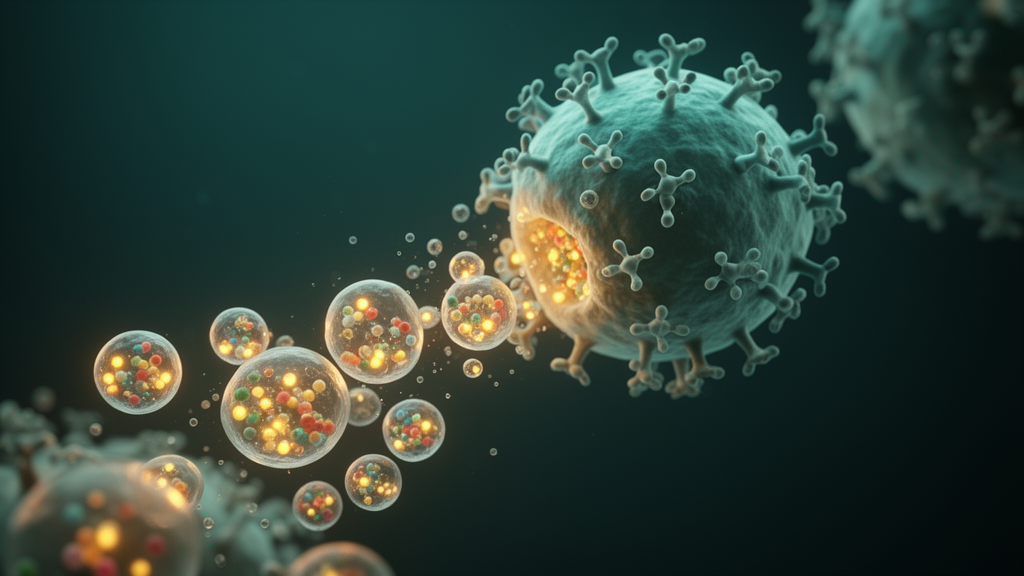
Neuroblastoma is the most common solid tumor of childhood outside the brain, and its most aggressive forms remain among the hardest pediatric cancers to treat. A new study published in Frontiers in Oncology adds a striking piece to the puzzle of how these tumors manipulate their surroundings: a single secreted glycoprotein, LGALS3BP, appears to be linked with a profound change in the molecular cargo carried by tumor-derived extracellular vesicles, the nanoscale packages that cancer cells use to communicate with neighboring tissues.
LGALS3BP, also known as galectin-3-binding protein or 90K, is a heavily glycosylated protein that circulates in the blood and coats the surface of vesicles released by many tumor types. Previous work from the same Italian research group, based at the University G. d’Annunzio of Chieti-Pescara, had shown that LGALS3BP is abundantly enriched on neuroblastoma-derived extracellular vesicles and that elevated levels correlate with increased metastatic potential in preclinical models. The team had also demonstrated that an antibody-drug conjugate targeting secreted LGALS3BP can boost lymphocyte infiltration into tumors and synergize with anti-PD-1 immunotherapy in mouse models of the disease.
In the new study, the researchers asked a more fundamental question: does the presence of LGALS3BP change what these vesicles actually carry? To find out, they exploited an unusual experimental asset. The patient-derived neuroblastoma cell line hNB, isolated from a non-MYCN-amplified tumor that had metastasized to the neck of a three-year-old patient, naturally lacks LGALS3BP expression entirely, at both the messenger RNA and protein levels. Using lentiviral gene delivery, the team created a matched counterpart that stably re-expresses the protein at levels comparable to SK-N-AS, a neuroblastoma line that naturally produces high amounts of LGALS3BP. The result was an isogenic pair of cell lines differing essentially only in LGALS3BP status, an ideal platform for isolating the protein’s effects.
The first set of experiments focused on the tumor microenvironment, the cellular ecosystem that surrounds a tumor and often determines whether it can grow and spread. High-risk neuroblastoma is notorious for its immunologically cold, poorly infiltrated microenvironment, which limits the effectiveness of current immunotherapies. As a representative stromal component, the researchers used bone marrow-derived mesenchymal stem cells, or BMMSCs, key players in the bone marrow niche where metastatic neuroblastoma often takes hold. When these stromal cells were exposed to conditioned medium from LGALS3BP-expressing tumor cells, a multiplex Luminex assay measuring thirty soluble mediators revealed a broad shift in their secretory profile, with increased release of inflammatory factors such as IL-6, IL-8, and TNF-alpha, myeloid-related cytokines including M-CSF and IL-10, and the angiogenic driver VEGF-A.
Validation by ELISA confirmed a statistically significant increase in VEGF and a parallel rise in IL-6, both well-established pro-tumorigenic factors. Importantly, these molecules were virtually undetectable in the tumor-conditioned media themselves, confirming that the stromal cells, not the cancer cells, were their source. The team also detected the mature, hyperglycosylated form of LGALS3BP, roughly 100 kilodaltons in size, inside the recipient BMMSCs after exposure to LGALS3BP-containing medium, and this signal dropped markedly when the anti-LGALS3BP therapeutic antibody 1959 was added. Purified vesicles from LGALS3BP-positive cells produced the same result, suggesting that tumor-derived extracellular LGALS3BP physically associates with stromal cells.
The heart of the study, however, lies in the molecular analysis of the vesicles themselves. Extracellular vesicles were isolated by differential ultracentrifugation from the culture supernatants of both cell lines and profiled for their microRNA content using TaqMan array cards covering 94 vesicular miRNAs. Thirty-three showed differential abundance between LGALS3BP-positive and control vesicles, with a clear predominance of upregulation in the LGALS3BP-containing vesicles. In the donor cells, by contrast, the pattern was reversed: among 118 profiled miRNAs, 29 were differentially expressed, mostly downregulated in LGALS3BP-expressing cells. Seven miRNAs stood out as simultaneously enriched in vesicles and depleted in the cells that released them, a signature consistent with preferential sorting into the vesicular compartment.
These seven candidates, including miR-26a-5p, miR-27b-3p, miR-29a-3p, miR-103a-3p, miR-152-3p, miR-340-5p, and miR-374b-5p, were validated by highly sensitive stem-loop RT-PCR. When BMMSCs were then incubated with fluorescently labeled vesicles, confocal microscopy confirmed that the vesicles interacted with the recipient cells, and four of the seven miRNAs, specifically miR-340-5p, miR-27b-3p, miR-103a-3p, and miR-152-3p, were detected at increased levels inside the stromal cells after exposure to LGALS3BP-positive vesicles. Notably, the remaining three did not rise in recipients despite their enrichment in the vesicles, a discrepancy the authors interpret as evidence that vesicular enrichment does not automatically translate into increased abundance in recipient cells, and that additional factors govern the fate of vesicle-associated miRNAs after uptake.
In silico analysis of public neuroblastoma datasets added clinical context. miR-27b and miR-340 were significantly upregulated in tumor samples compared with normal controls, and predicted targets of the enriched miRNAs include PPARG, a master regulator of adipogenic differentiation and mesenchymal plasticity, and DNMT1, a key epigenetic enzyme. Because PPAR-gamma is a validated target of miR-27b, the authors speculate that increased delivery of this miRNA to bone marrow stromal cells could alter adipogenic programs and push the stroma toward a more tumor-supportive, activated state. The picture is nuanced, however, since miR-27b, miR-340, and miR-103a have each been reported to act as either tumor suppressors or promoters depending on context, targeting molecules such as PD-L1 and PTEN.
Proteomic analysis by nanoLC-MS/MS of the same vesicle preparations revealed a parallel story at the protein level. LGALS3BP-positive vesicles were selectively enriched in RNA-binding proteins, notably members of the serine/arginine-rich splicing factor family, and the splicing factor SRSF1 was validated by western blotting as more abundant in LGALS3BP-positive vesicles than in control vesicles, with no corresponding difference in whole-cell lysates. This finding is particularly intriguing because SRSF1 has recently been implicated in the selective sorting of miRNAs into tumor-derived extracellular vesicles, and its vesicular form appeared to migrate at a different apparent molecular weight than the intracellular protein, hinting at distinct post-translational modifications or processing. Patient dataset analyses reinforced the clinical relevance: SRSF1 expression was significantly higher in high-risk than in non-high-risk neuroblastoma in the SEQC cohort, and high SRSF1 levels were associated with poorer overall survival in the Kocak cohort.
The authors are careful to frame these findings as associative rather than causal. The miRNA profiling was exploratory, without correction for multiple testing, and some results derive from a single experiment. Whether LGALS3BP physically interacts with RNA-binding proteins such as SRSF1, alters endosomal trafficking, or shapes vesicle biogenesis pathways remains unknown, and functional studies and in vivo validation will be needed to determine whether the enriched cargo genuinely drives stromal reprogramming, metastatic niche formation, or therapeutic resistance. Nevertheless, the study broadens the portfolio of LGALS3BP, already under development as a biomarker and antibody-drug conjugate target, by suggesting that the protein may act not only as a passenger on tumor vesicles but as a marker of a fundamentally altered cargo program, one that could reshape how the youngest cancer patients’ tumors talk to their surroundings.
Subject of Research: The association of LGALS3BP with altered microRNA and protein cargo in neuroblastoma-derived extracellular vesicles and stromal cell modulation
Article Title: LGALS3BP is associated with selective cargo enrichment in neuroblastoma extracellular vesicles
Article References: Cela, I., Konstantinidou, F., Amodei, L., Mercatelli, A., Piermatteo, F., Santoro, S., Pece, A., Staropoli, M. C., Lamolinara, A., Capone, E., Gatta, V., & Sala, G. (2026). LGALS3BP is associated with selective cargo enrichment in neuroblastoma extracellular vesicles. Frontiers in Oncology, 16, Article 1966526. https://doi.org/10.3389/fonc.2026.1966526
Image Credits: AI Generated
DOI: 10.3389/fonc.2026.1966526
Keywords: neuroblastoma, LGALS3BP, extracellular vesicles, tumor microenvironment, microRNA, SRSF1, mesenchymal stem cells, proteomics, pediatric cancer, biomarker, antibody-drug conjugate, tumor-stroma communication
Cite Scienmag News
Nathaniel Bowman. (October 16, 2026). Cancer Protein LGALS3BP Reshapes the Cargo of Neuroblastoma Extracellular Vesicles. Scienmag. https://scienmag.com/cancer-protein-lgals3bp-reshapes-the-cargo-of-neuroblastoma-extracellular-vesicles/
Nathaniel Bowman. "Cancer Protein LGALS3BP Reshapes the Cargo of Neuroblastoma Extracellular Vesicles." Scienmag, 16 October 2026, https://scienmag.com/cancer-protein-lgals3bp-reshapes-the-cargo-of-neuroblastoma-extracellular-vesicles/. Accessed 16 October 2026.
Nathaniel Bowman. "Cancer Protein LGALS3BP Reshapes the Cargo of Neuroblastoma Extracellular Vesicles." Scienmag. October 16, 2026. https://scienmag.com/cancer-protein-lgals3bp-reshapes-the-cargo-of-neuroblastoma-extracellular-vesicles/


