


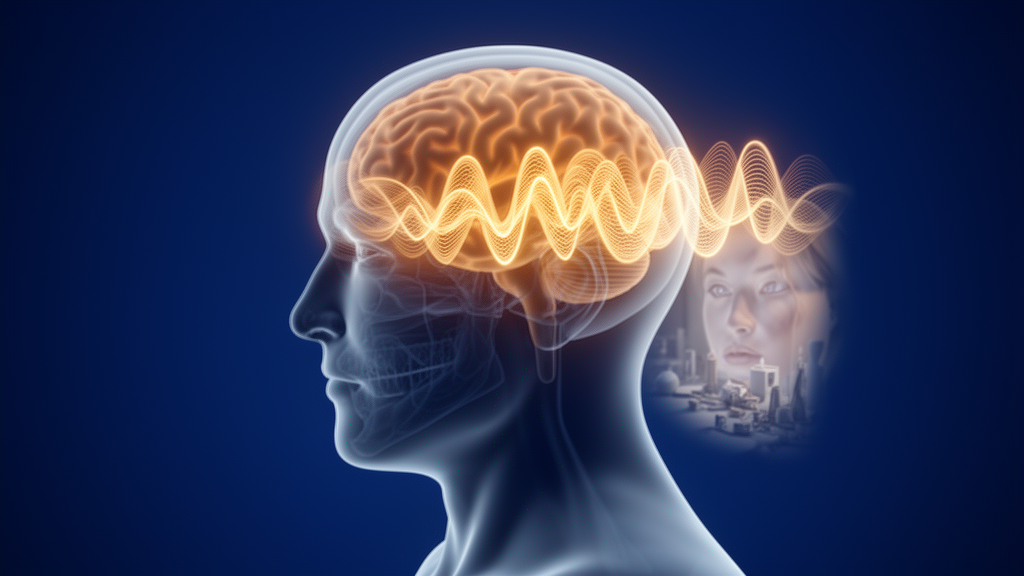
For more than a century, neuroscientists have suspected that perception is not the smooth, continuous stream it feels like. Now a new study offers some of the strongest neural evidence yet that the brain’s own rhythms actively shape how we see, even when the visual world in front of us never changes. In research published in the journal iScience, Michele Deodato and David Melcher of New York University Abu Dhabi show that the brain’s ability to represent visual information fluctuates rhythmically with the phase of alpha oscillations, the 8 to 13 hertz waves that sweep through the cortex roughly ten times per second. The finding suggests that seeing is not a steady process but one that pulses in time with the brain’s intrinsic electrical beat.
The question of whether perception is continuous or rhythmic has long divided the field. We experience vision as seamless, yet the brain must construct that experience from limited and noisy input. Sharp, color-rich vision is confined to the fovea, the tiny central region of the retina, and each eye carries a blind spot with no photoreceptors at all. To fill these gaps, the visual system stitches together fragments of information, and many researchers have argued that this stitching is organized by oscillations. Alpha rhythms, in particular, have been proposed to act as dynamic gates, opening and closing temporal windows during which sensory input is preferentially processed.
Previous support for this idea came mostly from brief, fleeting stimuli. Studies showed that the phase of pre-stimulus alpha oscillations could predict whether people detected phosphenes, illusory flashes, or near-threshold flashes, and whether they judged the timing and order of short visual events correctly. But these experiments had three major shortcomings. They relied on transient stimuli, limiting what they could say about natural, continuous vision. They focused almost exclusively on the phase before a stimulus appeared, leaving open whether rhythmic modulation persists during sustained input. And they typically measured perception through subjective reports, which can be contaminated by decision-making factors rather than reflecting genuine neural processing.
Deodato and Melcher designed their study to overcome all three limitations at once. Twenty-two participants viewed Gabor patches, striped circular patterns that varied in orientation and spatial frequency, for a full two seconds each. Crucially, the Gabors were entirely irrelevant to the task: participants judged whether a brief flash and tone, delivered afterward, appeared synchronous or asynchronous. This design kept fixation stable and attention engaged elsewhere, allowing the researchers to examine how the brain processes visual information that no one is deliberately watching. Electroencephalography recorded brain activity from 64 scalp electrodes at a sampling rate of 1,000 hertz, while an eye tracker monitored gaze to rule out artifacts from eye movements.
The first step was to establish that continuous, unattended stimuli produce robust neural representations at all. Using time-resolved multivariate pattern analysis, the team trained a linear discriminant analysis classifier to read out stimulus features from EEG topographies at every millisecond of the trial. Decoding accuracy for orientation peaked at 86.5 percent around 100 milliseconds after stimulus onset, then fell back to chance. Spatial frequency decoding peaked at 54.7 percent and, remarkably, remained significantly above chance for the entire two-second presentation, decaying exponentially from an early encoding stage into a later maintenance stage. Control analyses confirmed that this sustained decoding was not driven by eye movements or microsaccades: decoding from eye-position data alone yielded nothing, and microsaccade rates did not differ between stimulus conditions.
With sustained representations established, the researchers asked their central question: does the quality of these representations fluctuate with the alpha cycle? Their novel phase-dependent decoding approach works by sampling EEG data at specific points within the oscillatory cycle. For each trial, they identified moments when the instantaneous alpha phase, extracted via the Hilbert transform from band-pass-filtered signals, matched a target angle such as the peak or the trough, then averaged voltage maps around those timestamps to boost signal quality. Classifiers were then trained on these phase-locked maps. The analysis focused on a late window, from 1,000 to 2,000 milliseconds after onset, when transient onset-related activity had long subsided and alpha phase estimation was no longer compromised by stimulus-evoked desynchronization.
The results were striking. Over posterior sensors near the parietal and occipital cortex, spatial frequency was decoded significantly more accurately at the alpha trough than at the peak, a difference that was statistically robust and specific to the alpha band, since no such effect appeared when the phase of theta oscillations was used instead. Frontal electrodes showed the opposite pattern, with better decoding at the alpha peak. When the researchers sampled data at random phases, accuracy fell in between, and the poorly decoded phase was no worse than the random condition, indicating that the effect is driven by enhancement at favorable phases rather than suppression at unfavorable ones. Fitting a harmonic regression across 18 equally spaced phase bins revealed smooth, unimodal tuning curves, with the model explaining a substantial portion of variance across the scalp, a mean R-squared of 0.57, and an average modulation amplitude of about 1.5 percent in decoding accuracy.
What does this rhythmic modulation mean for the neural code itself? Temporal generalization analyses showed that discriminative information generalized across the entire alpha cycle, and cross-decoding between phase-locked and time-locked data revealed that classifiers trained at the preferred phase generalized to earlier time points in the stimulus-locked record. This suggests a shared representational structure whose expression waxes and wanes with oscillatory phase, rather than a qualitative reorganization of what the brain encodes. In other words, alpha phase does not change what is represented; it changes how strongly and how accessibly that representation is expressed, a periodic reactivation of a stable pattern. Interestingly, the effect appeared only for spatial frequency and not for orientation, leaving open whether other visual features are modulated the same way.
The opposing phase relationships at frontal and posterior sites raised the possibility of two interacting brain sources. To probe this, the team computed the phase relationship between every pair of significant anterior-posterior channels. Circular statistics showed that 88.5 percent of the 243 channel pairs clustered tightly around a 180-degree offset, meaning the frontal and posterior signals were nearly perfectly anti-phase. Yet the phase-slope index, a measure of directed information flow that is robust to volume conduction, was not significantly different from zero, suggesting no actual communication between the two regions. Source reconstruction pointed to overlapping cortical generators with opposite orientations, consistent with a common occipito-parietal alpha source whose apparent polarity flips across the cycle, though the authors caution that scalp EEG’s limited spatial resolution cannot fully exclude more complex network dynamics.
Beyond settling a long-standing theoretical debate, the work carries practical implications. The idea that perception is rhythmically modulated traces back to mid-twentieth-century proposals such as Pitts and McCulloch’s cortical scanning theory, and more recently to the framework of rhythmic perception, which holds that certain phases of brain rhythms promote efficient sensory processing while others impair it. Importantly, this rhythmicity does not imply that perception comes in discrete, frame-like snapshots; rather, continuous fluctuations in neural excitability modulate the fidelity of sensory information over time. Because the stimuli in this study were task-irrelevant, the effects are unlikely to reflect rhythmic attentional sampling, which is typically linked to slower theta rhythms, and may instead reflect intrinsic periodic changes in cortical excitability, possibly tied to the balance of synaptic excitation and inhibition or to the differential engagement of magnocellular and parvocellular visual pathways. The phase-dependent decoding technique itself is also a flexible new tool, and the authors highlight its promise for brain-computer interfaces, where timing decoding to optimal oscillatory phases could significantly boost performance. Not all moments in the EEG signal are equally informative, and knowing when to read the brain may matter as much as knowing how.
Subject of Research: Phase-dependent EEG decoding of continuous visual stimuli and alpha oscillations
Article Title: Phase-dependent EEG decoding of continuous visual stimuli
Article References: Phase-dependent EEG decoding of continuous visual stimuli. (n.d.). https://doi.org/10.1016/j.isci.2026.117870
Image Credits: AI Generated
DOI: Not provided
Keywords: alpha oscillations, EEG decoding, visual perception, neural oscillations, spatial frequency, multivariate pattern analysis, rhythmic perception, brain rhythms, continuous stimuli, attention, brain-computer interface, occipital cortex
Cite Scienmag News
Cassandra Pierce. (October 16, 2026). Brain Rhythms Shape How We See: Alpha Waves Gate Vision in Real Time. Scienmag. https://scienmag.com/brain-rhythms-shape-how-we-see-alpha-waves-gate-vision-in-real-time/
Cassandra Pierce. "Brain Rhythms Shape How We See: Alpha Waves Gate Vision in Real Time." Scienmag, 16 October 2026, https://scienmag.com/brain-rhythms-shape-how-we-see-alpha-waves-gate-vision-in-real-time/. Accessed 16 October 2026.
Cassandra Pierce. "Brain Rhythms Shape How We See: Alpha Waves Gate Vision in Real Time." Scienmag. October 16, 2026. https://scienmag.com/brain-rhythms-shape-how-we-see-alpha-waves-gate-vision-in-real-time/


