


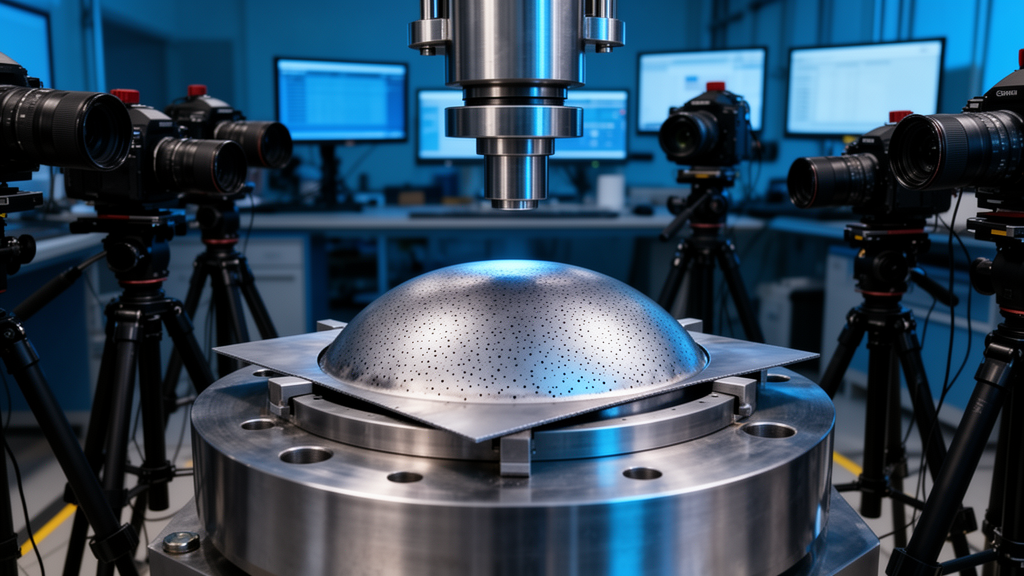
In the unforgiving world of automotive manufacturing, advanced high-strength steels have become the quiet heroes of vehicle construction. Alloys such as QP980 and TRIP590 deliver the strength and elongation properties that modern crash regulations and fuel-efficiency targets demand, without adding unwanted weight. Yet these steels must be shaped into structural components by stamping, a process whose economics hinge on something deceptively simple: how the sheet slides over the steel tooling that bends it. Now a research team has put computer vision itself to the test, pitting five image-tracking algorithms against one another to determine which can best measure the local kinematics of a bending steel strip at the exact point where metal meets die.
The study, published in Results in Engineering by Gonzalo Cerezo-Calle, Javier Guilabert-Martinez, Luis M. Jimenez-Garcia, Miguel Angel Selles Canto and Carlos Perez-Vidal, tackles a long-standing blind spot in experimental mechanics. Digital image correlation, or DIC, has been the gold standard for non-contact measurement of displacement and strain since the early 1980s, delivering full-field kinematic data with subpixel accuracy. But DIC carries implicit assumptions: a stable, information-rich surface texture, adequate contrast, continuous visibility of tracked regions, and consistent illumination. In the controlled calm of a standard tensile test these conditions are easily met. In a forming operation dominated by contact and friction, they can quietly collapse.
The researchers chose the bending-under-tension, or BUT, test as their proving ground. This simplified model of the stamping process, first proposed by Wilson and Saha, pulls a strip specimen over a pin using two linear actuators, one of which remains locked while the other drags the strip at a fixed velocity. As the strip bends over the pin, friction arises across the contact surface, and the interplay between tensile loading, bending and sliding reproduces the critical conditions found at die and punch corners in industrial presses. It is precisely in this zone that engineers most want to know what the material is doing, and precisely where optical measurement becomes hardest: large strain gradients, localized sliding and progressive surface deformation conspire against any tracking algorithm.
The experimental platform was a sheet metal forming simulator instrumented with two load cells, two incremental linear transducers and two rotary sensors, feeding signals through an HBM QuantumX MX840 amplifier. Specimens of QP980 and TRIP580 steels, both 1 millimeter thick, were speckled with a high-contrast random pattern and tested across a deliberately broad matrix of conditions: tensile velocities of 3, 7 and 15 millimeters per second, contact angles of 30, 45 and 60 degrees, pin diameters from 19 to 26 millimeters, and dry, liquid and solid lubrication. A monochrome industrial camera equipped with a Sony IMX178 CMOS sensor recorded the contact region at 2560 by 1920 pixels and 30 frames per second, its fixed 25-millimeter lens chosen to balance field of view against geometric distortion.
Against this backdrop, the team compared two fundamentally different families of tracking. Lucas-Kanade optical flow, the classical subpixel reference, estimates motion through local photometric consistency between consecutive frames, solving a weighted least-squares problem that assumes brightness remains constant as a point moves. Feature-based methods work differently: detectors find distinctive keypoints in each frame and descriptors characterize them, so correspondences are established by matching. The team selected four representatives chosen for their contrasting trade-offs between computational cost and robustness: ORB with its efficient binary descriptors, KAZE and its accelerated AKAZE-MLDB variant built on a nonlinear diffusion scale space that preserves edges while smoothing uniform regions, and SIFT, the venerable scale-invariant standard, whose perspective tolerance was expected to help on a specimen curving away from the camera.
The study’s methodological novelty lies in imposing absolute fairness. Every algorithm operated on the same masked working region, with keypoints distributed through six parallel bands to prevent clustering, and identical validation filters: a ratio test on descriptor distances, limits on frame-to-frame displacement calibrated to test velocity, and RANSAC-based affine estimation with a 3-pixel reprojection threshold to discard outliers. Crucially, the feature-based methods re-detected keypoints unconditionally in every frame, matching against the immediately preceding image, while Lucas-Kanade propagated a single cohort of Shi-Tomasi corners detected once at the start. The feature-based population could therefore renew itself indefinitely, whereas the LK population could only shrink, an asymmetry the authors took care to acknowledge when interpreting their results.
The outcome was nuanced rather than a clean victory. Across all repeated tests on both steels, Lucas-Kanade and AKAZE-MLDB achieved the highest effective tracking density, with LK also posting the lowest inter-frame variability of the point population, around 0.15 percent, and the smoothest velocity fields. Its variance of velocity magnitude was orders of magnitude below that of ORB, which showed the most fragmented and heterogeneous motion fields, while SIFT produced clean but sparse measurements, constrained by a mean of barely 200 valid correspondences per frame. The authors were careful, however, to note that LK’s smoother fields partly reflect genuine Lagrangian consistency, since tracking the same physical points naturally reveals coherent advection of the surface pattern, whereas continuously re-detected points represent a fresh sample of each region of interest every frame.
Two independent checks anchored the optical measurements to mechanical reality. First, the mean longitudinal velocity measured optically in a region upstream of the contact was compared with the signal from an incremental encoder on the test bench. During the initial seconds the encoder returned anomalous, even negative velocities, consistent with transient loss of contact at its instrumented wheel, while the camera-based signal remained physically coherent throughout. Once the encoder stabilized after about 4.5 seconds, agreement between the two was excellent: a mean absolute error of 0.189 millimeters per second, a root-mean-square error of 0.209 millimeters per second, and a Pearson correlation of 0.970. Second, strain estimated from the velocity difference between two automatically defined regions of interest was combined with the force recorded by the pulling cylinder to construct a stress-strain curve that showed the smooth, monotonic response expected of advanced high-strength steel under the test’s combined tension, bending and friction.
The team also confronted a geometric subtlety inherent to the test itself: because the strip conforms to the cylindrical pin, displacements measured in the camera’s flat image plane are projections of curvilinear trajectories. A curvature-correction model showed that even in the worst configuration, a 26.1-millimeter pin at a 60-degree contact angle, the discrepancy amounted to roughly 0.33 millimeters, about 4 to 5 percent of the contact-zone extent, small enough to fall below the experimental uncertainty of the correlation method. This finding validated the choice of a simple monocular two-dimensional system over a stereoscopic rig, avoiding costly calibration and synchronization complexity when the goal is longitudinal displacement and relative strain along the tensile direction.
The broader lesson resonates well beyond a single laboratory. In manufacturing environments where scrap rates, energy consumption and press lifetime hang on precise friction control, the ability to extract reliable local kinematics from a camera alone, without touching the specimen or depending on contact-based sensors, opens a practical path to understanding and optimizing forming operations. The results suggest that algorithm selection should be guided by engineering intent: Lucas-Kanade as a high-precision reference when imaging conditions cooperate, and re-detecting methods such as KAZE and MLDB when robustness and continuous spatial coverage matter most. The authors caution that their rankings apply specifically to the BUT configurations studied, but the framework they have built, combining homogeneous algorithm comparison, geometrically automated regions of interest, and validation against independent mechanical references, offers a rigorous template for bringing computer vision into the demanding, contact-dominated world of sheet metal forming.
Subject of Research: Comparative evaluation of feature-based tracking and Lucas-Kanade optical flow for local kinematic measurement in bending-under-tension tests of advanced high-strength steels
Article Title: Feature-based tracking with keypoint re-detection for local kinematic measurement in bending-under-tension tests: A comparative study with Lucas-Kanade optical flow
Article References: Feature-based tracking with keypoint re-detection for local kinematic measurement in bending-under-tension tests: A comparative study with Lucas-Kanade optical flow. (n.d.). https://doi.org/10.1016/j.rineng.2026.113298
Image Credits: AI Generated
DOI: Not provided
Keywords: digital image correlation, Lucas-Kanade optical flow, bending-under-tension test, advanced high-strength steel, sheet metal forming, computer vision, keypoint detection, friction measurement, QP980, TRIP590, encoder validation, feature tracking
Cite Scienmag News
Denise Maddox. (October 16, 2026). Teaching Machines to Watch Steel Bend: Tracking Algorithms Face Off in Sheet-Forming Tests. Scienmag. https://scienmag.com/teaching-machines-to-watch-steel-bend-tracking-algorithms-face-off-in-sheet-forming-tests/
Denise Maddox. "Teaching Machines to Watch Steel Bend: Tracking Algorithms Face Off in Sheet-Forming Tests." Scienmag, 16 October 2026, https://scienmag.com/teaching-machines-to-watch-steel-bend-tracking-algorithms-face-off-in-sheet-forming-tests/. Accessed 16 October 2026.
Denise Maddox. "Teaching Machines to Watch Steel Bend: Tracking Algorithms Face Off in Sheet-Forming Tests." Scienmag. October 16, 2026. https://scienmag.com/teaching-machines-to-watch-steel-bend-tracking-algorithms-face-off-in-sheet-forming-tests/


