


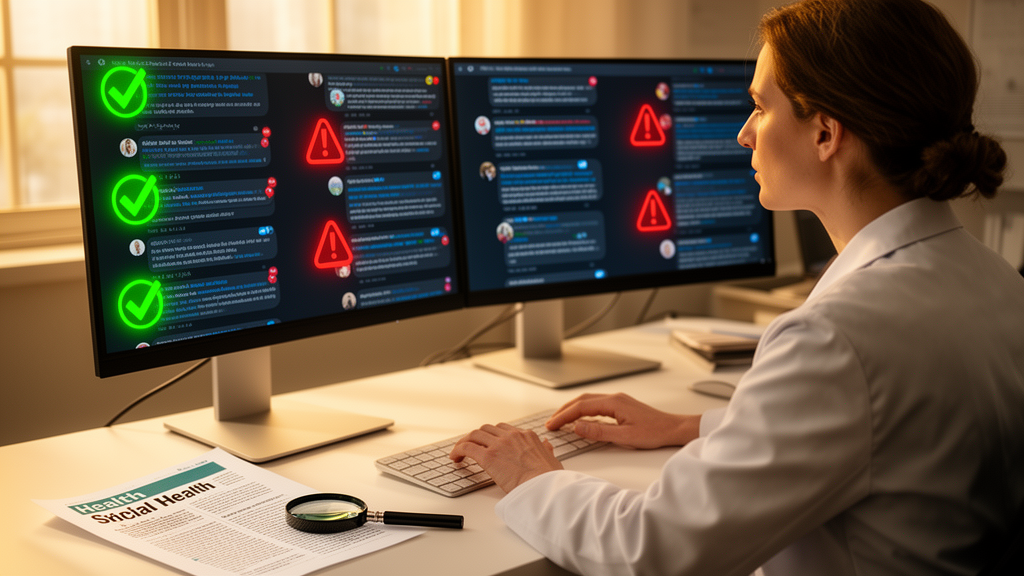
Health misinformation spreads faster than most public health systems can react, and the tools built to catch it are far more fragile than their marketing suggests. A new systematic review published in Frontiers in Big Data has mapped, with unusual candor, what actually works and what fails when researchers deploy big data analytics and sentiment analysis against false health claims online. The verdict is sobering: the emotional tone of a post tells you almost nothing about whether it is true, and the most sophisticated detection systems still collapse under the weight of bad data, biased algorithms, and institutions that cannot keep up.
The review, led by Khurram Shahzad of Government College University in Lahore with collaborators from Alfaisal University, Prince Sultan University, and the University of Salford, screened 3,280 records pulled from eleven databases including Scopus, Web of Science, PubMed, and MEDLINE. After removing duplicates, ineligible studies, and non-English publications, only thirty peer-reviewed articles and conference proceedings survived the full-text gauntlet. The team followed PRISMA 2020 guidelines, registered the protocol on the Open Science Framework, and applied a ten-item CASP-informed quality appraisal to each surviving study, with inter-rater agreement checked using Cohen’s Kappa. The result is less a triumphal catalog of AI successes than a field guide to the gap between laboratory performance and real-world deployment.
The central technical finding concerns sentiment analysis itself. Sentiment analysis classifies the emotional polarity, attitudes, and opinions expressed in text, whereas misinformation detection asks whether a claim is factually accurate or misleading. These are fundamentally different tasks, and the review is emphatic that conflating them is a methodological trap. A false claim about a vaccine can be written in cheerful, confident language; a genuine warning about a drug interaction can sound alarming and negative. Both factual and misleading health information may carry positive or negative sentiment, which means emotional polarity alone cannot establish truthfulness. The authors position sentiment-derived signals as an auxiliary feature that must be combined with contextual semantics, source credibility, behavioral patterns, temporal information, and evidence-based verification before any judgment about accuracy can be made.
What does move the needle, according to the synthesis, is a cluster of five enabling factors. Advanced deep learning architectures, including transformer models and large language models, provide contextual reasoning that older lexical and statistical approaches cannot match. Feature engineering, the craft of extracting sentiment scores, named entities, health-specific lexicons, and semantic representations from raw text, remains foundational; high-quality data improved classification performance across transformer-based and machine learning frameworks alike. Real-time analytics, powered by cloud infrastructure and streaming pipelines, allow systems to flag emerging misinformation narratives during fast-moving public health events rather than cataloging them after the fact. And human-centered verification, where domain experts review automated outputs before they inform decisions, emerged as a critical safeguard against the unsupported inferences that even state-of-the-art models confidently produce.
The challenges side of the ledger is equally detailed. Annotation limitations top the list: high-quality labeled health misinformation datasets are scarce, manual annotation struggles to keep pace with rapidly evolving narratives, and inconsistencies between annotators degrade model training. Sampling and algorithmic biases can skew sentiment estimates derived from social media data, reducing the representativeness of any downstream detection system. Informal language, slang, emojis, and code-switching complicate processing, particularly in non-English settings, and mixed or neutral sentiments increase misclassification risk. These are not peripheral annoyances; they strike at the training data on which every detection model depends.
Scalability constraints form the second major barrier. Large language models demand substantial memory and processing power, real-time analytics introduce latency trade-offs between speed and accuracy, and cloud-based deployments carry infrastructure costs and external dependencies that many health systems cannot sustain. During health emergencies, when misinformation volumes spike, resource requirements can overwhelm the very systems meant to respond. Domain adaptation compounds the problem: models trained on one misinformation context lose accuracy when applied to different health topics, populations, or linguistic environments, and distinguishing misinformation from legitimate expressions of psychological distress remains contextually fraught.
Ethical and sustainability concerns round out the picture. Analyzing sensitive patient-generated and mental health data raises privacy questions that current governance frameworks do not consistently answer. Unreliable automated reasoning, hallucinated outputs from large language models, and inadequate external knowledge sources erode trust in AI-based detection. Cyber-security vulnerabilities, algorithmic bias in public health decision-making, and the absence of comprehensive infodemic surveillance frameworks all constrain long-term adoption. The review notes that operational integration into existing healthcare systems, coordination among healthcare decision-makers, policymakers, and technical teams, and cross-platform consistency remain unsolved organizational problems rather than purely technical ones.
From this synthesis the authors derive a five-component conceptual framework: a multi-source data acquisition layer to capture heterogeneous health information across social media, news portals, healthcare repositories, and IoT-enabled systems; an intelligent data management system handling cleaning, normalization, multilingual processing, and feature engineering; an AI-driven analytical engine integrating deep learning, sentiment signals, knowledge graphs, and real-time analytics; a human validation layer incorporating explainable AI, evidence retrieval, and expert oversight; and adaptive governance covering ethics, privacy, bias mitigation, regulatory compliance, and continuous model updating. The components are interdependent rather than sequential, and the authors are explicit that the framework is evidence-informed but not empirically validated; its effectiveness awaits prototype implementation and field testing.
One of the review’s more consequential observations is that data quality may matter as much as, or more than, algorithmic sophistication. Recent studies reporting strong performance from deep learning and LLM-based architectures still depend on representative, balanced, accurately annotated, domain-specific datasets. Increasing model complexity cannot compensate for weaknesses in annotation, contextual representation, or domain adaptation. This challenges a purely technology-centered reading of the misinformation problem and suggests that future research should prioritize computationally efficient, context-adaptive approaches over raw predictive performance, especially in healthcare settings with limited resources.
The review also documents a clear historical shift in the field. Earlier studies emphasized linguistic, statistical, and behavioral features for classification, while recent work increasingly employs BERT, transformer models, and large language models with retrieval-augmented generation for evidence-grounded analysis. Detection itself has moved from static classification of already-disseminated content toward streaming analytics, continuous surveillance, anomaly detection, and predictive assessment, a shift particularly relevant during health emergencies when narratives mutate rapidly. The authors caution that real-time capability is an operational requirement to be balanced against scalability and resource constraints, not an inherent marker of system superiority. For policymakers and health officials, the practical message is blunt: investing in advanced analytics without matching investment in datasets, human expertise, verification workflows, and governance will produce systems that look impressive in benchmarks and fail when it matters.
Subject of Research: Big data analytics and sentiment analysis for detecting health misinformation on social media
Article Title: Big data analytics and sentiment analysis for health misinformation detection: a systematic literature review of influencing factors, implementation challenges and a data-driven adoption framework
Article References: Shahzad, K., Javeed, A. M. D., Ahmad, S., Latif, M., & Saleem, K. (2026). Big data analytics and sentiment analysis for health misinformation detection: a systematic literature review of influencing factors, implementation challenges and a data-driven adoption framework. Frontiers in Big Data, 9, Article 1948398. https://doi.org/10.3389/fdata.2026.1948398
Image Credits: AI Generated
DOI: 10.3389/fdata.2026.1948398
Keywords: health misinformation, big data analytics, sentiment analysis, systematic literature review, deep learning, large language models, real-time analytics, human verification, data quality, AI ethics, public health surveillance, Frontiers in Big Data
Cite Scienmag News
Denise Maddox. (October 16, 2026). AI Sentiment Analysis Alone Cannot Tell Truth From Health Misinformation, Major Review Finds. Scienmag. https://scienmag.com/ai-sentiment-analysis-alone-cannot-tell-truth-from-health-misinformation-major-review-finds/
Denise Maddox. "AI Sentiment Analysis Alone Cannot Tell Truth From Health Misinformation, Major Review Finds." Scienmag, 16 October 2026, https://scienmag.com/ai-sentiment-analysis-alone-cannot-tell-truth-from-health-misinformation-major-review-finds/. Accessed 16 October 2026.
Denise Maddox. "AI Sentiment Analysis Alone Cannot Tell Truth From Health Misinformation, Major Review Finds." Scienmag. October 16, 2026. https://scienmag.com/ai-sentiment-analysis-alone-cannot-tell-truth-from-health-misinformation-major-review-finds/


