


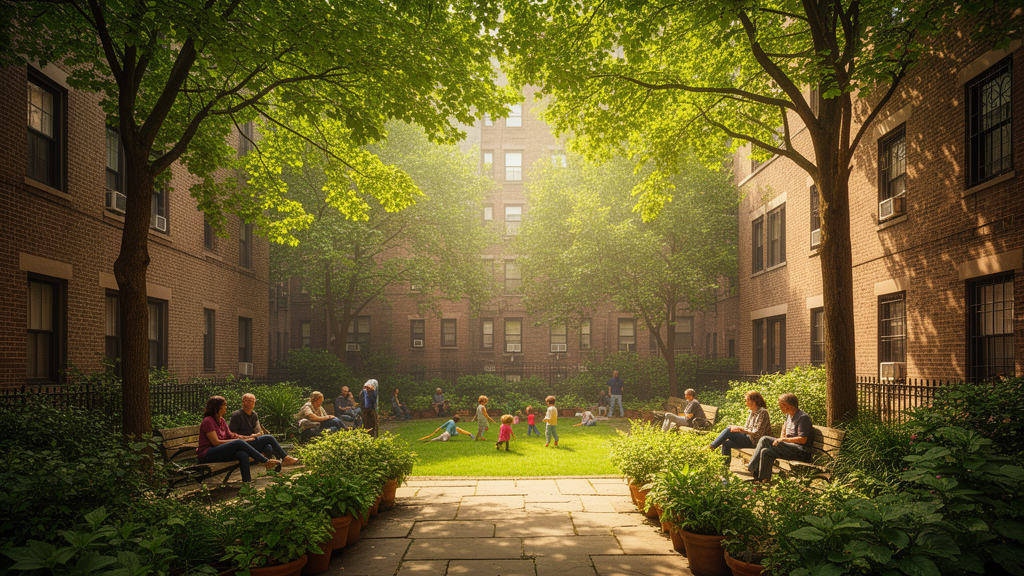
Every morning, millions of city dwellers step out of their front doors into a landscape that urban science has largely ignored: the shared greenery surrounding apartment blocks. A new Perspective published in Discover Sustainability argues that this overlooked layer of the city — the courtyards, lawns, and planted margins embedded in residential developments — constitutes an underused form of preventive health and sustainability infrastructure, one whose potential has been systematically underestimated by planners, researchers, and housing managers alike.
The research team, led by Frederike Büttner and Ina Säumel with colleagues from institutions across Berlin and Germany, draws a crucial conceptual distinction at the heart of their argument. Residential greenness, they write, is an exposure — a quantity of vegetation measured from satellites and captured in epidemiological indicators such as normalized difference vegetation index values and spatial buffers. Residential greenery, by contrast, is a place: a lived, designed, and managed environment where people actually spend time. The authors define it as green space in the immediate surroundings of residential buildings, created as part of the housing development itself — semi-public everyday spaces situated between private gardens and municipal parks. It is this second category, they contend, that urban health and sustainability governance has treated as a blind spot.
The scale of that blind spot is considerable. In Berlin, the researchers estimate that semi-public residential greenery associated with multi-storey housing covers roughly 43.6 million square meters — comparable in magnitude to the city’s 53.8 million square meters of public green space and exceeding both its 31.6 million square meters of public parks and its 28.8 million square meters of allotment gardens. International figures reinforce the pattern: residential yards have been estimated to occupy about 23 percent of urban area in Great Britain and up to 36 percent in Dunedin, New Zealand. Although these estimates largely concern private yards and are not directly comparable, they underscore how much of the urban green fabric lies immediately around people’s homes rather than in celebrated parks and flagship projects.
Why has such a vast resource escaped strategic attention? The authors trace the answer through more than a century of planning history. During the Wilhelminian period from 1870 to 1918, economic efficiency and rapid urban expansion outweighed health considerations, producing dense perimeter blocks with narrow courtyards that served circulation, storage, and light provision rather than recreation. Early twentieth-century housing cooperatives introduced setbacks and semi-open blocks, creating courtyards visible from the street — an early shift toward shared green space for hygiene and social purposes. After World War I, modernist planners embraced light, air, and sun, weaving tenant gardens, communal lawns, playgrounds, and seating into housing estates. By the 1960s, designers sought urbanity through density, embedding high-rise buildings within expansive open landscapes on the assumption that sheer quantity of open space would automatically improve living conditions.
That assumption failed in practice. Shading, lack of spatial differentiation, and long implementation phases often rendered these spaces unusable; residents described the experience as sitting on a plate. By the mid-1980s, only approximately 30 percent of open spaces in such estates were considered truly usable, while around 70 percent were occupied by infrastructure, distance zones, or garages. The lesson, the authors argue, is that planning intentions and health-promoting outcomes do not necessarily coincide. The landscapes inherited from each era are path-dependent: historical decisions established durable relationships between buildings and open space that continue to shape accessibility, ecological quality, and opportunities for well-being today, interacting with ownership structures, maintenance budgets, and established management routines.
The health relevance of these spaces lies not simply in the presence of vegetation but in how spatial, ecological, and social qualities interact with residents’ daily lives. Residential greenery may influence health through multiple interacting pathways: reducing environmental harms, restoring psychological and physiological capacities, and building capacity through physical activity and social interaction. The Berlin evidence base — field surveys and resident interviews across multi-storey housing typologies — shows these functions vividly. Before the pandemic, residents primarily valued their courtyards for tranquility and passive restoration. During lockdowns, the same spaces became sites of physical activity, social interaction, and neighborhood support. One resident put it plainly: during lockdown, this was the only place where I could meet other people. For older and less mobile residents, regular visual contact with vegetation from windows proved especially important, while vegetation quality and opportunities for recreation emerged as the most valued attributes across all groups.
The pandemic, the authors argue, did not create the health relevance of residential greenery — it exposed a function that had long been overlooked. Yet management practices in the studied estates remained oriented toward maintenance efficiency rather than explicit health outcomes, and such priorities may also underrecognize ecological functions. Independent research on shared residential yards shows that larger potentially vegetated areas and lower maintenance intensity can support greater wild-plant richness and diversity, demonstrating that seemingly ordinary residential open spaces can constitute significant components of urban biodiversity infrastructure. Vegetation structure and management also influence ecosystem services and potential disservices, including exposure to highly allergenic species — a reminder that greening decisions carry biological consequences in both directions.
Co-creation workshops in Berlin’s Marzahn-Hellersdorf high-rise estates reveal how differently residents and institutions can value the same ground. Participatory processes surfaced needs only partially reflected in existing management practices. One participant’s remark captures the shift: I don’t need another big park. I need greenery I can use every day. Where suggestions before 2018 focused primarily on tidiness and maintenance, discussions in 2021 showed a clear movement toward biodiversity, ecological quality, and multifunctional green spaces — though the authors caution this cannot be attributed to the co-creation process alone, as broader societal attention to biodiversity and the pandemic’s exceptional circumstances likely played roles. Competing expectations, such as quiet retreat versus active recreation or naturalistic versus manicured landscapes, highlighted that residential greenery is not a neutral space but a site where different visions of well-being must be negotiated. Historical accounts from Leningrad courtyards, tenement houses in Buenos Aires, and New York City public housing echo the same theme: shared open spaces become social tissue through residents’ practices, encounters, and place attachment — the collective green living room that the authors propose as a reframing concept.
The authors propose an adaptive governance approach to close the gap between potential and practice, combining co-diagnosis of existing conditions, co-creation with residents, implementation of nature-based solutions such as biodiversity-friendly planting, bioswales, resident gardening plots, and shaded seating, and continuous monitoring and learning. They view these steps not primarily as technical interventions but as mechanisms for recognizing residential greenery as urban health infrastructure. Housing providers occupy a pivotal position, but municipalities, public-health authorities, planners, landscape professionals, local organizations, and residents all have complementary roles. Emerging evidence suggests that resident willingness alone is insufficient where access arrangements, responsibilities, communication, and long-term organizational support remain unclear — governance, in other words, becomes part of the infrastructure itself.
The authors are careful not to promise costless transformation. Compact-city densification can conflict with green-space preservation, and in residential environments the tension is particularly tangible because shared greenery represents both potentially developable land and everyday space providing health, ecological, and social functions. Multifunctionality itself involves trade-offs, as biodiversity, recreation, climate adaptation, perceived tidiness, and cost-efficient maintenance do not necessarily favor identical interventions. In rental housing, some maintenance costs may ultimately be borne by tenants, while some biodiversity-sensitive practices may reduce recurrent costs. Environmental justice, the authors stress, is not an automatic outcome of greening but a criterion by which the transition should be assessed: residents already exposed to multiple burdens often have less access to high-quality green space despite potentially benefiting most, and residential greening can become entangled with real-estate valorization and green grabbing. The future of healthy and equitable cities, the Perspective concludes, may depend less on spectacular green interventions than on the quality of the everyday landscapes outside people’s front doors — a matter not simply of better design, but of environmental justice, social resilience, public health, and sustainable urban futures.
Subject of Research: The role of shared residential greenery around multi-storey housing as preventive health and sustainability infrastructure
Article Title: Residential greenery as an overlooked preventive health and sustainability infrastructure
Article References: Büttner, F., Sanft, S., Mohr-Stockinger, S., Butenschön, S., & Säumel, I. (2026). Residential greenery as an overlooked preventive health and sustainability infrastructure. Discover Sustainability, 7(1), Article 1719. https://doi.org/10.1007/s43621-026-05022-7
Image Credits: AI Generated
DOI: 10.1007/s43621-026-05022-7
Keywords: residential greenery, urban green space, preventive health, environmental justice, urban biodiversity, co-creation, adaptive governance, housing estates, green living room, Berlin, urban planning, sustainability
Cite Scienmag News
Violet Maxwell. (October 16, 2026). The Courtyard Effect: Why the Green Outside Your Door May Be Urban Health’s Sleeping Giant. Scienmag. https://scienmag.com/the-courtyard-effect-why-the-green-outside-your-door-may-be-urban-healths-sleeping-giant/
Violet Maxwell. "The Courtyard Effect: Why the Green Outside Your Door May Be Urban Health’s Sleeping Giant." Scienmag, 16 October 2026, https://scienmag.com/the-courtyard-effect-why-the-green-outside-your-door-may-be-urban-healths-sleeping-giant/. Accessed 16 October 2026.
Violet Maxwell. "The Courtyard Effect: Why the Green Outside Your Door May Be Urban Health’s Sleeping Giant." Scienmag. October 16, 2026. https://scienmag.com/the-courtyard-effect-why-the-green-outside-your-door-may-be-urban-healths-sleeping-giant/


