


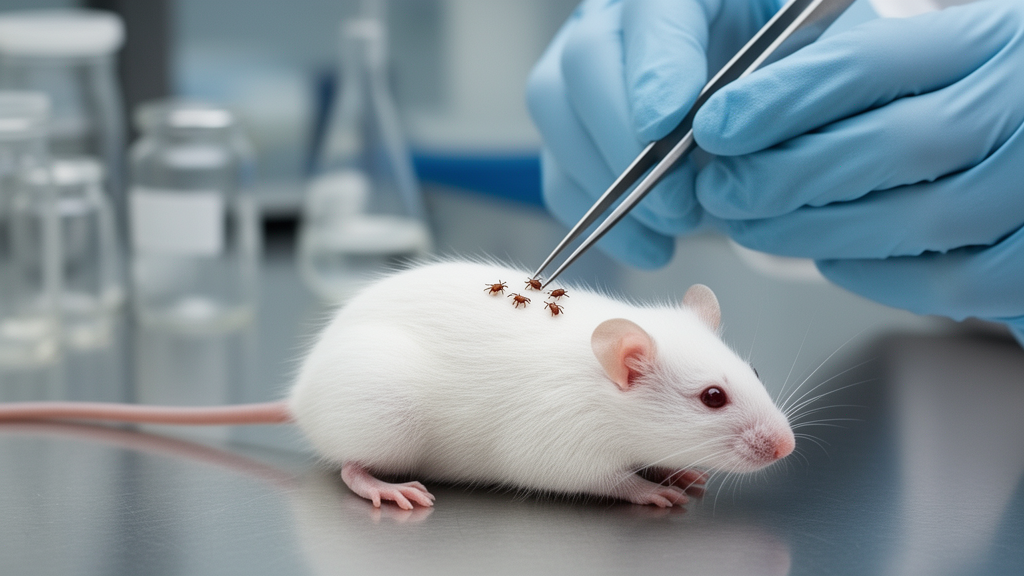
In a laboratory finding that reads like a medical detective story, researchers at the University of Southern Mississippi have documented a rare and unexpected case of tick paralysis in genetically modified mice bitten by nymphs of the Gulf Coast tick, Amblyomma maculatum. The study, published in Frontiers in Arachnid Science, describes how four of ten alpha-gal-deficient mice became progressively paralyzed after tick attachment, with two animals dying before the cause was identified and two others recovering completely within 24 hours of tick removal. The report is the first to implicate the nymphal stage of this species in paralysis under either experimental or natural conditions, and it arrives at a moment when the Gulf Coast tick is quietly expanding its footprint across the United States.
Tick paralysis is one of the strangest and most underappreciated hazards in the world of arthropod bites. Unlike the infectious diseases for which ticks are infamous, such as Lyme disease or Rocky Mountain spotted fever, tick paralysis is purely toxin-mediated. A neurotoxin delivered in the saliva of an attached tick disrupts the release of acetylcholine, the chemical messenger that nerves use to command muscles to contract. The result is an ascending flaccid paralysis: early malaise and weakness give way to loss of muscle function that climbs the body from the limbs upward, and in severe cases, respiratory failure can be fatal. Symptoms typically appear four to seven days after attachment, progress rapidly, and reverse only when the tick is removed. Once the tick is off, clinical improvement usually begins within hours, and full recovery follows within days.
More than 75 tick species, mostly hard ticks, are capable of producing paralytic toxins, yet the condition remains rare and is often overlooked precisely because it does not fit the infectious or allergic mold of better-known tick-borne illnesses. In North America, most reported cases have historically involved two culprits: the Rocky Mountain wood tick, Dermacentor andersoni, in western regions, and the American dog tick, Dermacentor variabilis, in the east and south. Cases cluster in spring and summer, and while small dogs are the most common victims, paralysis has been documented in snakes, birds, ruminants, horses, bobcats, and domestic cats. Human cases are rarer but real, including a 2011 report from the Mexican Pacific Coast in which an Amblyomma maculatum bite caused ascending flaccid paralysis that resolved after tick removal.
The new study emerged from an experiment designed for an entirely different purpose. The researchers, Olaoluwa Oyediran and Shahid Karim, were working with alpha-1,3-galactosyltransferase knockout mice, animals engineered to lack the alpha-gal sugar epitope found on the cells of most mammals. Because these mice do not carry alpha-gal on their own tissues, their immune systems treat the molecule as foreign, making them a valuable humanized model for studying alpha-gal syndrome, the tick bite-induced red meat allergy, and for probing immune pathways, tick salivary components, and potential vaccine strategies. Thirty mice were randomly assigned to three groups: an uninfested control group, a group infested with the lone star tick, Amblyomma americanum, and a group infested with the Gulf Coast tick. Fifteen nymphal ticks were placed on each mouse’s ear, where they were allowed to attach freely.
What happened next was not part of the plan. Five days after infestation, two mice in the Gulf Coast tick group were found weak and unresponsive, displaying stiffness and immobility in their hind limbs and attempting to move using only their forelimbs. They also showed a marked loss of appetite. The attached nymphs remained on their ears. By day seven, two more mice in the same group had developed similar symptoms. On day eight, the first two symptomatic animals were found dead in their cages, with tick bite-induced paralysis suspected as the cause. Critically, no mouse infested with Amblyomma americanum, a tick from the same colony applied to the same anatomical site, showed any sign of paralysis. When the researchers immediately removed the attached nymphs from the two remaining symptomatic mice, both animals recovered fully within 24 hours and returned to normal activity.
The timing of the outbreak fits a well-established pattern in tick biology. Ixodid ticks, the hard ticks, feed in a characteristic slow-fast rhythm divided into three phases: attachment, slow feeding, and what researchers call the big sip. Both immature and adult ticks anchor themselves by inserting a barbed mouthpart called the hypostome deep into the host’s skin and secreting cement that locks them in place. As pool feeders, they drip saliva throughout the slow feeding phase to modulate and evade the host’s immune defenses. In some species, once feeding is established and just before full engorgement, the tick’s grip on the skin loosens, and this loosening coincides with the release of neurotoxins capable of paralyzing the host, apparently allowing the tick to take a large final blood meal before detaching. The paralysis window of three to seven days after attachment, and the appearance of symptoms on days five and seven in the mice, aligns precisely with this schedule.
The mechanism behind the paralysis is increasingly well understood, even if the toxins themselves remain elusive. The stiffness and immobility observed in the mice reflect a blockage of acetylcholine release from presynaptic vesicles at the neuromuscular junction; without that chemical signal, muscles cannot contract. The hind limbs were affected first in every case, a pattern the researchers attribute to the toxin’s disruption of nerve-muscle communication required for coordinated movement, though why the hind limbs are preferentially hit remains an open question. The loss of appetite has two plausible explanations drawn from the literature. Tick paralysis toxins may interfere with acetylcholine release not only at limb motor endplates but also at the neuromuscular junctions of cranial nerves, impairing the muscles of chewing, swallowing, and tongue movement. In addition, because the toxins can affect the autonomic nervous system, including the vagus nerve, disruption of vagal signaling may impair gastrointestinal motility and alter satiety pathways, providing a mechanism for the anorexia observed.
Perhaps the most provocative aspect of the study is what it says about the molecular identity of tick paralysis toxins, which remains frustratingly incomplete. No single, unified tick paralysis toxin has ever been identified. The best-characterized paralytic factors are the holocyclotoxins produced by the Australian paralysis tick, Ixodes holocyclus: small, cystine-rich secreted proteins that cause presynaptic failure of neurotransmitter release by interfering with calcium-dependent acetylcholine release at motor nerve terminals. Similar findings in Dermacentor species, including reduced motor nerve conduction and diminished acetylcholine release, support a comparable presynaptic mechanism in that genus. But the molecular identity of paralysis-associated factors in Amblyomma ticks is poorly defined, and the diversity of candidate salivary toxins across tick genera suggests convergent evolution, with different tick lineages independently evolving venom-like neurotoxic molecules that impair host motor function and support prolonged feeding.
Why would a tick evolve the ability to paralyze its host at all? The leading hypothesis is that paralysis improves feeding success by reducing host grooming and mobility, allowing the tick to maintain attachment long enough to complete its blood meal. Supporting evidence comes from field studies of wild baboons, in which animals receiving higher amounts of grooming carried significantly fewer ticks, and of impalas, in which individuals experimentally restricted from grooming harbored nine times more ticks than those permitted to groom. Species that feed on small mammals or birds, which can easily remove ticks by grooming or preening, would benefit from secreting toxins that immobilize the host, whereas ticks specializing on large ungulates or reptiles, which are less agile groomers, may not require such toxins and instead invest in other salivary strategies such as anticoagulants and immunomodulators. It is also notable that ticks causing paralysis are often attached near the head, on the scalp, neck, behind the ears, or in the groin, consistent with the ear attachment sites in the mice.
The researchers are careful to note a caveat: these observations were made in alpha-gal knockout mice, whose altered glycan profiles could theoretically influence the host response to tick feeding or toxin exposure, affecting immune regulation or the clearance of salivary proteins and neurotoxins. Still, the clinical signs, marked loss of appetite, progressive hind limb paralysis, and complete recovery after tick removal, are consistent with classic tick paralysis. The finding expands understanding of tick salivary biology, highlights paralysis and host-immune modulation as important components of the tick’s arsenal, and identifies salivary toxins as potential targets for anti-tick vaccines or inhibitors. Because such molecules are essential for tick feeding, they represent valuable tools for disrupting tick survival. As Amblyomma maculatum, already known as a vector of Rickettsia parkeri, continues its northward expansion into states such as Connecticut, New Jersey, New York City, Arizona, and New Mexico, the study underscores a need for greater vigilance toward this underrecognized, toxin-mediated disease, with implications for both human and animal health.
Subject of Research: Tick paralysis induced by Amblyomma maculatum nymphal bites in alpha-gal knockout mice
Article Title: Unusual paralytic response to Amblyomma maculatum nymphal bite in alpha-gal knockout mice
Article References: Oyediran, O., & Karim, S. (2025). Unusual paralytic response to Amblyomma maculatum nymphal bite in alpha-gal knockout mice. Frontiers in Arachnid Science, 4, Article 1709631. https://doi.org/10.3389/frchs.2025.1709631
Image Credits: AI Generated
DOI: 10.3389/frchs.2025.1709631
Keywords: tick paralysis, Amblyomma maculatum, Gulf Coast tick, alpha-gal syndrome, nymphal ticks, neurotoxin, tick saliva, acetylcholine, Ixodes holocyclus, tick-borne disease, knockout mice, vector biology
Cite Scienmag News
Kristina Jarvis. (October 16, 2026). Gulf Coast Tick Nymphs Trigger Rare Paralysis in Alpha-Gal Knockout Mice. Scienmag. https://scienmag.com/gulf-coast-tick-nymphs-trigger-rare-paralysis-in-alpha-gal-knockout-mice/
Kristina Jarvis. "Gulf Coast Tick Nymphs Trigger Rare Paralysis in Alpha-Gal Knockout Mice." Scienmag, 16 October 2026, https://scienmag.com/gulf-coast-tick-nymphs-trigger-rare-paralysis-in-alpha-gal-knockout-mice/. Accessed 16 October 2026.
Kristina Jarvis. "Gulf Coast Tick Nymphs Trigger Rare Paralysis in Alpha-Gal Knockout Mice." Scienmag. October 16, 2026. https://scienmag.com/gulf-coast-tick-nymphs-trigger-rare-paralysis-in-alpha-gal-knockout-mice/


