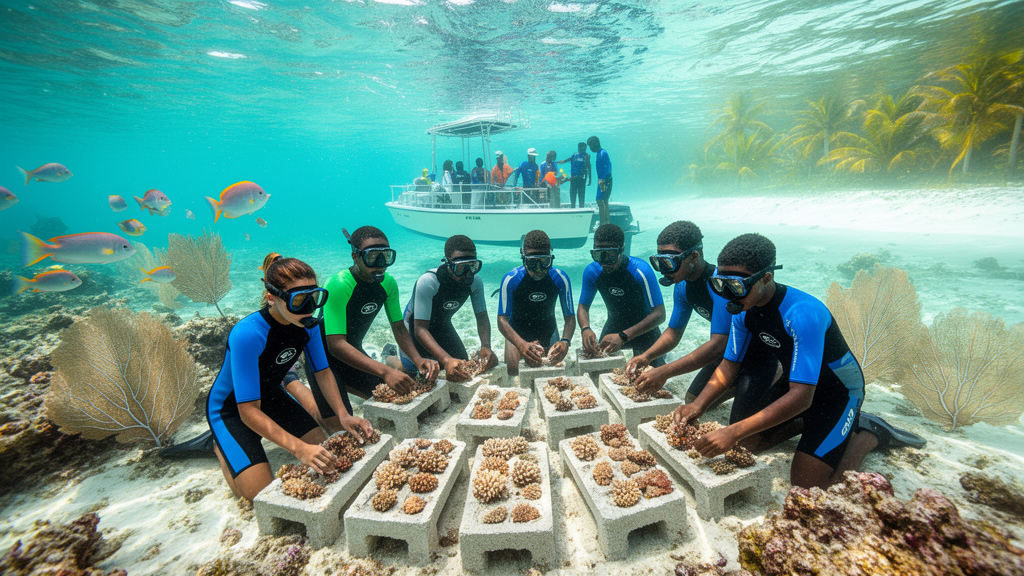
On the island of Eleuthera in The Bahamas, a small team of coral scientists has spent five years proving that the future of reef restoration may depend less on laboratory breakthroughs and more on who is standing beside the nursery tanks. A new community case study published in Frontiers in Ocean Sustainability documents how the Bahamas Coral Innovation Hub, a partnership between the Cape Eleuthera Institute, the Perry Institute for Marine Science and The Nature Conservancy, turned outreach and dive training into a pipeline of local coral stewards. Between January 2021 and April 2026, the Hub engaged 482 Bahamians in coral conservation activities, awarded 171 PADI dive certifications and recruited 59 divers into the Reef Rescue Network, the country-wide volunteer infrastructure for coral nursery maintenance and outplanting.
The numbers matter because the stakes are enormous. Coral reefs shelter coastlines, sustain fisheries and anchor the tourism industry that tops the Bahamian economy, generating an estimated $15 billion in ecosystem services per year across Caribbean nations. Yet the researchers note that the state of reefs in Bahamian waters remains poorly understood within many local communities, a disconnect driven by cost, variable swimming confidence and the training barriers that keep ordinary residents from ever seeing a reef up close. When people cannot access the ecosystems their livelihoods depend on, conservation becomes an abstraction rather than a shared project.
The Hub’s founders, who established the program in 2018 at the Cape Eleuthera Island School in South Eleuthera, set three explicit objectives: diversify restoration through a multi-technique approach, maintain long-term monitoring of restoration sites, and engage Bahamian and international students in reef restoration to create educational and research opportunities. The new report, led by Natalia Hurtado-López of the Cape Eleuthera Institute and Wageningen University & Research, focuses on the third pillar, treating community engagement not as a public-relations add-on but as a technical component of restoration capacity. The logic is straightforward: coral nurseries require divers, monitoring requires trained eyes, and disease outbreaks require early detection from people already in the water.
The educational machinery behind the program was considerable. The team designed 58 distinct educational materials, spanning coral anatomy, reef ecology, species identification and restoration techniques, all tiered by age. Younger children, typically ages 3 to 9, built coral polyps from edible materials and assembled their own miniature reef ecosystems, while students aged 12 to 15 measured live corals, constructed nursery trees and compared resilience among coral species. To explain Stony Coral Tissue Loss Disease, a lethal condition affecting roughly 30 coral species including the endangered reef-builder Orbicella faveolata, instructors borrowed a frame students already knew, calling it Coral COVID and teaching pathogen identification, reporting protocols and containment strategies through that analogy. Climate change lessons used paint and water temperature experiments to demonstrate ocean acidification and bleaching in tangible terms.
Delivery relied on a layered structure. Classroom-only sessions, lasting one to three hours, served local schools where logistics permitted only short engagements and visiting groups such as Lyford Cay International School and Windsor School. Full-day programs combined lessons with field components, allowing students to practice fish and coral identification, spot bleaching and disease, and estimate percentage coral cover on real reefs around South Eleuthera. Fourteen schools across Eleuthera were contacted about hosting outreach activities, and every one expressed interest; by April 2026, five schools had completed activities, including 15 sessions with Deep Creek Middle School and programs at Deep Creek Primary School, the Elementary Learning Center, Green School on Harbour Island and Harbour Island All Age School, reaching 163 primary, middle and high school students in classroom settings alone.
Assessment, though informal, was encouraging. After lessons, quizzes covering coral species identification and even the symbiotic relationships of reef organisms were met with near-universal correct answers, which the authors interpret as evidence of both high engagement and effective material delivery. The team observed that hands-on activities, from cleaning nursery trees to designing reef fish cut-outs and visiting field and lab facilities, generated the strongest excitement and, notably, unprompted continued engagement after sessions ended. Presentations anchored the material geographically, using maps of Eleuthera on which students located their own schools, the institute and nearby coral nurseries, a technique the authors credit with cementing the idea that reef conservation is a local, personal concern rather than a distant global problem.
The dive-training component is where the program converts interest into operational capacity. Staff calibrated instruction to water comfort: first-time swimmers and snorkelers received Discover Scuba experiences, confident swimmers pursued PADI Open Water certification, and certified divers advanced through Advanced Open Water, Rescue Diver and AWARE Fish Identification courses. Over five years, the tally included 36 Open Water certifications, 14 Advanced and Rescue certifications, 11 Fish Identification certifications, 48 AWARE Coral Conservation certifications and 59 Reef Rescue Diver specialty certifications, the credential that qualifies volunteers to work at more than thirty nurseries across the Reef Rescue Network. Ten Bahamians completed Discover Scuba Diver training having never dived before, and the Hub also extended dive opportunities to Bahamian staff working at the institute itself.
The most vivid demonstration of the model came from Deep Creek Middle School’s ninth graders. After learning to identify Stony Coral Tissue Loss Disease, the students presented their knowledge at a local Earth Day festival, explaining disease prevention and restoration techniques to community members. The authors argue this creates a distributed surveillance network: the first reports of SCTLD in The Bahamas, on the island of New Providence where the capital sits, came not from scientists but from regular ocean users such as spearfishers. Students trained to recognize disease symptoms become a constant early-warning presence, and student-led outreach is known to transfer knowledge to adults more effectively than external messaging, reaching parents and family members who work in tourism or commercial seafood distribution.
The same cohort progressed from theory to practice in a single arc. Having learned to build nursery trees on land using coral skeletons, the students helped expand the Hub’s ocean nursery by installing and populating a tree with staghorn coral, Acropora cervicornis, a critically endangered Caribbean species, then assisted with outplanting nursery-raised fragments back onto the reef. They subsequently prepared presentations of learning for their peers, closing the loop from classroom to reef to community. The authors frame this as evidence that community engagement can function as a genuine restoration tool, not merely an awareness campaign, while simultaneously opening career pathways into research, dive instruction and conservation leadership for young Bahamians.
The report is candid about its limitations. Because the outreach evolved organically over five years rather than following a pre-designed study protocol, feedback was collected inconsistently, relying on informal qualitative responses, spontaneous conversations and staff observation rather than standardized instruments. The authors recommend that future programs adopt concrete feedback collection to support replication in other contexts, and suggest mechanisms such as recurring reef-assessment projects that students carry out outside school, or conservation materials designed for students to share with family and friends. Their broader recommendation is that similar youth-focused outreach be implemented across The Bahamas and other reef-dependent Caribbean nations, aligned with the UN Decade of Ocean Science for Sustainable Development and the Kunming-Montreal Global Biodiversity Framework. The end goal, they write, is for the Hub’s staff to act less as educators and more as guides, cultivating local stewards unafraid to make change within their communities and their surrounding seas.
Subject of Research: Community outreach and dive training to build local capacity for coral reef restoration in The Bahamas
Article Title: Outreach and community engagement as a tool to build capacity and to support effective coral restoration in Eleuthera, The Bahamas
Article References: Hurtado-López, N., Woodside, S., Love, D., van Brugge, I., & Caprino, M. (2026). Outreach and community engagement as a tool to build capacity and to support effective coral restoration in Eleuthera, The Bahamas. Frontiers in Ocean Sustainability, 4, Article 1871427. https://doi.org/10.3389/focsu.2026.1871427
Image Credits: AI Generated
DOI: 10.3389/focsu.2026.1871427
Keywords: coral restoration, The Bahamas, community engagement, ocean literacy, dive training, coral reefs, marine conservation, Stony Coral Tissue Loss Disease, environmental education, youth outreach, Reef Rescue Network, capacity building
Cite Scienmag News
Violet Maxwell. (October 16, 2026). Bahamian Youth Dive Into Coral Restoration Through Hands-On Community Outreach. Scienmag. https://scienmag.com/bahamian-youth-dive-into-coral-restoration-through-hands-on-community-outreach/
Violet Maxwell. "Bahamian Youth Dive Into Coral Restoration Through Hands-On Community Outreach." Scienmag, 16 October 2026, https://scienmag.com/bahamian-youth-dive-into-coral-restoration-through-hands-on-community-outreach/. Accessed 16 October 2026.
Violet Maxwell. "Bahamian Youth Dive Into Coral Restoration Through Hands-On Community Outreach." Scienmag. October 16, 2026. https://scienmag.com/bahamian-youth-dive-into-coral-restoration-through-hands-on-community-outreach/