


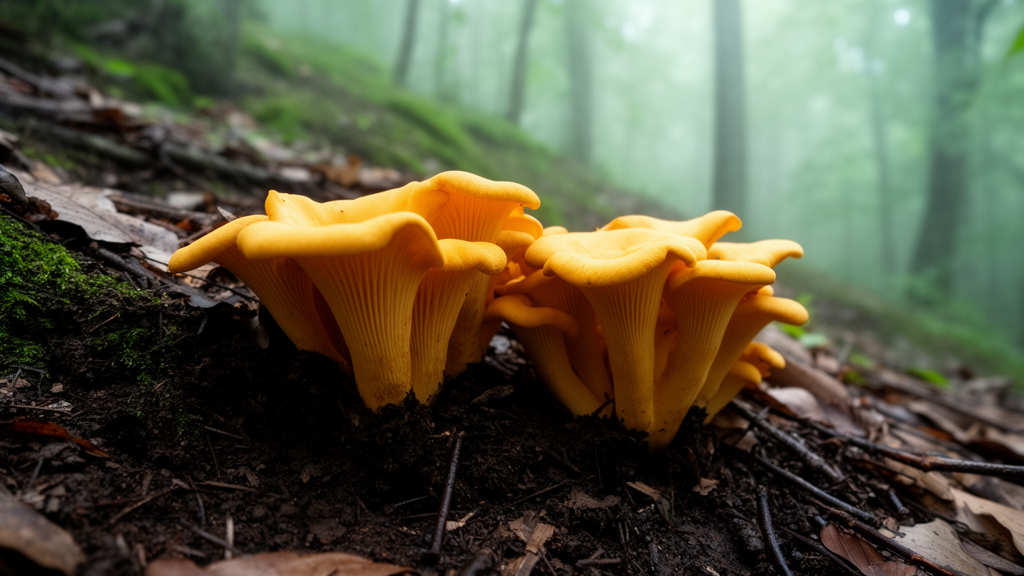
Deep in the misty forests of the Dabie Mountains, where Anhui, Hubei and Henan provinces meet in central China, mycologists have uncovered two species of chanterelle that are entirely new to science. The discoveries, published in the journal MycoKeys, also include a provincial range extension for a third species and fresh documentation of a fourth, all belonging to the genus Cantharellus, the group that contains some of the world’s most prized edible mushrooms. The findings significantly expand what is known about fungal diversity in a mountain range that has proven to be a hotspot for newly described fungi in recent years.
The research team, led by H. Chu, Y.L. Tuo and B. Zhang, conducted field investigations across the Dabie Mountains during the summer and autumn months of 2023 and 2024. Over two field seasons, they collected 16 specimens of Cantharellus belonging to two subgenera, Parvocantharellus and Cinnabarinus. Each specimen was photographed in detail while fresh, dried at 45 degrees Celsius, and deposited in the Fungarium of Jilin Agricultural University under voucher numbers FJAU81683 through FJAU81698. What began as a routine survey of mushroom diversity in a biodiverse mountain region ultimately revealed organisms that no scientist had ever formally named.
Identifying chanterelle species is notoriously difficult. While the genus is easy to recognize in the field, thanks to brightly colored fruiting bodies and characteristic gill-like or nearly smooth undersurfaces, individual species show extensive morphological overlap and considerable variation within populations. This has historically led to misidentification and a systematic underestimation of true species diversity. To overcome these limitations, the researchers combined careful microscopic examination with DNA sequencing of three genetic markers: the nuclear large subunit ribosomal RNA gene (nrLSU), the translation elongation factor 1-alpha gene (tef1-α), and the second-largest subunit of RNA polymerase II (rpb2). This multigene approach has become the gold standard for delimiting species in Cantharellus, particularly for taxa that look deceptively similar.
The molecular dataset assembled by the team was substantial. They generated 48 new sequences, 16 for each of the three gene regions, and combined them with previously published data from type specimens held in collections across the globe, including material from Zambia, Madagascar, Korea, the United States, France, Mexico, Japan and New Caledonia. The final concatenated alignment contained 275 sequences from 108 fungal collections spanning 2,785 characters. Of these, 833 characters, or 29.91 percent, were parsimony-informative, providing ample signal for resolving evolutionary relationships. Maximum likelihood analyses using IQ-TREE and Bayesian inference using MrBayes produced nearly identical tree topologies, giving the researchers high confidence in the resulting phylogeny.
The first new species, Cantharellus cremeus, is a delicate mushroom with fruiting bodies measuring just 4 to 15 millimeters across. Its cap is white to pale yellow, sometimes taking on greyish-yellow to olive-yellow tones at the center, and its well-developed gill-like hymenophore is white to pastel yellow. The specific epithet refers to this creamy-white coloration. Under the microscope, the species produces broadly ellipsoid to elongate ellipsoid basidiospores measuring 6.4 to 8.2 by 4.1 to 5.8 micrometers, and clavate basidia bearing two to six sterigmata. It was found growing gregariously in mixed forests dominated by Quercus serrata, the Japanese oak, with one collection made just 1.6 meters from a pine tree with a diameter at breast height of 27.3 centimeters. Currently, the species is known only from the Dabie Mountains in Anhui Province.
What makes C. cremeus particularly noteworthy is its color. Among the 21 species of subgenus Cinnabarinus accepted prior to this study, the vast majority display orange, yellow or red pigmentation. Only one species, the Japanese C. cyphelloides, produces white fruiting bodies. C. cremeus is therefore only the second white-colored species ever described in this subgenus. Despite sharing this pale appearance with C. cyphelloides, the new species differs markedly in having a lamellate rather than smooth hymenophore, an indistinct rather than strong odor, and smaller basidiospores. Phylogenetically, C. cremeus is sister to the orange-red C. sinocinnabarinus and closely related to the cinnabar-red C. cinnabarinus, yet it is only distantly related to the white C. cyphelloides, demonstrating that color is a poor predictor of evolutionary relationships in this group.
The second new species, Cantharellus armeniacus, is more flamboyant. Its small fruiting bodies, with caps measuring 12 to 36 millimeters wide, are bright yellow to vivid yellow, resembling the flesh of an apricot, which inspired its name. The cap surface is finely tomentose, meaning it is covered with a layer of short, soft hairs, and the well-developed lamellate hymenophore features folds less than 1.5 millimeters high with anastomosing veins between them. The stipe is solid, cylindrical or slightly tapered downward, and finely tomentose. The mushroom emits a mild but distinctly apricot-like fragrance. Basidiospores measure 6.1 to 8.1 by 4.1 to 5.7 micrometers, and basidia are subclavate, measuring 35 to 72 by 5 to 9 micrometers. It was collected in mixed forests dominated by Quercus aliena, growing approximately 1.5 meters from a host tree with a diameter at breast height of 18.5 centimeters.
Distinguishing C. armeniacus from other yellow species in its subgenus required careful comparison across multiple characters. It differs from C. diminutivus in having a finely tomentose rather than squamulose cap surface and a solid rather than hollow stipe. It differs from C. fistulosus in having a bright yellow rather than pink hymenophore and larger basidiospores. It can be separated from C. chrysanthus by its bright yellow rather than pinkish-white hymenophore, smaller basidiospores, and shorter basidia. It also differs from C. citrinus in having a solid and finely tomentose rather than hollow and glabrous stipe. Phylogenetically, C. armeniacus is sister to the white-colored C. cyphelloides, an unexpected relationship given their contrasting colors, and is distantly related to other yellow species in the subgenus, further confirming that basidiome color does not track evolutionary history in this lineage.
Beyond the two new species, the study documented Cantharellus curvatus as a new provincial record for Anhui. Originally described from the Republic of Korea, this small yellow species had previously been reported in China only from Heilongjiang and Shandong provinces based on molecular data. Its discovery in the Dabie Mountains represents a significant southward range extension. The researchers also collected specimens of C. phloginus, a vivid orange-red species with a strong apricot-like fragrance that was originally described from southwestern China in 2016. Their analysis supports the treatment of C. albovenosus, described from Korea in 2017, as a synonym of C. phloginus, consistent with recent multi-marker phylogenetic work showing that the genetic divergence between these two taxa is not supported when multiple genes are considered together.
All four species collected in the study were found exclusively in association with trees of the family Fagaceae, which includes oaks, chestnuts and beeches. This consistent co-occurrence points to a tight ecological association between these Cantharellus subgenera and their host plants. The pattern holds across China, where all eight reported species of subg. Cinnabarinus and 12 of 17 species of subg. Parvocantharellus are linked to Fagaceae. Globally, the figures are similarly striking, with 15 of 29 species of Parvocantharellus and 14 of 23 species of Cinnabarinus associated with this plant family. The geographic distribution of both subgenera in China closely mirrors the distribution of Fagaceae diversity, with hotspots in the tropical and subtropical south and southwest and declining species richness moving northward. These findings underscore how much fungal diversity remains undocumented in China’s mountain forests, and how integrating morphology with multigene phylogenetics is essential for uncovering it.
Subject of Research: Taxonomic description of two new Cantharellus species and a new provincial record from the Dabie Mountains, China, based on morphology and multigene phylogenetics
Article Title: Two new species and one new provincial record of Cantharellus ( Hydnaceae , Cantharellales ) from the Dabie Mountains, China
Article References: Chu, H., Tuo, Y.-L., Zhang, B., & Li, X. (2026). Two new species and one new provincial record of Cantharellus (Hydnaceae, Cantharellales) from the Dabie Mountains, China. MycoKeys, 141, 127-152. https://doi.org/10.3897/mycokeys.141.210171
Image Credits: AI Generated
DOI: 10.3897/mycokeys.141.210171
Keywords: Cantharellus, chanterelles, Dabie Mountains, new species, mycology, fungi diversity, phylogenetics, China, Fagaceae, taxonomy, Cinnabarinus, Parvocantharellus
Cite Scienmag News
Roger Howard. (October 16, 2026). Two New Chanterelle Species Discovered in China’s Dabie Mountains. Scienmag. https://scienmag.com/two-new-chanterelle-species-discovered-in-chinas-dabie-mountains/
Roger Howard. "Two New Chanterelle Species Discovered in China’s Dabie Mountains." Scienmag, 16 October 2026, https://scienmag.com/two-new-chanterelle-species-discovered-in-chinas-dabie-mountains/. Accessed 16 October 2026.
Roger Howard. "Two New Chanterelle Species Discovered in China’s Dabie Mountains." Scienmag. October 16, 2026. https://scienmag.com/two-new-chanterelle-species-discovered-in-chinas-dabie-mountains/


