


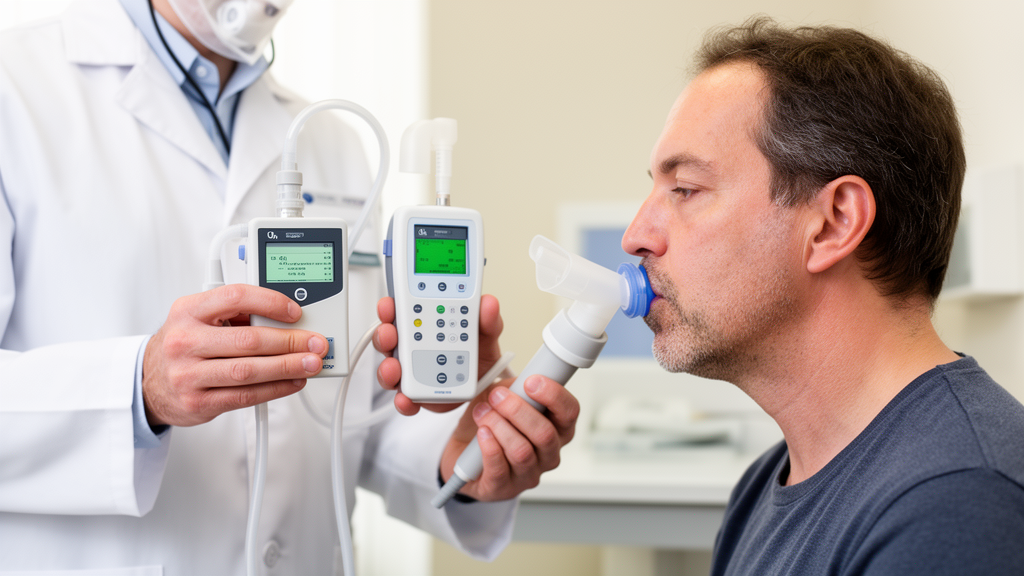
For a test that promises to make lung diagnostics easier, oscillometry has a surprisingly messy problem: the machines do not agree with each other. A new study from researchers at the University of Toronto and University Health Network, published in Frontiers in Allergy, put two commercial oscillometry devices head to head in 76 people whose lung function ranged from perfectly normal to severely abnormal, and found that the two instruments produced systematically different numbers for every major measurement they recorded. The findings, the authors argue, mean the devices cannot be used interchangeably, a conclusion with real consequences for anyone tracking a chronic lung disease over time.
Oscillometry, also called the forced oscillation technique, works by superimposing small, multi-frequency pressure oscillations on a person’s ordinary tidal breathing. Unlike spirometry, which demands forceful, coordinated blows, oscillometry is effort-independent and requires only passive cooperation, making it attractive for children, elderly patients, and people who cannot perform forced maneuvers. The technique reports two fundamental quantities: respiratory resistance, which reflects how hard it is for air to move through the airways, and respiratory reactance, which captures the elastic and inertive properties of the lungs and chest wall. Both are derived from respiratory system impedance, measured across a spectrum of frequencies from 5 to 37 hertz in modern devices.
The Toronto team compared the Tremoflo C-100, made by Thorasys Medical Systems in Canada, with the Resmon Pro, made by Restech srl in Italy. Their cohort of 76 participants included 49 patients with chronic lung disease and 27 healthy volunteers. Among the patients were 37 double-lung transplant recipients, 10 people with interstitial lung disease, one with chronic obstructive pulmonary disease, and one with lymphangioleiomyomatosis. Standard pulmonary function tests classified the group into 36 people with normal lung function, 26 with restriction, 8 with obstruction, and 5 with mixed patterns. Participants completed paired oscillometry with both devices in alternating order, each calibrated daily and performed according to European Respiratory Society technical standards.
The results were unambiguous. For all five primary oscillometry parameters, resistance at 5 hertz (R5), the resistance difference between 5 and 19 hertz (R5-19), reactance at 5 hertz (X5), resonant frequency (Fres), and the area of reactance (AX), the differences between devices reached statistical significance at p at or below 0.001. The Resmon Pro consistently reported lower R5, R5-19, Fres, and AX, and a less negative X5 than the Tremoflo C-100. In practical terms, the Resmon Pro painted a rosier picture of airway mechanics than the Tremoflo did for the same pair of lungs on the same day.
Statistical agreement analysis told a similar story. Intraclass correlation coefficients ranged from 0.59 to 0.85, and Spearman correlations were strong, between 0.779 and 0.920, meaning the devices rank-ordered patients similarly. But correlation is not agreement. Bland-Altman analysis, which plots the difference between paired measurements against their average, revealed systematic bias with wide limits of agreement for every parameter. The bias for AX, a reactance-derived index that integrates the frequency-dependent behavior of reactance, was minus 4.10 centimeters of water per liter, with limits of agreement stretching from minus 14.99 to plus 6.80. For Fres, the limits spanned from minus 6.46 to plus 4.75 hertz. Cohen’s d effect sizes were large for R5, R5-19, X5, and AX, confirming that the differences were not merely statistically detectable but substantively meaningful.
One of the study’s most clinically important findings concerned where the disagreement mattered most. When the researchers applied per-patient Oostveen reference limits, they found that agreement between devices was excellent, 91 to 100 percent within the Bland-Altman limits, when measurements fell within the normal reference range. But when measurements fell outside that range, agreement dropped to 81 to 92 percent. In other words, the systematic bias does little harm when a patient’s lungs are clearly normal, but becomes clinically consequential precisely when the lungs are abnormal, which is when monitoring decisions are being made.
The researchers also tested whether the inter-device differences translated into different patient classifications. They applied two schemes: a two-step decision tree the team had previously developed and validated in over 1,800 patients, and recently published Delphi consensus thresholds for asthma and COPD. Neither device showed clearly superior agreement with the pulmonary-function-test-derived gold standard, with kappa values of roughly 0.30 for the decision tree and only 0.09 to 0.12 for the Delphi thresholds. More concerning, individual participants could be classified differently depending on which device was used, meaning the same patient might be labeled normal by one machine and abnormal by the other.
Why do two devices measuring the same physical quantity disagree so much? The authors point to several technical factors. Hardware differences in oscillation waveform and amplitude can influence the measured signal. The two devices also handle mouthpiece dead space differently and use different calibration procedures: the Tremoflo completes an 8-second calibration against a 15-centimeter-water-second-per-liter reference load, while the Resmon Pro performs an 86-second calibration against a manufacturer-supplied load with distinct resistance and reactance characteristics. Signal processing differs too. The Tremoflo records for 20 seconds with 9 frequencies, while the Resmon Pro records for 60 seconds with 10 frequencies. The longer Resmon recording may improve low-frequency reactance estimation but increases susceptibility to drift and within-test changes in lung mechanics. Tidal volume was also higher during Tremoflo testing in this study.
The study is notable for extending device comparison beyond the healthy volunteers and asthma or COPD populations that dominated earlier work. Prior studies, including work by Dandurand and colleagues using mechanical test loads, Ducharme and colleagues in children, Soares and colleagues with a 3D-printed airway model, and De’s 2026 comparison of the same two devices in 97 symptomatic adults, all found systematic inter-device bias. But the Toronto cohort is the first to directly compare two commercial forced oscillation devices across normal, restrictive, obstructive, and mixed lung function patterns, including patients with interstitial lung disease and stable lung transplant recipients. The restrictive group showed the largest AX discrepancy, with a median Tremoflo value of 13.70 versus 8.23 on the Resmon Pro, a difference the authors note is particularly relevant because reactance abnormalities are the primary oscillometric signature of restrictive disease.
The practical message for clinicians is straightforward: stick with one device when following a patient over time. Changes in oscillometry parameters could otherwise be misattributed to disease progression or treatment response when they actually reflect device-specific differences. The authors also call for standardization of signal generation and processing across manufacturers, which they argue is necessary for cross-device comparability in both clinical practice and multi-center research. Participant feedback added a human dimension: of the 51 people who completed a survey, 61 percent had no preference, but some found the longer Resmon recordings fatiguing, while others preferred the handheld Tremoflo for its easier positioning. As oscillometry moves toward wider clinical adoption, particularly for early detection of lung disease and monitoring of transplant recipients, the Toronto findings make clear that the technology’s promise depends on the field first solving a problem that is less glamorous than the physics itself: getting the machines to speak the same language.
Subject of Research: Agreement between two commercial respiratory oscillometry devices across normal, obstructive, restrictive, and mixed lung function patterns
Article Title: Comparison of two respiratory oscillometers in patients with a broad range of lung function patterns
Article References: Binnie, M., Wu, J. K. Y., & Chow, C.-W. (2026). Comparison of two respiratory oscillometers in patients with a broad range of lung function patterns. Frontiers in Allergy, 7, Article 1896281. https://doi.org/10.3389/falgy.2026.1896281
Image Credits: AI Generated
DOI: 10.3389/falgy.2026.1896281
Keywords: oscillometry, forced oscillation technique, lung function, respiratory resistance, respiratory reactance, Bland-Altman analysis, pulmonary function testing, interstitial lung disease, lung transplant, device standardization, Tremoflo C-100, Resmon Pro
Cite Scienmag News
Barbara Leach. (October 16, 2026). Two Lung Oscillometry Devices Tell Different Stories, Study Finds. Scienmag. https://scienmag.com/two-lung-oscillometry-devices-tell-different-stories-study-finds/
Barbara Leach. "Two Lung Oscillometry Devices Tell Different Stories, Study Finds." Scienmag, 16 October 2026, https://scienmag.com/two-lung-oscillometry-devices-tell-different-stories-study-finds/. Accessed 16 October 2026.
Barbara Leach. "Two Lung Oscillometry Devices Tell Different Stories, Study Finds." Scienmag. October 16, 2026. https://scienmag.com/two-lung-oscillometry-devices-tell-different-stories-study-finds/


