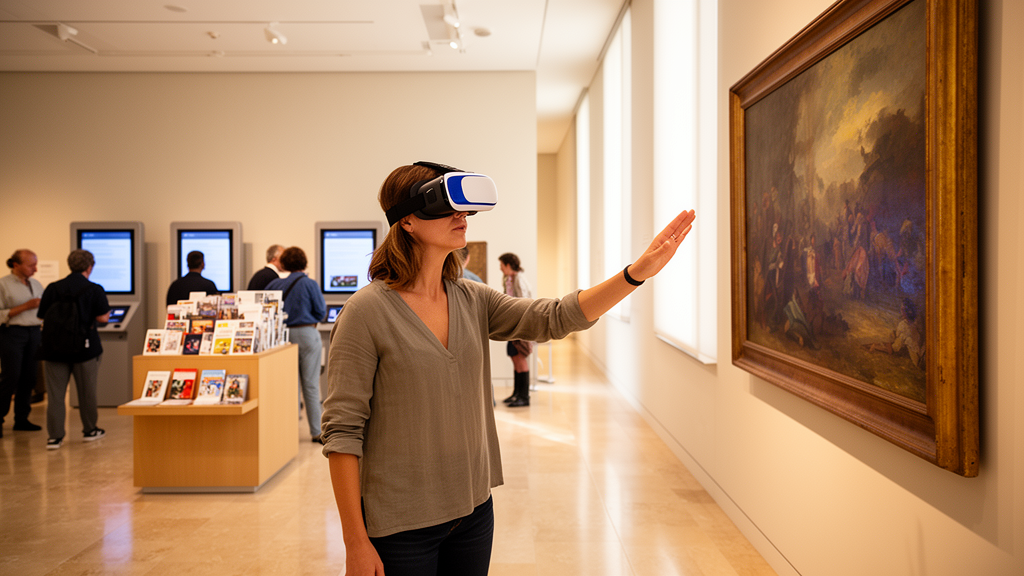
The museum has long been a temple of the physical object: the glass case, the climate-controlled gallery, the hushed corridor where visitors shuffle past artifacts that demand presence. But a new study published in Humanities and Social Sciences Communications suggests that the future of cultural institutions may be decided less in those corridors and more on the screens where millions of people now encounter heritage for the first time. Researchers led by Abid Hussain of Shandong Xiehe University, together with colleagues at Dezhou University, Jiangsu University, the University of Agriculture Faisalabad, and Jilin University, set out to quantify what actually happens when museums go digital, and their findings carry a provocative message for cultural economics: a well-crafted online museum experience does not merely substitute for the real thing, it can actively build the kind of loyalty that makes people willing to pay more.
The research team constructed a model linking six psychological constructs that heritage scholars have debated for years. At the center sits the digital museum experience itself, the sum of what a visitor encounters when navigating virtual exhibitions, interactive collections, and online interpretive content. Around it, the researchers positioned perceived value derived from social media, visitor satisfaction, cultural identity, museum loyalty, and finally willingness to pay higher prices. The logic of the chain is intuitive but had rarely been tested end to end: if digital experiences and social media make people feel satisfied and culturally connected, that satisfaction and connection should deepen loyalty, and loyalty should translate into economic support. The study tested each link statistically rather than assuming it.
Methodologically, the team surveyed 385 respondents recruited through snowball sampling, a technique in which initial participants refer others, expanding the sample through social networks. The data were collected between April 14, 2024, and May 17, 2024, following ethical approval from the Institutional Review Board of Jiangsu University granted on March 25, 2024, under protocols consistent with the Declaration of Helsinki and the ethical codes of the American Psychological Association. Participants were fully informed of the survey’s purpose, the voluntary nature of participation, and their right to withdraw at any time. The researchers then processed the responses in SPSS and ran structural equation modeling in AMOS 24, a technique that allows simultaneous estimation of multiple causal pathways among latent variables that cannot be observed directly but are inferred from clusters of survey items.
Structural equation modeling is particularly well suited to this kind of question because it treats concepts like satisfaction or cultural identity as latent constructs measured through multiple indicators, and it estimates the strength of the paths connecting them while accounting for measurement error. In this study, the results were strikingly coherent. The digital museum experience significantly influenced visitors’ satisfaction, their sense of cultural identity, and their loyalty to the museum. Perceived value from social media showed the same triple effect, significantly boosting satisfaction, cultural identity, and loyalty. In other words, both the curated online exhibition and the informal chatter of social platforms feed into the same psychological pipeline that ends in commitment to the institution.
The downstream links proved equally robust. Greater museum loyalty correlated with a greater willingness to pay higher prices, a finding that transforms the often abstract language of engagement into something museum finance officers can act upon. Loyalty, in this model, is not a vague sentiment but a measurable predictor of revenue behavior. For institutions struggling with post-pandemic attendance volatility and shrinking public subsidies, the implication is that investment in digital experience quality is not a marketing luxury; it is a direct input into the willingness of audiences to open their wallets for tickets, memberships, and premium digital offerings.
Perhaps the most theoretically interesting results came from the mediation analyses. Visitor satisfaction was found to mediate the relationship between the digital museum experience and museum loyalty, meaning that digital experiences do not build loyalty directly so much as they build it through the satisfaction they generate. Similarly, cultural identity mediated the relationship between perceived value from social media and museum loyalty, indicating that social media’s power lies in its ability to make people feel that a museum’s heritage is part of who they are. These mediation findings refine the causal story considerably. A slick virtual tour that leaves visitors cold will not produce loyal patrons, and a viral social media campaign that fails to resonate with users’ cultural self-image will not convert clicks into commitment.
The researchers also examined age as a moderating variable, testing whether the relationships in their model differed across generational groups. Using multi-group analysis, a procedure that compares whether path coefficients are statistically equivalent across subgroups, they found that the proposed relationships did not differ significantly by age. Digital engagement levels were consistent across age groups, a result that challenges the widespread assumption that digital museum strategies are fundamentally youth-oriented. Older audiences, according to this data, respond to digital experiences and social media value in much the same way younger ones do, deriving satisfaction and cultural connection from them at comparable rates.
That age finding deserves particular attention because it upends a common strategic reflex. Many heritage institutions design their digital offerings with an implicit demographic target, assuming that virtual reality tours and social media campaigns are the province of digital natives while older visitors remain attached to physical galleries. The multi-group results suggest instead that the psychological mechanisms linking digital experience to loyalty operate across the age spectrum. A museum investing in online engagement is therefore not merely courting a younger demographic; it is building loyalty infrastructure that serves its entire audience, from students encountering collections through TikTok clips to retirees exploring digitized archives from home.
The study’s authors frame these findings as having significant implications for enhancing user engagement, fostering loyalty, and improving the sustainability of digital heritage platforms. Sustainability is the operative word. Cultural institutions worldwide face a structural dilemma: physical visitation is constrained by geography, capacity, and cost, while digital reach is potentially global but historically difficult to monetize. By demonstrating an empirical pathway from digital experience through satisfaction and identity to loyalty and ultimately to willingness to pay, the research offers a business model sketch for the virtual museum. The monetizable asset is not the digital content itself but the psychological bond it creates, a bond that audiences appear ready to reward financially.
There are, of course, boundaries to what a single survey can establish. Snowball sampling, while efficient for reaching engaged audiences, does not produce a probability representative sample, and the cross-sectional design captures associations at one point in time rather than proving causal direction over the long term. Willingness to pay, moreover, is a stated intention rather than an observed transaction. Yet the rigor of the structural equation approach, the mediation tests, and the multi-group age comparison give the findings a solidity that goes well beyond anecdote. As museums continue their migration from marble halls to mobile screens, this study provides something rare in the heritage digitization debate: quantitative evidence that the digital experience, done well, does not dilute the museum’s relationship with its audience but deepens it, and that audiences, whatever their age, will reward that deepening with loyalty and, crucially, with money.
Subject of Research: How digital museum experiences shape visitor loyalty and willingness to pay
Article Title: Exploring the transition from traditional museums to digital experiences: implications for online engagement and willingness to pay
Article References: Exploring the transition from traditional museums to digital experiences: implications for online engagement and willingness to pay. (n.d.). https://doi.org/10.1038/s41599-026-09355-6
Image Credits: AI Generated
DOI: 10.1038/s41599-026-09355-6
Keywords: digital museums, visitor loyalty, willingness to pay, social media, cultural identity, visitor satisfaction, structural equation modeling, heritage digitization, online engagement, museum economics, snowball sampling, age moderation
Cite Scienmag News
Courtney Benton. (October 16, 2026). Virtual Museums Turn Digital Visitors Into Paying Loyal Audiences, Study Finds. Scienmag. https://scienmag.com/virtual-museums-turn-digital-visitors-into-paying-loyal-audiences-study-finds/
Courtney Benton. "Virtual Museums Turn Digital Visitors Into Paying Loyal Audiences, Study Finds." Scienmag, 16 October 2026, https://scienmag.com/virtual-museums-turn-digital-visitors-into-paying-loyal-audiences-study-finds/. Accessed 16 October 2026.
Courtney Benton. "Virtual Museums Turn Digital Visitors Into Paying Loyal Audiences, Study Finds." Scienmag. October 16, 2026. https://scienmag.com/virtual-museums-turn-digital-visitors-into-paying-loyal-audiences-study-finds/