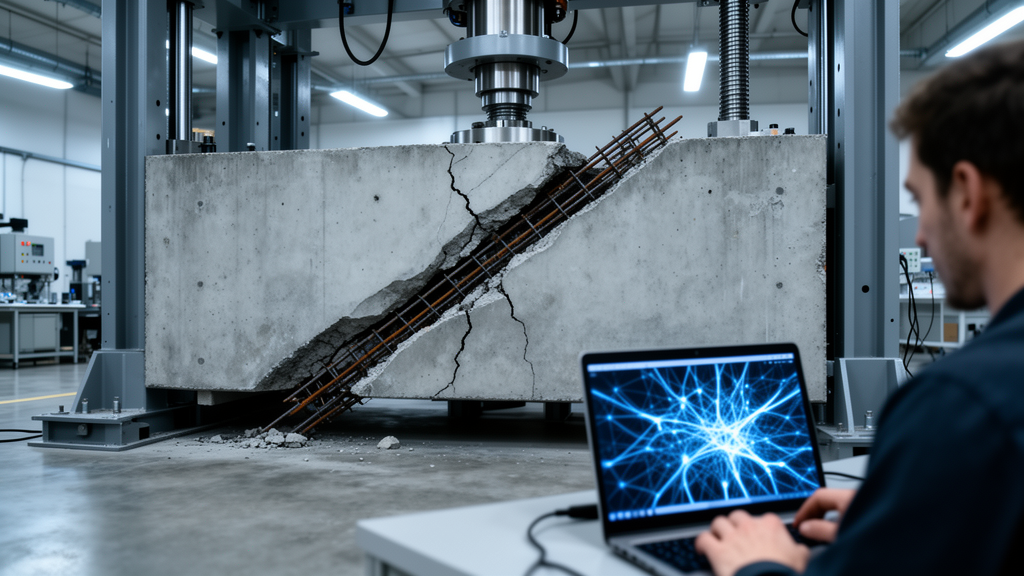
Deep beams are the quiet workhorses of modern construction. They appear as transfer girders stacked above the columns of high-rise buildings, as pile caps buried beneath bridge piers, and as shear walls that keep towers upright in earthquakes. Unlike ordinary slender beams, deep beams are so squat relative to their span that they resist loads through a fundamentally different internal mechanism, one that classical bending theory was never designed to describe. Predicting how much shear force such a member can carry before it fails has therefore remained one of the most stubborn problems in reinforced concrete design, and a new study published in Scientific Reports suggests that explainable machine learning may finally offer a reliable way forward.
The research, led by Zeinab Meghdadi and Alireza Khaloo of Sharif University of Technology together with Mohammad Shabanlou and Mahmoud R. Shiravand of Shahid Beheshti University in Tehran, tackles the problem by combining a large experimental database with a suite of supervised learning algorithms. The team compiled results from 419 reinforced concrete deep beam specimens that had been physically tested to failure in laboratories around the world, spanning a wide range of concrete strengths, reinforcement arrangements, and geometric proportions. This experimental foundation matters because shear behavior in deep beams is governed by a tangle of interacting variables that no single closed-form equation has ever captured convincingly.
The difficulty is rooted in the physics of these members. In a slender beam, shear is carried largely by diagonal tension that must be resisted by stirrups, and design codes offer relatively straightforward formulas. In a deep beam, load travels from the point of application to the support through a compressed arch of concrete, often described by engineers as a strut-and-tie action. The strut-and-tie method, which is widely accepted in design codes, essentially treats the beam as a truss made of concrete struts and steel ties. While conceptually elegant, the method is laborious for routine design: the engineer must idealize the internal load path, check each strut and node, and iterate when geometry changes. Empirical equations, by contrast, are fast but tend to miss the highly nonlinear interactions among material properties, geometry, and reinforcement that determine whether a deep beam fails gracefully or catastrophically.
To bridge that gap, the researchers trained eight different supervised machine learning models on the experimental database. Each model was tuned with the Optuna framework, an automated hyperparameter optimization tool that searches efficiently through the space of possible settings, such as tree depth, learning rate, and regularization strength, rather than relying on hand-picked defaults. When the models were compared on unseen test data, the Gradient Boosting Decision Tree approach came out on top, achieving a coefficient of determination of 0.93 on the test set. In practical terms, that means the model explained roughly ninety-three percent of the variance in measured shear capacity across beams it had never encountered during training, a level of accuracy that compares favorably with the scatter typically seen in code-based predictions.
Gradient boosting works by building an ensemble of decision trees sequentially, with each new tree trained to correct the residual errors left by its predecessors. This additive correction strategy allows the final model to capture sharp thresholds and curved response surfaces that linear regression or even simpler neural architectures struggle to represent. For deep beams, such flexibility is essential: the influence of the shear-span-to-depth ratio, for example, is not a gentle linear trend but a steep decline as the span grows shallower, while the contribution of web reinforcement changes character depending on whether the beam fails by concrete crushing or by steel yielding. An ensemble of boosted trees can encode these regime shifts naturally, which likely explains its edge over the other seven algorithms in the comparison.
Accuracy alone, however, is not enough to win the trust of structural engineers, who must justify every design decision to clients, reviewers, and regulators. A model that performs well but cannot explain its reasoning is of limited use in a safety-critical field. The Iranian team therefore built interpretability directly into their framework. They applied Shapley Additive Explanations, a technique borrowed from cooperative game theory that assigns each input variable a quantified contribution to every individual prediction, and they generated three-dimensional partial dependence plots that visualize how the predicted shear capacity responds as pairs of variables vary simultaneously. Together, these tools turn an opaque black box into something closer to a transparent, inspectable instrument.
The resulting feature-response patterns were broadly consistent with what decades of laboratory testing have established about deep beam behavior. Concrete compressive strength emerged as a positive driver of shear capacity, exactly as expected, since stronger concrete forms more robust compression struts. The shear-span-to-depth ratio exerted a negative influence, confirming that shallower spans concentrate the load path and reduce the arching action available to carry shear. More intriguingly, the three-dimensional partial dependence analysis revealed important nonlinear interactions among key variables, showing, for instance, that the effect of one parameter can change depending on the value of another. These interaction effects are precisely what empirical equations miss, and seeing them emerge from data-driven analysis provides a form of independent confirmation of the underlying mechanics.
The study also went beyond static interpretation by probing the numerical robustness of the models. The researchers conducted a synthetic Gaussian input-perturbation study, deliberately disturbing the input variables with progressively larger random noise drawn from Gaussian distributions and observing how the predictions responded. This kind of stress test addresses a real-world concern: measured material properties and geometric dimensions always carry some uncertainty, and a model that swings wildly in response to tiny input errors would be dangerous to use in practice. By quantifying sensitivity under disturbed inputs, the team demonstrated how gracefully their predictions degrade when data quality slips, an aspect of model validation that is often overlooked in machine learning studies applied to civil engineering problems.
To move the work from the laboratory into the design office, the researchers wrapped their optimized GBDT model in a user-friendly graphical user interface. The tool allows a practicing engineer to enter the properties of a proposed deep beam, such as concrete strength, dimensions, and reinforcement details, and receive a rapid, interpretable estimate of its shear capacity. Such interfaces lower the barrier to adopting advanced predictive models in everyday workflows, potentially replacing hours of iterative strut-and-tie calculations with an instant estimate that can then be verified through conventional checks. The authors position the interface as a practical aid for routine engineering applications rather than a replacement for code-based verification, a framing that reflects the cautious culture of structural design.
The broader significance of the study lies in its demonstration that explainable artificial intelligence can do more than match the accuracy of traditional methods; it can also recover, from raw experimental data, the same physical relationships that engineers have spent decades establishing through theory and testing. When a machine learning model independently rediscovers that stronger concrete helps and longer shear spans hurt, and does so through quantified attribution scores rather than hand-coded rules, it earns a credibility that pure black-box systems cannot claim. For a field where the cost of failure is measured in lives, that combination of predictive power and transparency may prove to be the decisive factor in bringing data-driven tools into mainstream structural engineering practice. The research was supported by the Iran National Science Foundation under grant number 4047782, and the article is published open access under a Creative Commons license, making both the findings and the underlying methodology available to the global engineering community.
Subject of Research: Explainable machine learning prediction of shear capacity in reinforced concrete deep beams
Article Title: Explainable machine learning for shear capacity prediction of reinforced concrete deep beams
Article References: Explainable machine learning for shear capacity prediction of reinforced concrete deep beams. (n.d.). https://doi.org/10.1038/s41598-026-75117-8
Image Credits: AI Generated
DOI: 10.1038/s41598-026-75117-8
Keywords: reinforced concrete, deep beams, shear capacity, machine learning, gradient boosting decision tree, SHAP, explainable artificial intelligence, strut-and-tie method, Optuna, partial dependence plots, structural engineering, Scientific Reports
Cite Scienmag News
Denise Maddox. (October 16, 2026). AI Cracks the Code on Why Concrete Deep Beams Fail in Shear. Scienmag. https://scienmag.com/ai-cracks-the-code-on-why-concrete-deep-beams-fail-in-shear/
Denise Maddox. "AI Cracks the Code on Why Concrete Deep Beams Fail in Shear." Scienmag, 16 October 2026, https://scienmag.com/ai-cracks-the-code-on-why-concrete-deep-beams-fail-in-shear/. Accessed 16 October 2026.
Denise Maddox. "AI Cracks the Code on Why Concrete Deep Beams Fail in Shear." Scienmag. October 16, 2026. https://scienmag.com/ai-cracks-the-code-on-why-concrete-deep-beams-fail-in-shear/