


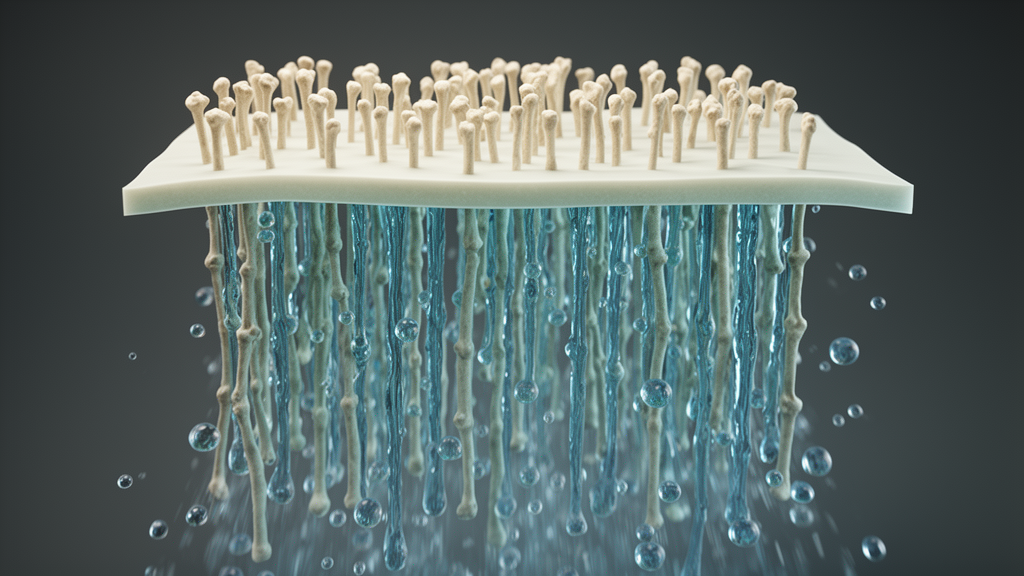
Freshwater scarcity is one of the defining challenges of the twenty-first century, and membrane technology sits at the heart of the search for solutions. In a new study published in Frontiers in Membrane Science and Technology, researchers from Egypt’s Central Metallurgical Research and Development Institute and Italy’s Institute on Membrane Technology report a deceptively simple recipe for making forward osmosis membranes work dramatically better: weave ultralong hydroxyapatite nanowires, a material chemically akin to bone mineral, into a polyvinylidene fluoride polymer matrix. The resulting mixed-matrix membranes pushed water flux from 2.1 liters per square meter per hour in the pristine polymer to 3.6 LMH, an improvement of roughly 70 percent, while also showing better antifouling behavior and steadier operation over time.
The choice of base polymer is deliberate. Polyvinylidene fluoride, or PVDF, is a semi-crystalline fluoropolymer prized for its thermal stability, chemical resistance, mechanical strength, and ease of processing, properties that stem from strong dipole interactions between fluorine and carbon atoms along its backbone. It is also piezoelectric and ferroelectric, which has made it popular in sensors and energy devices as well as membranes. But in water treatment, PVDF carries a stubborn flaw: it is intrinsically hydrophobic. Water molecules do not spread readily across its surface, so permeability suffers, fouling takes hold more easily, and operating costs climb as pumps work harder to push water through reluctant pores.
Forward osmosis offers a way around the energy penalty of pressure-driven desalination. Instead of forcing water through a membrane with hydraulic pressure, as reverse osmosis does, FO exploits the natural tendency of water to diffuse from a solution of low osmotic pressure to one of high osmotic pressure. A concentrated draw solution, in this study a 2 molar sodium chloride brine, pulls water across a semipermeable membrane from the feed side. The process runs under mild conditions, achieves high water recovery, and fouls less than pressure-driven systems, but its efficiency hinges on the membrane itself, and hydrophobic PVDF has long been a limiting factor.
Enter hydroxyapatite, the calcium phosphate mineral that gives bones and teeth their strength. The team synthesized ultralong hydroxyapatite nanowires, abbreviated UHA, using a solvothermal method in which calcium chloride, sodium hydroxide, sodium dihydrogen phosphate, oleic acid, water, and methanol were sealed in a Teflon-lined stainless-steel autoclave and heated at 180 degrees Celsius for 24 hours. Oleic acid plays a key role, guiding the mineral to grow into exceptionally long, high-aspect-ratio wires rather than bulky particles. These nanowires are hydrophilic, chemically stable, and biocompatible, and their hydroxyl and phosphate surface groups form strong hydrogen bonds with water and with the surrounding polymer, making them ideal candidates for membrane modification.
Fabrication followed the workhorse route of membrane science: non-solvent-induced phase inversion. The researchers dispersed UHA nanowires in dimethylformamide by stirring and ultrasonication, dissolved PVDF at about 70 degrees Celsius to form a transparent casting solution, and let it rest overnight to release trapped air. The solution was then cast onto glass with a knife set to 200 micrometers and plunged into a water bath, where phase inversion locked in the membrane’s asymmetric structure. Six compositions were prepared, containing 0, 0.1, 0.3, 0.5, 0.7, and 1.0 weight percent UHA relative to PVDF, allowing the team to trace exactly how filler loading reshaped the material.
Characterization told a consistent story across three techniques. X-ray diffraction showed the characteristic PVDF crystalline peak near 2θ of 20 degrees alongside new hydroxyapatite peaks between 25 and 35 degrees, whose intensity grew steadily with loading while the polymer peaks stayed put, evidence that PVDF and UHA interact physically without forming new chemical phases. Infrared spectroscopy confirmed the same picture: hydroxyl bands between 3,200 and 3,500 wavenumbers strengthened with UHA content, phosphate vibrations appeared in the 875 to 1,030 and 560 to 600 regions, and the polymer’s own carbon-hydrogen and carbon-fluorine signatures remained essentially unchanged. Scanning electron microscopy revealed the morphological payoff, with pristine membranes showing semi-dense, poorly defined surfaces while the composites developed homogeneous, interconnected pores and, at 1.0 percent loading, a tangled, carpet-like fibrous network resembling nacre in cross-section.
Wettability measurements tied the chemistry directly to performance. The mean flow pore size rose from about 0.14 micrometers in the pristine membrane to roughly 0.26 micrometers at moderate filler loading, and the water contact angle fell as nanowires accumulated, confirming that the hydroxyl and phosphate groups raised surface energy and eased the membrane’s embrace of water. More hydrophilic surfaces mean less resistance to water transport and fewer opportunities for contaminants to stick. The improvements were not without cost, however. Tensile testing showed Young’s modulus dropping from about 70 to 25 megapascals and elongation at break falling from 600 to 250 percent as UHA content increased, a shift from ductile toward more brittle behavior caused by rigid particles restricting polymer chain movement and creating stress concentration sites.
In forward osmosis tests with distilled water as feed and 2 molar sodium chloride as draw, run for over three hours with mass logged every minute, the membranes delivered water fluxes between 2.1 and 3.6 LMH and reverse salt fluxes between 13 and 66 grams per square meter per hour. The best water flux came at the highest UHA loading, but the selectivity picture was more nuanced. The membrane containing 0.5 percent nanowires, designated M3, showed a notably lower reverse salt flux than the trend, suggesting an optimal balance where improved structural homogeneity suppresses salt transport while preserving water permeability. At higher loadings, additional interfacial pathways appear to open, letting salt slip back toward the feed and eroding the driving force. The authors note that precise control of the additive ratio is therefore essential to reconcile permeability, selectivity, and long-term stability.
The composite membranes also held their performance over time, with no decline in water flux during extended operation, a sign of improved fouling resistance and reduced salt accumulation on the surface. Compared with previously published PVDF-based forward osmosis membranes tested under similar conditions, the PVDF/UHA results fall squarely within the range reported for thin-film composite and modified PVDF systems, validating the fabrication method while pointing to room for further gains. Beyond desalination, the researchers see applications in wastewater treatment and even in separating and concentrating precious metals and dyes from solution, where hydrophilic, fouling-resistant membranes are equally valuable.
What makes the work compelling is its economy of means. Rather than designing an entirely new polymer or resorting to exotic nanomaterials, the team combined two robust, well-understood substances, a durable fluoropolymer and a bone-like calcium phosphate, and let their complementary properties do the work. The nanowires’ extraordinary length allows them to interpenetrate and reinforce the polymer matrix, building interconnected water channels that blunt internal concentration polarization, the hidden enemy of forward osmosis efficiency. The trade-off in mechanical flexibility is real, and the salt selectivity at high loadings still needs tuning, but the study demonstrates that a 70 percent jump in water flux can be achieved with a straightforward blending step. As freshwater demand rises and desalination plants multiply worldwide, such incremental but meaningful improvements in membrane design may prove to be exactly the kind of practical innovation the water sector needs.
Subject of Research: Mixed-matrix PVDF membranes reinforced with ultralong hydroxyapatite nanowires for enhanced forward osmosis desalination
Article Title: Ultralong hydroxyapatite nanowire-incorporated PVDF mixed-matrix membranes for enhanced forward osmosis performance
Article References: Gomaa, M. G., Abdel-Aal, E.-S. A., Russo, F., Galiano, F., Figoli, A., & Abdel-Ghafar, H. M. (2026). Ultralong hydroxyapatite nanowire-incorporated PVDF mixed-matrix membranes for enhanced forward osmosis performance. Frontiers in Membrane Science and Technology, 5, Article 1894848. https://doi.org/10.3389/frmst.2026.1894848
Image Credits: AI Generated
DOI: 10.3389/frmst.2026.1894848
Keywords: forward osmosis, desalination, PVDF, hydroxyapatite nanowires, mixed-matrix membranes, water flux, membrane fouling, hydrophilicity, water treatment, phase inversion, reverse salt flux, nanocomposites
Cite Scienmag News
Denise Maddox. (October 16, 2026). Bone-Mineral Nanowires Boost Water Flow Through Desalination Membranes by 70 Percent. Scienmag. https://scienmag.com/bone-mineral-nanowires-boost-water-flow-through-desalination-membranes-by-70-percent/
Denise Maddox. "Bone-Mineral Nanowires Boost Water Flow Through Desalination Membranes by 70 Percent." Scienmag, 16 October 2026, https://scienmag.com/bone-mineral-nanowires-boost-water-flow-through-desalination-membranes-by-70-percent/. Accessed 16 October 2026.
Denise Maddox. "Bone-Mineral Nanowires Boost Water Flow Through Desalination Membranes by 70 Percent." Scienmag. October 16, 2026. https://scienmag.com/bone-mineral-nanowires-boost-water-flow-through-desalination-membranes-by-70-percent/


