


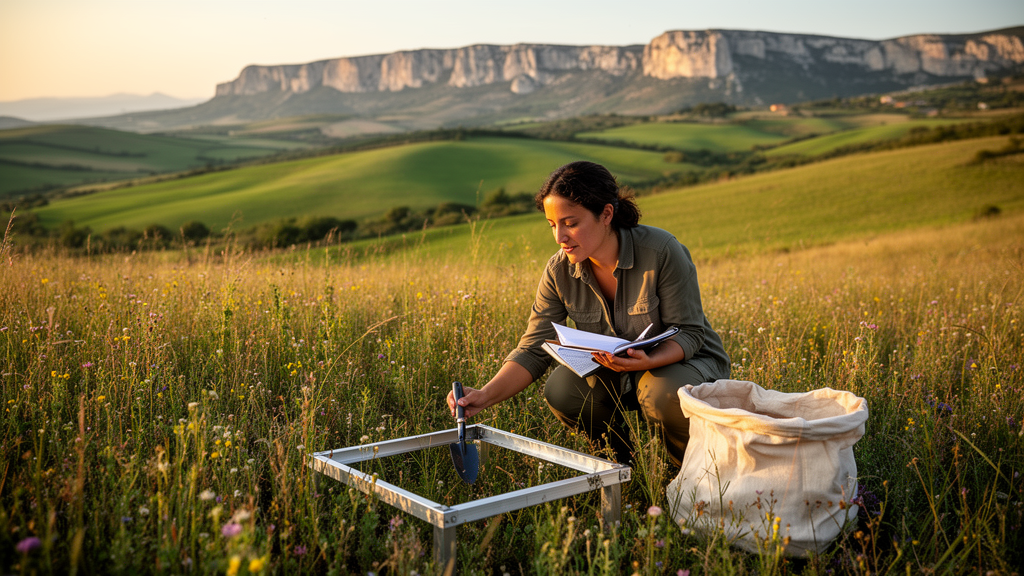
Sicily’s sun-baked dry grasslands have long been treated by Mediterranean vegetation scientists as two separate worlds: annual plant communities dominated by short-lived therophytes, and perennial grasslands anchored by tough bunchgrasses. A new study, published in Vegetation Classification and Survey, argues that this split has been hiding much of the region’s true biodiversity. An international team of vegetation ecologists, working under the umbrella of the Eurasian Dry Grassland Group (EDGG), sampled Sicilian dry grasslands with an unusually complete protocol, recording every terricolous vascular plant, bryophyte and lichen in precisely delimited plots. The results suggest that Mediterranean grasslands are considerably richer than conventional datasets indicate, and that the traditional practice of splitting annual from perennial vegetation may be methodologically flawed.
The research emerged from the fourth EDGG Research Expedition, held from 29 March to 5 April 2012, when an international team of experts jointly sampled homogeneous grassland stands across the island. Sicily, the largest Mediterranean island at roughly 25,700 square kilometres, offered an ideal natural laboratory: pronounced climatic gradients, extraordinary geological diversity, and a well-studied flora. The team worked from sea level up to 1,200 metres on the northeastern flank of Mount Etna, and targeted four contrasting geo-lithological settings: the carbonate Panormid Complex in western Sicily, the Messinian evaporitic ‘Gessoso-Solfifera’ formation in the centre and south, coastal and inland dunes in the southeast, and Etna’s volcanic slopes.
The sampling design followed the EDGG’s standardised methodology. Twenty-one so-called EDGG Biodiversity Plots consisted of nested series with seven grain sizes ranging from 0.0001 to 100 square metres, with the smaller grains replicated in two opposite corners of the largest plot. Twenty-five additional 10-square-metre plots were added, yielding 67 plots of that size for classification. In every plot, the researchers recorded all species with shoot presence and estimated percentage cover on a continuous scale, deliberately including mosses, liverworts and soil lichens that Mediterranean surveys typically omit. Structural and topographic variables, from slope aspect to maximum microrelief, were measured in situ, and soil samples from the top 15 centimetres were analysed for texture, pH, electrical conductivity and organic matter content.
The biodiversity results are striking. Across all plots the team found 597 taxa, including 505 vascular plants, 71 bryophytes, 20 lichens and one cyanobacterium. Mean total species richness climbed from just 2.1 species in a 1-square-centimetre plot to 24.9 in a square metre and 60.6 in 100 square metres, with non-vascular plants contributing on average 15 percent of the taxa. At the 10-square-metre scale, mean richness was 42.4 species, ranging from 9 to 72. The expedition also yielded three first records for Sicily: the lichens Agonimia globulifera on Mount Cofano and Steinia geophana and Thelidium minutulum on evaporitic sediments near the ancient site of Heraclea Minoa.
When the 67 plots were subjected to a modified TWINSPAN cluster analysis, crispness analysis pointed to four main clusters at the upper level and nine at the lower level. The four main units corresponded to base-rich coastal sands, mainly of the class Ammophiletea; acidic inland sands on volcanic substrates, mainly Poetea bulbosae; nutrient-rich loamy soils, mainly Chenopodietea; and alkaline clayish soils, mainly Lygeo-Stipetea. Crucially, each cluster contained both annual and perennial vascular plants, and most also included non-vascular taxa, both in their overall species composition and in their diagnostic species lists. Non-metric multidimensional scaling confirmed that all nine terminal clusters were reasonably well separated in floristic space, with the first axis separating coastal dune vegetation from inland stands, the second distinguishing Etna’s high-elevation plots from lowland types, and the third tracking a disturbance gradient.
Soil variables proved to be the strongest environmental drivers of the classification. The nine clusters were clearly separated by all six measured soil properties. Coastal dune plots had the highest pH values, around 8, while the two Etna clusters had the lowest, around 6.5. Organic matter, measured as loss on ignition, reached about 15 percent in the heavily grazed rangeland cluster near a temporary pond on Mount Cofano, but fell below 2 percent on the dunes and young volcanic soils. Clay content of roughly 20 percent was restricted to the alkaline clayish-soil cluster and one sub-cluster, while sand content cleanly separated the sandy clusters from the finer-textured ones. Ecological Indicator Values for Europe, calculated as unweighted plot means, matched these measured patterns closely, with soil moisture, reaction, nitrogen, light and temperature all differing significantly among clusters.
The most consequential finding concerns classification. Under the prevailing Mediterranean practice, often described as quasi-synusial sampling, surveyors record one life form exhaustively and treat the other as occasional companions, and the class Thero-Brachypodietea was long ago split into separate annual and perennial classes. Yet in the new dataset, only six of the 67 plots could be assigned to a single phytosociological class by expert assessment; 33 plots belonged to two classes simultaneously and 22 to three. The unsupervised numerical classification did not reproduce the annual-versus-perennial split at the higher level at all. Instead, the therophyte-dominated units emerged nested within broader grassland types defined primarily by soil and elevation, suggesting that annual and perennial Mediterranean grasslands might be better treated at the order or alliance level rather than as distinct classes.
The authors argue that this mismatch has measurable costs for science. Comparing their data with the GrassPlot Diversity Explorer, Sicilian grasslands were about 30 percent poorer in species at the smallest grain than the Palaearctic average, but from 1 square metre upward they were richer, exceeding the Palaearctic mean by roughly 32 percent at 100 square metres, with 50.7 vascular plant species against a mean of 38.4. By contrast, analyses based on the European Vegetation Archive, which largely aggregates traditional phytosociological relevés, had ranked Sicilian grasslands as only average in richness, with about 16 species at 10 square metres versus 35.4 in the new study. The discrepancy, the researchers contend, stems largely from incomplete recording: when annuals are deliberately skipped in perennial plots and vice versa, biodiversity statistics are systematically biased downward, distorting continental and global diversity models.
The team also notes that the so-called perennial classes themselves are not as pure as the standard diagnostic species lists imply. Recent comprehensive revisions of Ammophiletea and Lygeo-Stipetea have shown that these units include substantial numbers of annual diagnostic species, sometimes exclusively so. Historical datasets predating the selective sampling convention, and surveys by schools that never adopted it, consistently record richer, more mixed stands. The authors therefore recommend that Mediterranean grassland ecologists adopt the same comprehensive protocol used elsewhere in Europe: record all vascular plants, and ideally bryophytes and lichens, in every precisely delimited plot, and assign vegetation units only after evaluating diagnostic, constant and dominant species together. Such consistency, they argue, is a prerequisite for any sound classification system.
The broader message extends beyond Sicily. Dry grasslands are among Europe’s most biodiverse and most threatened habitats, and conservation planning depends on accurate vegetation maps and diversity assessments. If a substantial fraction of the existing relevé data systematically underestimates richness because of a regional sampling convention, then macroecological models built on those data may misrepresent Mediterranean biodiversity hotspots. The Sicilian expedition demonstrates that when the whole community is counted, from tiny Pottiaceae mosses on clay soils to the iconic Ampelodesmos mauritanicus tussocks on limestone slopes, these landscapes reveal a level of fine-scale diversity that rivals, and at larger scales surpasses, their temperate counterparts. Reconciling the Mediterranean classification tradition with a consistent pan-European methodology, the authors conclude, would ultimately make both vegetation science and conservation practice more objective and comparable across the continent.
Subject of Research: Multi-taxon diversity and vegetation classification of Mediterranean dry grasslands in Sicily
Article Title: Dry grasslands of Sicily: Multi-taxon diversity and classification challenges
Article References: Guarino, R., Becker, T., Dembicz, I., Dolnik, C., Kozub, Ł., & Dengler, J. (2025). Dry grasslands of Sicily: Multi-taxon diversity and classification challenges. Vegetation Classification and Survey, 6, 301-327. https://doi.org/10.3897/vcs.175402
Image Credits: AI Generated
DOI: 10.3897/VCS.175402
Keywords: dry grasslands, Sicily, phytosociology, biodiversity, bryophytes, lichens, TWINSPAN, vegetation classification, Mediterranean ecology, species-area relationship, EDGG, soil variables
Cite Scienmag News
Margaret Porter. (October 16, 2026). Sicily’s Hidden Grassland Wealth Revealed by Whole-Community Sampling. Scienmag. https://scienmag.com/sicilys-hidden-grassland-wealth-revealed-by-whole-community-sampling/
Margaret Porter. "Sicily’s Hidden Grassland Wealth Revealed by Whole-Community Sampling." Scienmag, 16 October 2026, https://scienmag.com/sicilys-hidden-grassland-wealth-revealed-by-whole-community-sampling/. Accessed 16 October 2026.
Margaret Porter. "Sicily’s Hidden Grassland Wealth Revealed by Whole-Community Sampling." Scienmag. October 16, 2026. https://scienmag.com/sicilys-hidden-grassland-wealth-revealed-by-whole-community-sampling/


