


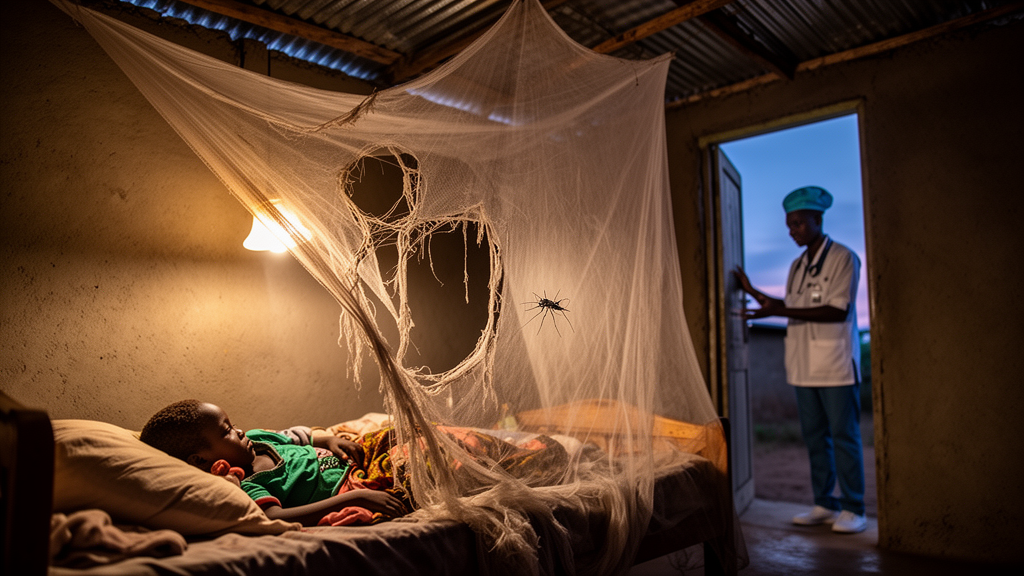
For two decades, Africa’s fight against malaria rested on a deceptively simple design. The dominant mosquito vectors bred in rural water bodies, people slept indoors under insecticide-treated nets, and a single class of chemistry, the pyrethroids, killed mosquitoes on contact with the netting. That architecture worked: between 2000 and 2015, infection prevalence roughly halved across endemic Africa and an estimated 663 million clinical cases were prevented, with insecticide-treated nets the single largest contributor, responsible for about two-thirds of the cases averted. Yet the World Health Organization now estimates 282 million malaria cases and 610,000 deaths in 2024, with the African region carrying approximately 94 percent of cases and 95 percent of deaths, most of them among children under five. Cases have risen every year since 2019, and mortality remains above prepandemic levels. A new Perspective published in Frontiers in Malaria argues that the problem is no longer one of scale but of design, and that vector control must be redesigned rather than merely resupplied.
The redesign is driven by two threats arriving at once, each dismantling one of the founding assumptions of the old model. The first is Anopheles stephensi, an efficient urban malaria vector native to South Asia and the Arabian Peninsula that has now been reported in nine African countries. Unlike the rural Anopheles gambiae and Anopheles funestus that African control programs were built around, A. stephensi is at home in the center of cities, breeding readily in water tanks, cisterns, rooftop reservoirs, and construction water. It tolerates the hot, dry conditions that exclude many native vectors, and it shows behavioral flexibility, resting and feeding both indoors and outdoors and taking blood from livestock as well as people, which allows it to slip past tools designed for a mosquito that bites a sleeping person indoors at night. A control system optimized for rural vectors was never configured to find or kill it.
The spread has been rapid and follows a recognizable pattern. A little over a decade ago, the species’ range extended only across South Asia and parts of the Arabian Peninsula. Its first African detection came in 2012 at a seaport in Djibouti, followed by Ethiopia and Sudan in 2016, Somalia in 2019, Nigeria in 2020, Eritrea, Kenya and Ghana in 2022, and Niger in 2024, with detections beyond Africa in Sri Lanka and Yemen. The African detections have clustered around seaports and trade corridors, consistent with introduction through maritime traffic. The World Health Organization has issued a vector alert, launched a dedicated initiative to slow the spread, and classified the mosquito as a major threat to malaria control and elimination. Djibouti shows where this can lead: the country was approaching elimination when the vector arrived, and reported cases climbed from a few thousand to tens of thousands within a decade. Spatial modeling suggests that if the mosquito spreads unchecked, an additional 126 million urban Africans could be brought within reach of malaria, a threat that grows as the share of Africans living in cities rises from more than four in ten today toward roughly six in ten by mid-century.
One of the most operationally useful features of the new vector is its resemblance to Aedes aegypti, the mosquito that transmits dengue. The two species share container habitats: in Djibouti, A. stephensi was found breeding alongside A. aegypti and Culex quinquefasciatus in urban containers, and in Aden, Yemen, it was first detected in container surveys targeting A. aegypti. This means the container larval surveys, ovitraps, and household container indices that arbovirus programs already run can find A. stephensi without building new field infrastructure, and multiplex molecular assays, including environmental DNA recovered from breeding-site water, can identify both species and their resistance markers from a single sample. But the overlap is partial rather than complete. In Kebri Dehar, in eastern Ethiopia, the most productive A. stephensi habitats were large ground-level cisterns holding domestic and construction water, while A. aegypti concentrated in tires and small containers. In Ouagadougou, drums and barrels ranked second to tires for larval production in two of three health districts and were the most productive pupal habitat in one. The lesson is that container lists cannot be written in advance; which containers carry the productivity must be established by local larval and pupal surveys, city by city, before larval source management is targeted.
The sharpest warning of what happens when threats converge came from Dire Dawa, Ethiopia’s second-largest city. In 2022, a prospective case-control investigation tied a dry-season malaria outbreak there to A. stephensi breeding in urban water containers. The episode mattered for more than the vector. The parasites recovered carried molecular signatures of both artemisinin partial resistance in the kelch13 gene and deletions of the histidine-rich protein 2 and 3 genes, which allow Plasmodium falciparum to evade the rapid diagnostic tests on which most African programs rely. In a single outbreak, three threats usually discussed separately arrived together: an invasive urban vector that the net-and-spray model does not stop, parasites against which the first-line medicine is beginning to fail, and parasites that the standard diagnostic can miss. A response that addresses only one of the three leaves the others free to operate, and the danger sits precisely where surveillance is thinnest, in fast-growing cities never previously treated as malaria-transmission settings.
The second front is chemical. For most of the period in which the treated net carried the response, pyrethroids were the only insecticide class approved for treating nets, and the resulting selection pressure has produced widespread resistance across the principal African vectors, driven by both target-site mutations that reduce insecticide binding and metabolic mechanisms in which overexpressed detoxifying enzymes break the compound down. The consequence is not theoretical. Mathematical modeling combining entomological and trial data estimates that pyrethroid resistance has measurably eroded the protection nets provide, and hut-trial data make the loss concrete: against wild pyrethroid-resistant mosquitoes, a standard pyrethroid-only net kills only about one in five of the host-seeking vectors that contact it. A net that kills a fifth of the mosquitoes it meets is still distributed, counted, and reported as coverage, but it delivers a fraction of the protection the coverage figure implies. Across large areas, coverage and protection have come apart, and the gap between them is invisible in the routine statistics that programs and donors use to judge progress.
Two redesigned net classes have reached scale in response. The first adds the synergist piperonyl butoxide, which inhibits the detoxifying enzymes behind metabolic resistance and partly restores the pyrethroid’s killing power; in a large pragmatic trial embedded in Uganda’s national net campaign, PBO nets reduced infection prevalence relative to conventional pyrethroid nets. The second pairs the pyrethroid with a second active ingredient acting by a different mechanism. A cluster-randomized superiority trial in Benin found that a chlorfenapyr-pyrethroid net reduced malaria infection prevalence by 46 percent over two years relative to a pyrethroid-only net, and a four-arm trial in Tanzania testing all three next-generation net types head to head recorded a 55 percent reduction in the odds of infection for the chlorfenapyr net and ranked it the most effective and most cost-effective of the new designs. In that same trial, neither the PBO net nor the pyriproxyfen net significantly outperformed the standard net, a reminder that the next-generation label spans products of very different value. The market has moved with the evidence: next-generation nets rose from 59 percent of those delivered to sub-Saharan Africa in 2022 to 78 percent of 195 million nets delivered in 2023.
The limits matter as much as the gains. Next-generation nets cost more, a real constraint as financing contracts, and their advantages rest on durability that varies between products. The third-year analysis of the Benin trial found that the entomological and epidemiological advantage of the dual-ingredient nets had largely faded by their final year of intended use, partly through declining insecticide content and lower net use. The operational implication is uncomfortable for programs accustomed to a single commodity: net type now has to be matched to the local resistance mechanism, and that matching is only possible where resistance is actually measured. The net has stopped being generic and has become a choice that depends on surveillance. Beyond the net, the evidence supports a diversified toolbox. A Cochrane review found that larval source management reduced malaria incidence by 49 to 74 percent and prevalence by 68 to 89 percent where breeding habitats are few, fixed, and findable, which closely describes A. stephensi in an African city. In Kebri Dehar, 77 percent of larvae came from just 23 percent of sites, and a metapopulation model predicted that treating those superproductive reservoirs at coverage above 60 percent could locally eliminate the population. House modification has independent support, with a Cochrane review finding residents of screened or otherwise modified houses about a third less likely to carry P. falciparum, and volatile pyrethroid spatial emanators address the outdoor and residual biting that nets do not capture. By contrast, larvivorous fish lack sufficient evidence, and attractive targeted sugar baits produced no significant reduction in malaria incidence or prevalence in phase III trials in Zambia and Kenya, a discipline that rejects the untested alternative on the same grounds as the generic pyrethroid net.
Every element of this redesign rests on entomological and resistance surveillance, and that is where the system is most exposed. Meaningful resistance monitoring requires sentinel sites sampled at defined intervals, WHO discriminating-concentration bioassays to establish whether resistance is present, intensity assays to establish whether it matters operationally, and synergist assays with piperonyl butoxide to establish whether the mechanism is metabolic, the question that determines whether a PBO net is the correct purchase or a wasted premium. Detecting A. stephensi requires larval container surveys and adult trapping at seaports, airports, and trade corridors, with molecular confirmation because misidentification against native anophelines is common. The obstacle is not only the volume of financing but its structure. The Global Fund requires that a switch to a more expensive net class be justified by robust entomological data, yet the surveillance that generates that evidence competes for the same country allocation as the commodities themselves, and commodities win when the allocation contracts. The failure mode is slow and specific: a program can distribute nets from existing pipelines for a year or more while its ability to detect rising resistance and find the new vector early decays without appearing in any coverage statistic. By the time the loss is visible in cases, the decisions that would have prevented it are years past. The cheapest moment to contain A. stephensi and stay ahead of resistance has already passed; the next cheapest is now, while the tools exist, the vector’s range is still incomplete, and the resistance is still partial. The window will not stay open on its own, and the surveillance that would tell us how fast it is closing is the very thing now most at risk.
Subject of Research: Redesigning malaria vector control in Africa in response to the invasive urban mosquito Anopheles stephensi and widespread pyrethroid insecticide resistance
Article Title: Built for the village, breached in the city: redesigning malaria vector control for Anopheles stephensi and insecticide resistance
Article References: Sriram, S. (2026). Built for the village, breached in the city: redesigning malaria vector control for Anopheles stephensi and insecticide resistance. Frontiers in Malaria, 4, Article 1916446. https://doi.org/10.3389/fmala.2026.1916446
Image Credits: AI Generated
DOI: 10.3389/fmala.2026.1916446
Keywords: Anopheles stephensi, urban malaria, pyrethroid resistance, insecticide-treated nets, chlorfenapyr, piperonyl butoxide, larval source management, vector surveillance, Ethiopia, Global Fund financing, spatial emanators, malaria control
Cite Scienmag News
Phoebe Ingram. (October 16, 2026). Urban mosquito and failing nets force a redesign of Africa’s malaria defense. Scienmag. https://scienmag.com/urban-mosquito-and-failing-nets-force-a-redesign-of-africas-malaria-defense/
Phoebe Ingram. "Urban mosquito and failing nets force a redesign of Africa’s malaria defense." Scienmag, 16 October 2026, https://scienmag.com/urban-mosquito-and-failing-nets-force-a-redesign-of-africas-malaria-defense/. Accessed 16 October 2026.
Phoebe Ingram. "Urban mosquito and failing nets force a redesign of Africa’s malaria defense." Scienmag. October 16, 2026. https://scienmag.com/urban-mosquito-and-failing-nets-force-a-redesign-of-africas-malaria-defense/


