


Vitamin C has long been celebrated as a workhorse of human biology, a cofactor for collagen synthesis, a scavenger of reactive oxygen species, and a staple of skincare counters and supplement shelves. Yet the raw molecule, L-ascorbic acid, is notoriously fragile: it degrades rapidly in water and enters cells inefficiently, which has pushed chemists to develop more stable derivatives. One of the most promising of these is 3-O-ethyl-L-ascorbic acid, or EAA, a compound in which an ethyl group is attached to the vitamin C backbone to shield it from premature breakdown. Now, a team of researchers at the Biota Laboratories R&D Center in Istanbul has asked what this stabilized derivative actually does inside human lung cells, and the answer, published in Acta Biochimica Polonica, is a striking pattern of simultaneous anti-inflammatory and matrix-building activity.
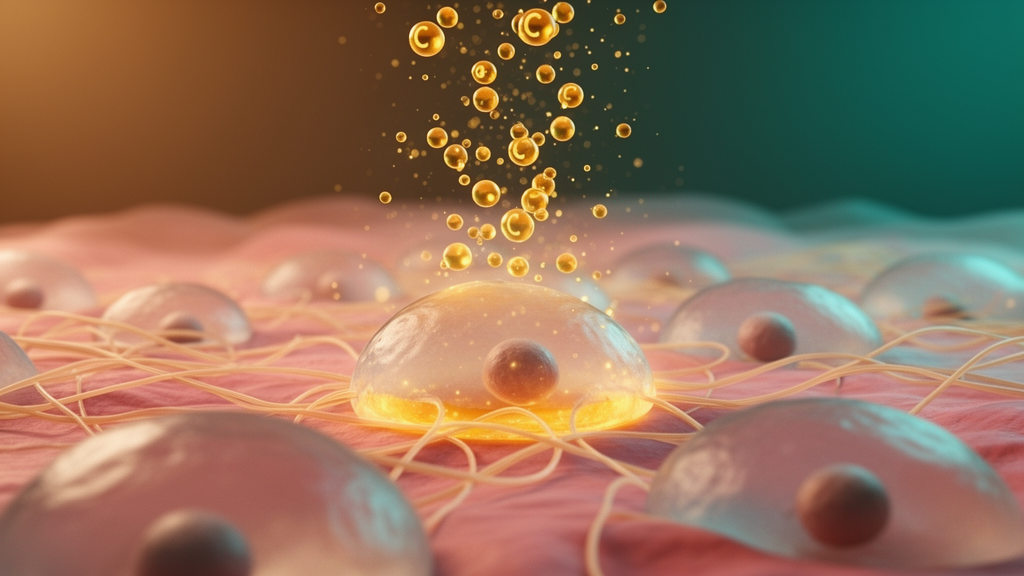
The study focused on MRC-5 cells, a widely used line of human lung fibroblasts. Fibroblasts are the unsung architects of the lung: they spin out the collagen, elastin, and other structural proteins that form the extracellular matrix, the three-dimensional scaffold that gives tissue its shape and elasticity. In the lung, this matrix is far more than passive scaffolding. It actively regulates development, repair, and cellular behavior, and its disorganization is a hallmark of chronic diseases ranging from chronic obstructive pulmonary disease to pulmonary fibrosis. Because resident fibroblasts are the principal matrix-producing cells of the lung interstitium, they are an ideal testing ground for compounds that might tip the balance of matrix maintenance in a favorable direction.
Before probing biomarkers, the researchers had to establish a safe dose. Using the XTT colorimetric assay, they exposed MRC-5 cells to EAA concentrations ranging from 1.25 to 160 millimolar for 24 and 48 hours. At low concentrations of 1.25 to 5 millimolar, viability after 24 hours actually exceeded control levels by 10 to 20 percent, hinting at a mild proliferative stimulus, though this effect faded toward baseline by 48 hours. Intermediate concentrations of 10 to 20 millimolar trimmed viability by roughly 10 to 25 percent, and concentrations of 40 millimolar or higher proved clearly cytotoxic. The team therefore settled on 5 millimolar for all subsequent experiments, a dose that preserved viability at or slightly above control levels across both exposure periods.
With a non-toxic dose in hand, the researchers turned to enzyme-linked immunosorbent assays, or ELISAs, to quantify a panel of nine proteins secreted into the culture medium: three pro-inflammatory cytokines, three matrix-building components, and three matrix-degrading enzymes. The inflammatory results were the first surprise. Under completely unstimulated, basal conditions, EAA treatment significantly lowered interleukin-1 beta by approximately 3 to 4 percent, interleukin-6 by about 26 percent, and tumor necrosis factor-alpha by roughly 24 percent, with p-values of 0.024, 0.013, and 0.006 respectively. These cytokines are not merely markers of inflammation; they actively drive the production of matrix-degrading enzymes, so damping them down could, in principle, protect the lung’s structural framework from inflammatory erosion.
The matrix-building side of the ledger told an even more dramatic story. Levels of collagen type I and collagen type III, the two fibrillar collagens that provide tensile strength to connective tissue, rose significantly in EAA-treated cells at both 24 and 48 hours, and the effect grew stronger with time. Two-way analysis of variance revealed highly significant effects of treatment, time, and their interaction for both collagen types, all with p-values below 0.0001. By 48 hours, EAA-treated cultures showed the highest collagen levels of any group. This is biochemically coherent: vitamin C serves as an essential cofactor for prolyl and lysyl hydroxylases, the enzymes that stitch together the hydroxylated residues needed to stabilize the collagen triple helix, and decades of prior work have shown that ascorbate stimulates collagen synthesis in fibroblasts, with maximal production typically emerging after about two days of exposure.
Just as notable was the behavior of hyaluronan synthase 2, or HAS2, the enzyme responsible for manufacturing hyaluronic acid, the glycosaminoglycan that keeps tissue hydrated, elastic, and communicative. HAS2 levels climbed significantly in EAA-treated cells at both time points, with the largest increase again at 48 hours and all pairwise comparisons against controls reaching p-values below 0.0001. The finding echoes earlier reports that ascorbic acid stimulates hyaluronic acid production in human trabecular meshwork cells, but extending that effect to lung fibroblasts through a stable derivative is new. Together, the collagen and HAS2 data suggest that EAA nudges fibroblasts toward a more matrix-productive state rather than simply acting as a passive antioxidant.
The matrix-degrading enzymes added a layer of nuance that makes the study genuinely interesting. Matrix metalloproteinase-1, which cleaves fibrillar collagens, and matrix metalloproteinase-9, which degrades a broader slate of matrix components, both responded to EAA in a biphasic, time-dependent fashion: their levels were higher than controls at 24 hours but lower than controls at 48 hours. For MMP-9, the two-way ANOVA showed significant effects of treatment, time, and interaction, while for MMP-1 the interaction was significant even though the overall treatment effect was not, indicating that EAA reshaped the enzyme’s trajectory over time rather than pushing it uniformly up or down. The authors suggest this early rise may reflect the dynamic sequence seen during tissue remodeling, in which a transient wave of matrix degradation precedes a phase of renewed synthesis.
Elastase, by contrast, showed no such ambivalence. This protease, best known as a weapon of neutrophils but also produced by fibroblasts themselves, chews through elastin and has been implicated in wrinkle formation in skin and in progressive structural deterioration in the lung. EAA reduced elastase levels at both 24 and 48 hours, with a significant main effect of treatment at p below 0.0001 and confirmed pairwise reductions at both time points. Because elastase-driven destruction of elastic fibers is a recurring theme in emphysema and other pulmonary disorders, a compound that consistently suppresses fibroblast-derived elastase while simultaneously raising collagen and hyaluronic acid machinery paints an intriguing picture of a cellular environment tilted toward matrix preservation.
Taken together, the measured biomarkers shifted in a coherent direction: less inflammatory signaling, more matrix-building output, and, by the later time point, less matrix-degrading capacity. The authors are careful, however, to keep the interpretation provisional. The experiments were conducted in a single fibroblast cell line under in vitro conditions, without an inflammatory stimulus, so the cytokine reductions reflect modulation of constitutive signaling rather than suppression of an induced inflammatory response. The study measured protein levels in culture supernatants, not protease activity, collagen deposition or cross-linking, actual hyaluronan production, or functional matrix remodeling. And because native L-ascorbic acid was not included as a comparator, the results cannot say whether EAA outperforms ordinary vitamin C or merely reproduces its effects in a more stable package.
Those caveats define the roadmap for what comes next. Side-by-side comparisons with L-ascorbic acid and other stable derivatives such as 2-phospho-L-ascorbate would clarify EAA’s relative potency, while experiments using inflammatory stimuli, co-culture systems, or three-dimensional lung tissue models would test whether the biomarker shifts translate into genuine functional changes in matrix homeostasis. Still, the core finding stands on its own: a cosmetic-industry favorite, long valued mainly for its shelf stability, turns out to be an active modulator of inflammatory and structural biology in human lung fibroblasts. If follow-up work confirms that these biomarker changes reflect real matrix remodeling, EAA could move from the skincare aisle toward a role in protecting the lung’s delicate architectural scaffold against the slow degradation that underlies so many chronic respiratory diseases.
Subject of Research: Effects of 3-O-ethyl-L-ascorbic acid on inflammatory and extracellular matrix biomarkers in human lung fibroblasts
Article Title: 3-O-ethyl-L-ascorbic acid modulates pro-inflammatory cytokine and extracellular matrix-related biomarker levels in human lung fibroblasts: an in vitro study
Article References: 3-O-ethyl-L-ascorbic acid modulates pro-inflammatory cytokine and extracellular matrix-related biomarker levels in human lung fibroblasts: an in vitro study. (n.d.). https://doi.org/10.3389/abp.2026.16774
Image Credits: AI Generated
Keywords: 3-O-ethyl-L-ascorbic acid, vitamin C, MRC-5 fibroblasts, extracellular matrix, collagen, hyaluronan synthase 2, matrix metalloproteinases, elastase, interleukin-6, TNF-alpha, lung fibrosis, ELISA
Cite Scienmag News
Barbara Leach. (October 16, 2026). Stable Vitamin C Derivative Calms Inflammation and Boosts Collagen in Human Lung Cells. Scienmag. https://scienmag.com/stable-vitamin-c-derivative-calms-inflammation-and-boosts-collagen-in-human-lung-cells/
Barbara Leach. "Stable Vitamin C Derivative Calms Inflammation and Boosts Collagen in Human Lung Cells." Scienmag, 16 October 2026, https://scienmag.com/stable-vitamin-c-derivative-calms-inflammation-and-boosts-collagen-in-human-lung-cells/. Accessed 16 October 2026.
Barbara Leach. "Stable Vitamin C Derivative Calms Inflammation and Boosts Collagen in Human Lung Cells." Scienmag. October 16, 2026. https://scienmag.com/stable-vitamin-c-derivative-calms-inflammation-and-boosts-collagen-in-human-lung-cells/


