


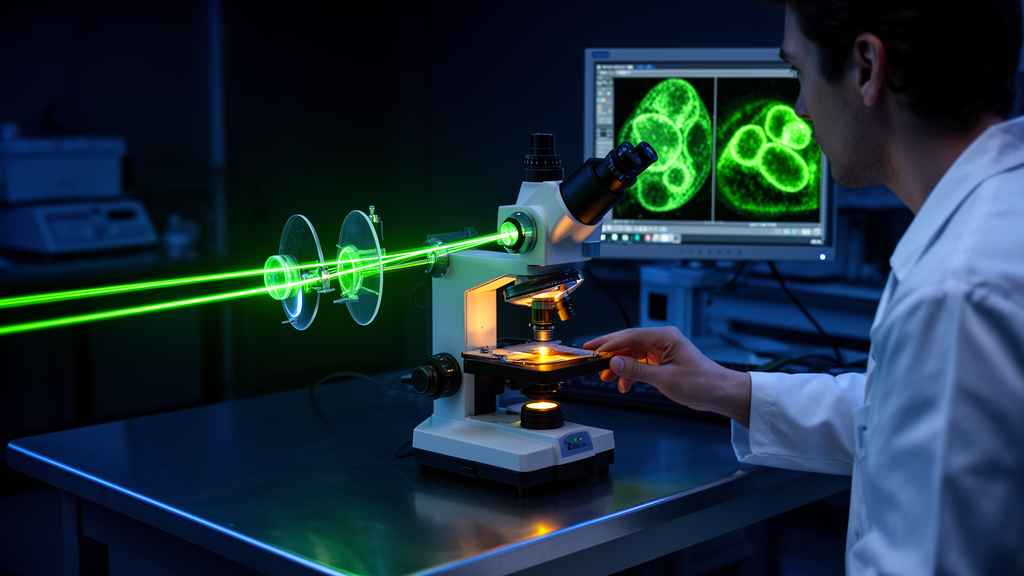
Two-photon microscopy has long been the workhorse of deep-tissue biological imaging, prized for its optical sectioning, reduced photobleaching and ability to peer hundreds of micrometers into scattering specimens. Yet its speed has always been hostage to mechanics: conventional instruments raster-scan a focused laser spot with moving mirrors, and the inertia of those scanners caps frame rates well below what fast biological events demand. Now researchers at the Institute for Biomedical Optics at Universität zu Lübeck, together with a colleague at Vilnius University, report a way to make one of the fastest point-scanning microscopes in existence not just quicker, but programmably adaptable to the physics of the sample itself.
The technique, called Spectro-Temporal Laser Imaging by Diffractive Excitation, or SLIDE, sidesteps mechanical scanning along the fast axis entirely. It exploits a Fourier domain mode-locked (FDML) laser, a swept-source laser whose narrow-linewidth output sweeps rapidly through its spectrum at megahertz rates. When this sweep is directed onto a diffraction grating, each wavelength in the sweep maps to a different angle, and therefore to a different position on the sample. The result is an inertia-free scan in which the laser’s wavelength sweep effectively paints one line of an image per sweep, at line rates in the megahertz regime. A galvanometric mirror handles only the slow axis, allowing kilohertz frame rates with pixel rates that can reach gigapixels per second.
That extraordinary speed, however, carries a hidden cost. In the original SLIDE configuration, the pixel dwell time is roughly one nanosecond, because each picosecond pulse from the laser addresses exactly one pixel. Most common fluorescent dyes emit over several nanoseconds, meaning the glow from one pixel is still decaying when the laser has already moved on to its neighbors. The consequence is bleed-through: photons from an excited spot contaminate adjacent pixels, blurring the image and corrupting any attempt to extract fluorescence lifetime information, the basis of fluorescence lifetime imaging microscopy (FLIM). For signals that respond essentially instantaneously, such as second harmonic generation (SHG) from collagen or urea crystals, the nanosecond dwell time is no problem at all, but for fluorescence it is fundamentally too short.
The Lübeck team’s solution, published in Frontiers in Photonics, is elegant in its simplicity: rather than forcing the sample to fit the microscope’s timing, they let the microscope’s timing fit the sample. Their approach, interleaved sampling, keeps the laser’s sweep rate constant but splits the illumination of each image line across multiple successive sweeps. For an interleaving factor of two, for example, the pulse repetition rate is halved and the pulse train is shifted in phase by half a pulse interval after every sweep. Two consecutive line scans are then binned together, reconstructing a single line with the same 512-pixel density as the original, but with twice the temporal spacing between excitation pulses.
The key enabling technology is a reprogrammable arbitrary waveform generator (AWG) card that drives the electro-optic modulator (EOM) which carves the FDML output into 35-picosecond pulses. In previous SLIDE systems, a phase-locked loop generated a fixed clock for a constant pulse rate of 820 megahertz, locked to the 1.6 megahertz FDML sweep. By replacing this fixed clock with an AWG pattern, the team gained pulse-on-demand operation: the pulse pattern can be changed on the fly, and the effective pixel dwell time becomes a programmable parameter. The AWG card communicates over PCIe at up to 2.8 gigabytes per second, allowing rapid reprogramming, and the system can update its imaging parameters with a latency of only 5 to 10 milliseconds.
The flexibility cuts both ways. At an interleaving factor of eight, the pixel dwell time stretches to nearly 10 nanoseconds, comfortably longer than typical fluorescence decays, while the pulse rate drops to 102.5 megahertz. Because the two-photon excitation efficiency depends quadratically on peak power, the lower pulse rate also concentrates the same average laser power into fewer, more intense pulses, boosting the fluorescence signal. The researchers report that the mean signal level increased fivefold under the interleaved pulse pattern, and that no jitter or inter-sweep phase mismatches were observed across all interleaving factors. At the opposite extreme, an interleaving factor of 0.5 pushes the pulse rate to 1.64 gigahertz, ideal for quasi-instantaneous SHG signals, though this regime demanded a substantially higher average power of 717 milliwatts on the sample.
The experimental validation spanned several sample types. Imaging micrometer-sized fluorescent beads showed that spatial resolution is fully retained under interleaved sampling, with no timing artefacts from jitter or sweep inhomogeneities. With 500-nanometer beads, the team quantified the bleed-through problem directly: under non-interleaved operation, the fluorescence decay exceeded the pixel dwell time and the bead appeared elongated along the scan direction, whereas eightfold interleaving suppressed the effect and restored a circular image. The improvement in localization precision was striking, with the standard deviation of a frame-wise two-dimensional Gaussian fit shrinking from 990 nanometers to 186 nanometers when moving from non-interleaved to eightfold-interleaved imaging.
On biological tissue, the technique demonstrated genuine lifetime-based contrast. Histological sections stained with SYTO82 for cell nuclei and Rhodamine 6G for non-specific labeling were imaged with single-pulse FLIM, and the fluorescence lifetimes, color-coded between 0.8 and 2.5 nanoseconds in an HSV representation, clearly distinguished nuclei from surrounding tissue using a single detector. Unaveraged images were acquired at 400 hertz, while tenfold frame averaging yielded higher-fidelity fits at 40 hertz, still fast enough for 25-millisecond temporal resolution. The authors note that a quantitative evaluation of single-pulse FLIM under interleaved SLIDE, including lifetime standards and fit-quality assessment, is ongoing work to be reported separately.
The approach also extends naturally into three dimensions. Using a piezo-driven objective scanner oscillating at 12 hertz, the team imaged living, highly motile Euglena gracilis microalgae, whose chloroplast autofluorescence requires no staining. Operating at a fourfold interleaving factor set the pixel dwell time to about 5 nanoseconds, enough to suppress bleed-through, while a 781-hertz frame rate distributed over 32 axial planes delivered a 24-hertz volume rate across a 210 by 150 by 64 cubic micrometer field of view. The cells showed no photodamage at the applied laser powers, although the authors caution that the thermal load in the fastest, highest-power regime would need separate investigation. Because volume rate equals frame rate divided by the number of planes, the interleaving factor propagates linearly into the third dimension, making it a programmable trade-off knob between bleed-through suppression and volumetric speed.
Looking forward, the researchers envision smart SLIDE systems in which the microscope adapts itself to the specimen in real time. Because each waveform contains the control signals for a full image scan, the pulse repetition rate can in principle be defined per pixel, allowing individual regions of interest to be addressed at individually optimized interleaving settings. Combined with real-time signal analysis, such a microscope could automatically choose pulse timing and excitation settings based on measured fluorescence lifetime or signal strength, balancing imaging speed, signal-to-noise ratio and laser dose for each region of the sample. For neuroscientists chasing kilohertz-scale voltage dynamics, or pathologists seeking rapid lifetime contrast in stained tissue, the message is clear: the fastest point-scanning multiphoton microscope has just learned to slow itself down precisely when, and only when, the biology requires it.
Subject of Research: Adaptive interleaved sampling in SLIDE two-photon microscopy for tunable pixel dwell times
Article Title: Interleaving SLIDE microscopy
Article References: Interleaving SLIDE microscopy. (n.d.). https://doi.org/10.3389/fphot.2026.1883605
Image Credits: AI Generated
DOI: 10.3389/fphot.2026.1883605
Keywords: two-photon microscopy, SLIDE, fluorescence lifetime imaging, interleaved sampling, FDML laser, second harmonic generation, electro-optic modulator, high-speed imaging, biophotonics, volumetric imaging, adaptive microscopy, FLIM
Cite Scienmag News
Katie Riggs. (October 16, 2026). Interleaved laser pulses give ultrafast two-photon microscope a tunable shutter speed. Scienmag. https://scienmag.com/interleaved-laser-pulses-give-ultrafast-two-photon-microscope-a-tunable-shutter-speed/
Katie Riggs. "Interleaved laser pulses give ultrafast two-photon microscope a tunable shutter speed." Scienmag, 16 October 2026, https://scienmag.com/interleaved-laser-pulses-give-ultrafast-two-photon-microscope-a-tunable-shutter-speed/. Accessed 16 October 2026.
Katie Riggs. "Interleaved laser pulses give ultrafast two-photon microscope a tunable shutter speed." Scienmag. October 16, 2026. https://scienmag.com/interleaved-laser-pulses-give-ultrafast-two-photon-microscope-a-tunable-shutter-speed/


