


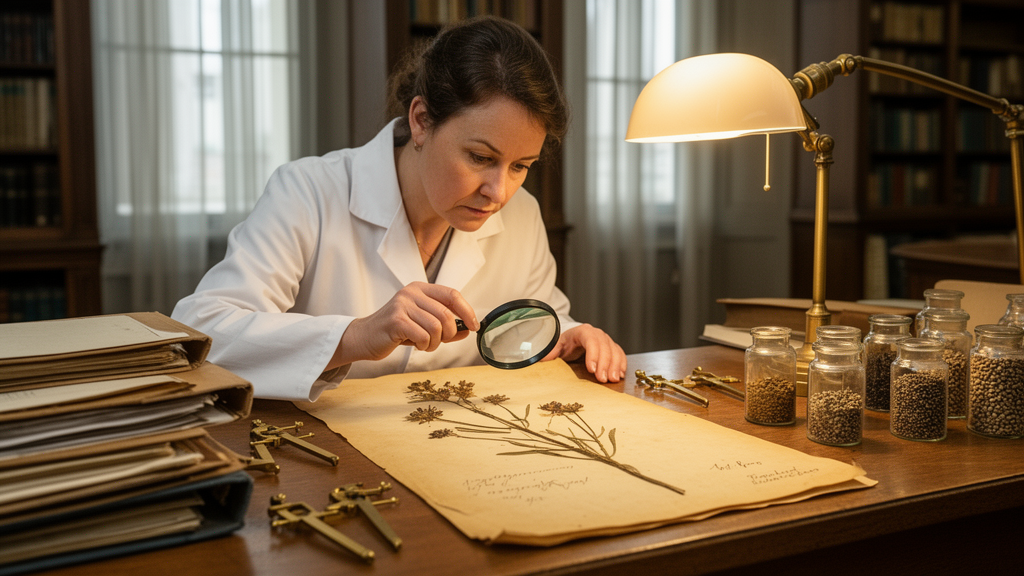
Deep inside the Linnaean Herbarium in London, a single pressed plant sheet has just been given one of botany’s quietest but most consequential honors: it is now the official reference specimen for a name that Carl Linnaeus himself coined in 1753. In a study published in Italian Botanist, a researcher has designated the specimen Herb. Linn. No. 1017.9, preserved at LINN, as the lectotype of Achillea impatiens, a yarrow relative Linnaeus described in his landmark Species Plantarum. The designation may sound like an archival footnote, but in taxonomy it is the difference between a name that means one thing forever and a name that could drift, split, or collapse into confusion.
Achillea impatiens belongs to the genus Achillea, the yarrow group of the daisy family Asteraceae, one of the largest genera in the tribe Anthemideae. Today botanists recognize roughly 141 accepted species spread across the temperate and subtropical Northern Hemisphere, with major centres of diversity in southeastern Europe and southwestern Asia and a range stretching across Eurasia to North America. Linnaeus published 22 names in Achillea between 1753 and 1763, and most of them are still accepted today. Five have been reduced to synonyms through later revisions, including transfers to other genera such as Tanacetum and Lonas. Every accepted Linnaean species in the genus had already been typified through previous nomenclatural studies, with one stubborn exception: Achillea impatiens remained untypified, leaving its application formally unstable.
Typification is the process by which a name is anchored to a physical specimen or illustration, called a type, that defines what the name actually refers to. Under the International Code of Nomenclature for algae, fungi, and plants, every species name must rest on a type so that future botanists can check exactly which plant Linnaeus meant. When Linnaeus described a species, the elements he worked from, including specimens in his own herbarium and illustrations he cited, are known as original material. Choosing one of these elements as the lectotype locks the name to current usage and prevents later botanists from reinterpreting it in ways that would force wholesale renaming of familiar plants.
The detective work behind the new designation began with the protologue, the original published description from Linnaeus’s Species Plantarum of 1753. There, Linnaeus gave a terse polynomial diagnosis, borrowed directly from the 1740 work of van Royen, describing the plant as having pinnately divided leaves with distant, linear-lanceolate segments. He also cited a polynomial and an illustration published by Johann Georg Gmelin in Flora Sibirica of 1747, and gave the provenance simply as Habitat in Sibiria. He added a note that the plant delights in white flowers and that the remote and widely spaced leaf segments distinguish it from all other species of the genus.
Following these citations, the study identified two elements that qualify as original material. The first is Gmelin’s illustration in Flora Sibirica, explicitly cited by Linnaeus in the protologue, which therefore counts as original material under the Code. The second is the specimen Herb. Linn. No. 1017.9 in the Linnaean Herbarium. The sheet bears Linnaeus’s own annotation, the number 8 followed by the word impatiens, where the number 8 corresponds exactly to the Linnaean number of Achillea impatiens in Species Plantarum. That annotation is the smoking gun: it proves the specimen was part of the material Linnaeus used when he prepared the original description, making it original material for the name.
The specimen itself is well preserved and displays the diagnostic features Linnaeus emphasized, including pinnately divided leaves with elongate, acute, linear-lanceolate segments, the lowermost segments bearing an additional upward-directed tooth, and the distinctly remote arrangement of the leaf segments that leaves the rachis conspicuously exposed. Both the LINN specimen and Gmelin’s illustration match the protologue on every point, confirming that they represent the same plant Linnaeus had in mind. In accordance with Article 9.12 of the Code, the LINN specimen was designated as the lectotype, a choice that preserves the traditional concept and current application of the name as used by generations of botanists from the nineteenth century to modern treatments.
Not every candidate specimen made the cut. Two further specimens are preserved in the Smith Herbarium at LINN-HS on sheet No. 1315.24, and their annotations tell a revealing story. The first is labelled Rev. Mr. Watts’s garden, Ashill, Sep. 1, 1801, meaning it was collected from a garden in England 48 years after Species Plantarum appeared. The second is labelled From his herbarium, and the sheet carries later annotations reading Achillea impatiens and Mr Watts. Because their post-1753 provenance is explicit, these specimens were not available to Linnaeus when he prepared the protologue and therefore cannot be considered original material. The study also searched the van Royen Herbarium, preserved at Leiden, for a specimen linked to the diagnosis Linnaeus cited from van Royen’s 1740 work, but no such specimen could be located.
The designation also settles a long-standing bibliographic tangle involving the French botanist Augustin Pyramus de Candolle. In 1838, Candolle accepted the species under the genus Ptarmica and published the name Ptarmica impatiens, explicitly citing Achillea impatiens L. along with the main synonyms associated with the Linnaean concept, including Gmelin’s illustration. Under Article 7.3 of the Code, that makes Ptarmica impatiens a nomenclatural combination based on the Linnaean name, correctly written Ptarmica impatiens (L.) DC. The study notes that the database Plants of the World Online erroneously treats the name as a heterotypic synonym, crediting it to Candolle as an independent name rather than as a combination, an error the new typification helps to correct.
Why does any of this matter beyond the herbarium walls? Names are the currency of biology. Achillea impatiens is used in floras, conservation assessments, ecological studies, and phylogenetic analyses across Eurasia, and every one of those uses depends on the name meaning exactly the same plant to every researcher. Without a type, a later botanist could argue that Linnaeus meant something different, forcing the familiar name to be reinterpreted or replaced and sending ripples through checklists and databases worldwide. By anchoring the name to a specimen Linnaeus himself annotated, the study promotes nomenclatural stability and preserves current usage, exactly the outcome the Code is designed to encourage.
The work also highlights how modern digital infrastructure has transformed nomenclatural research. High-resolution images of specimens in the Linnaean Herbarium and the Smith Herbarium were examined through the Linnean Collections Online portal, while Gmelin’s original illustrations were consulted through digital scans from the library of the Real Jardín Botánico de Madrid. Centuries-old volumes and specimens, once accessible only to researchers able to travel to European collections, can now be scrutinized by anyone with an internet connection. The result is a 270-year-old herbarium sheet, pressed from a plant of Siberia and annotated in Linnaeus’s own hand, now formally standing as the single reference point for a name that botanists will cite for centuries to come.
Subject of Research: Lectotypification of the Linnaean name Achillea impatiens in the yarrow genus Achillea
Article Title: Typification of the Linnaean name Achillea impatiens ( Asteraceae )
Article References: Abdollahi, M. R., Peruzzi, L., & Ghahremaninejad, F. (2026). Typification of the Linnaean name Achillea impatiens (Asteraceae). Italian Botanist, 22, 65-70. https://doi.org/10.3897/italianbotanist.22.212772
Image Credits: AI Generated
DOI: 10.3897/italianbotanist.22.212772
Keywords: Achillea impatiens, Carl Linnaeus, typification, lectotype, Asteraceae, nomenclature, herbarium, Italian Botanist, taxonomy, Species Plantarum, Linnaean, name
Cite Scienmag News
Drew Townsend. (October 15, 2026). Botanists Pin Down a Linnaean Name with a 270-Year-Old Herbarium Sheet. Scienmag. https://scienmag.com/botanists-pin-down-a-linnaean-name-with-a-270-year-old-herbarium-sheet/
Drew Townsend. "Botanists Pin Down a Linnaean Name with a 270-Year-Old Herbarium Sheet." Scienmag, 15 October 2026, https://scienmag.com/botanists-pin-down-a-linnaean-name-with-a-270-year-old-herbarium-sheet/. Accessed 15 October 2026.
Drew Townsend. "Botanists Pin Down a Linnaean Name with a 270-Year-Old Herbarium Sheet." Scienmag. October 15, 2026. https://scienmag.com/botanists-pin-down-a-linnaean-name-with-a-270-year-old-herbarium-sheet/


