


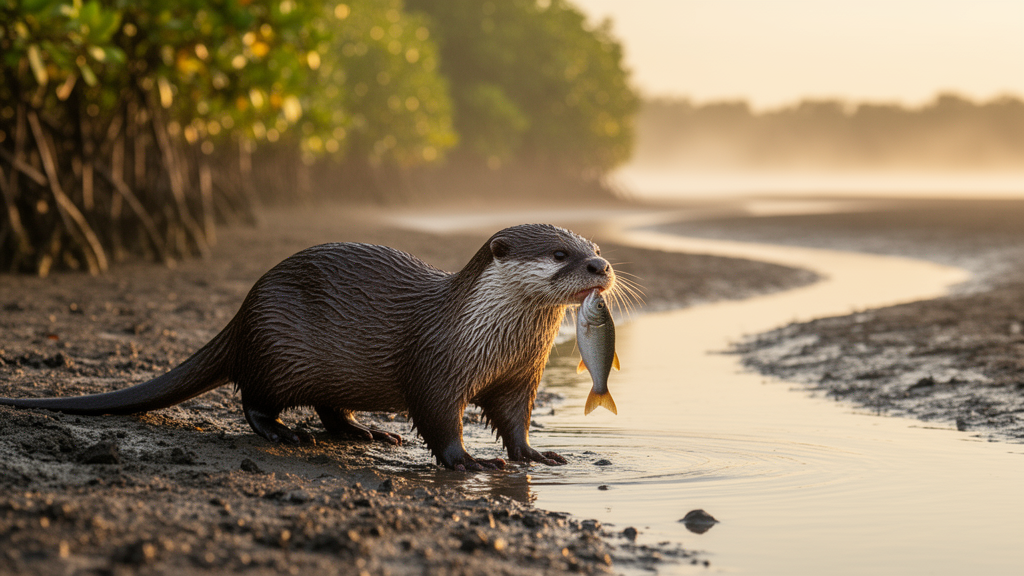
On Santa Catarina Island off the southern Brazilian coast, one of the longest continuous ecological monitoring programs in the Neotropics has turned a shy carnivore into a sensitive gauge of coastal ecosystem health. The Neotropical Otter Project has tracked Lontra longicaudis since 1986, and a new analysis of a standardized twenty-year dataset from 2004 to 2023 shows that the species regularly moves across freshwater, brackish, and marine environments, maintaining functional connectivity within a metapopulation spanning roughly 610 square kilometers. The study, published in Estuarine Management and Technologies, analyzed 9,531 spraints collected during monthly surveys at six monitoring sites and combined them with microsatellite DNA identification to reconstruct movement pathways among habitat compartments.
Estuaries are among the most productive and biologically diverse environments on Earth, yet they are increasingly squeezed by urban expansion, shoreline modification, water extraction, and infrastructure development, particularly in tropical regions where coastal occupation continues to intensify. Conservation strategies have traditionally emphasized protecting habitat patches, but growing evidence indicates that maintaining functional connectivity among freshwater, estuarine, and marine habitats is equally critical for sustaining ecological processes and viable wildlife populations. Unlike structural connectivity, which describes the physical arrangement of habitats, functional connectivity reflects the extent to which landscapes actually facilitate or impede organism movement, making it a more realistic measure of ecological integrity in highly dynamic coastal systems.
Top predators are particularly valuable for evaluating this kind of connectivity because their ecological requirements integrate processes operating across broad spatial and temporal scales. As high-trophic-level species, they respond simultaneously to habitat quality, prey availability, environmental contamination, and landscape permeability, providing an integrative measure of ecosystem integrity. The Neotropical otter is especially suitable for this purpose because its life cycle depends on the continuity of freshwater, estuarine, and marine habitats, and its sensitivity to fragmentation, declining water quality, and changes in prey availability makes it an effective ecological indicator of environmental change in tropical estuaries.
Santa Catarina Island, a 424-square-kilometer granitic island, offers a compressed freshwater-brackish-marine continuum within a single insular landscape. Peri Lagoon, a 5.1-square-kilometer freshwater reservoir in the south, drains to the Atlantic through a narrow 4-kilometer supralittoral corridor. Conceição Lagoon, a 19.71-square-kilometer brackish system in the north, maintains permanent oceanic exchange through the Barra da Lagoa channel with salinity ranging from 6.70 to 18.50. These two lagoons are connected by approximately 80 kilometers of indented rocky coastline punctuated by marine promontories and coastal islands such as Arvoredo, Campeche, Irmã do Meio, and Deserta, which otters regularly use as functional movement corridors. Evidence of scat deposition on 39 percent of surveyed coastal islands highlights their role as ecological stepping stones linking freshwater, estuarine, and marine habitats.
The monitoring protocol was deliberately standardized. Field surveys conducted during daylight hours by two trained observers systematically surveyed shorelines on foot or by canoe and kayak, georeferencing all fresh spraints with GPS receivers accurate to within about 3 meters, photographing them in situ, and refrigerating them within 24 hours to minimize DNA degradation. Because direct counts are difficult for cryptic, wide-ranging carnivores with low detectability, the study adopted intensity of presence, calculated as the number of spraints standardized by the shoreline length surveyed each month. This approach, widely applied in long-term monitoring of the European otter since the 1970s, works because spraint deposition in L. longicaudis is closely associated with territorial marking and movement routes.
Genetic validation strengthened the movement-based inference. Microsatellite analysis of 18 fresh spraints from seven shelters in the Peri Lagoon system generated multilocus genotypes that demonstrated multiple otters used the monitored shelters during the sampling period, confirming that spraint accumulation reflected the activity of several individuals rather than repeated marking by a single resident animal. Identical genotypes occurred at more than one shelter, demonstrating that individual otters moved between different sectors of the lagoon, while individual shelters were visited by different otters over time. The highest similarity was observed between shelters T1 and T7, with a Morisita index of 0.750, providing direct evidence that individual otters regularly traversed substantial portions of the Peri Lagoon shoreline.
Temporal analyses revealed a pronounced decline in movement intensity over the twenty-year study period. Locally weighted polynomial regression identified a gradual reduction in intensity of presence across the monitored landscape, with the strongest declines in the marine coastal sectors while Peri Lagoon maintained comparatively higher and more stable activity. During the same period, Santa Catarina Island experienced substantial urban expansion and infrastructure development, including rapid population growth in neighboring municipalities, highway expansion, and a 52 percent increase in Atlantic Forest deforestation between 2017 and 2018. Importantly, the decline was not accompanied by the disappearance of otter records from any monitoring site, indicating that functional connectivity remained intact despite lower overall movement intensity, though the pattern is consistent with cumulative environmental pressures affecting the island’s coastal ecosystems.
Dietary analysis demonstrated that the otters exploited a broad spectrum of aquatic prey throughout the monitored continuum. Fish constituted the dominant prey category, followed by crustaceans, amphibians, insects, birds, reptiles, and small mammals, with secondary prey varying according to habitat type and reflecting opportunistic feeding behavior. The occurrence of both freshwater and marine prey demonstrated that individual otters exploited resources from multiple aquatic environments, and this trophic plasticity constitutes an important ecological mechanism supporting functional connectivity by maintaining ecological links among environments that would otherwise function as isolated habitat patches.
Building on these ecological patterns, the researchers developed the Otter Health Index, a field-based framework that integrates movement integrity, dietary diversity, and shelter availability to support rapid assessments of estuarine condition. Each component is standardized to a common scale from 0 to 10 using linear min-max normalization, with movement activity receiving a weight of 0.50 and dietary composition and shelter availability each receiving 0.25. The resulting index values ranged from 0.91 at Peri Lagoon, classified as excellent, to 0.54 at Pântano do Sul, classified as moderate, and the ranking closely matched independent ecological indicators, suggesting the index successfully captures biologically meaningful variation across the monitored landscape.
The findings carry direct implications for coastal conservation planning. Because otters moved across freshwater, estuarine, and marine environments, strategies should focus not only on protecting individual habitat patches but also on maintaining the ecological processes that sustain connectivity among them, particularly supralittoral rocky habitats, native shoreline vegetation, and coastal islands that function as corridors and stepping stones. The authors argue that conservation planning should shift from a patch-oriented perspective toward a corridor-based approach, integrating functional connectivity into environmental licensing and territorial planning. The combination of long-term monitoring, non-invasive genetic analysis, dietary assessment, and the Otter Health Index offers a practical framework for adaptive conservation that may also be adapted to other semi-aquatic species, reinforcing the role of the Neotropical otter as a practical bioindicator of estuarine ecosystem integrity in the Anthropocene.
Subject of Research: Movement ecology of the Neotropical otter as a bioindicator of estuarine functional connectivity and coastal ecosystem management
Article Title: Estuarine connectivity through the lens of a top predator. Movement ecology of Lontra longicaudis as a management tool for coastal ecosystems
Article References: Carvalho Junior, O. D. O., Bez Birolo, A., Tosatti, M., & Sabbagh, A. (2026). Estuarine connectivity through the lens of a top predator. Movement ecology of Lontra longicaudis as a management tool for coastal ecosystems. Estuarine Management and Technologies, 3, 233-261. https://doi.org/10.3897/emt.3.189805
Image Credits: AI Generated
DOI: 10.3897/emt.3.189805
Keywords: Neotropical otter, Lontra longicaudis, estuarine connectivity, movement ecology, Santa Catarina Island, bioindicator, Otter Health Index, microsatellite DNA, coastal conservation, long-term monitoring, Estuarine, connectivity
Cite Scienmag News
Margaret Porter. (October 15, 2026). Neotropical otters reveal hidden estuarine connectivity in two decades of movement data. Scienmag. https://scienmag.com/neotropical-otters-reveal-hidden-estuarine-connectivity-in-two-decades-of-movement-data/
Margaret Porter. "Neotropical otters reveal hidden estuarine connectivity in two decades of movement data." Scienmag, 15 October 2026, https://scienmag.com/neotropical-otters-reveal-hidden-estuarine-connectivity-in-two-decades-of-movement-data/. Accessed 15 October 2026.
Margaret Porter. "Neotropical otters reveal hidden estuarine connectivity in two decades of movement data." Scienmag. October 15, 2026. https://scienmag.com/neotropical-otters-reveal-hidden-estuarine-connectivity-in-two-decades-of-movement-data/


