


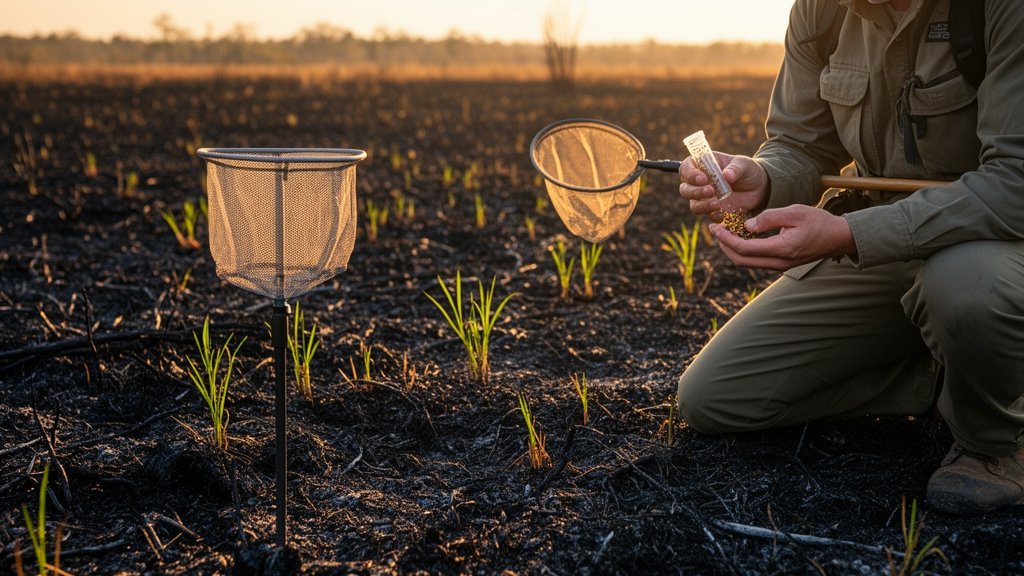
In the sun-baked grasslands of southern Slovakia, some of Europe’s smallest insects are quietly rewriting the rules of conservation fire management. A new study published in the Journal of Hymenoptera Research has found that prescribed burning, a widely used restoration tool in Central Europe’s species-rich dry grasslands, can either boost or devastate communities of microhymenopterans—minute parasitoid wasps measuring barely half a millimetre to two millimetres long—depending almost entirely on how much time the landscape is given to recover between fires. The findings carry weight far beyond entomology, because these invisible regulators sit at the heart of pest control services that sustain agriculture across entire regions.
The research team, working in the Cerová vrchovina Upland Protected Landscape Area, set out to answer a question that has long frustrated grassland ecologists: what actually happens to the parasitoid wasp community when conservationists light controlled fires? Semi-natural dry grasslands of Central Europe rank among the most species-rich plant communities on the planet, but they are vanishing fast. Traditional grazing and mowing have been abandoned across much of the region, allowing shrubs like hawthorn, blackthorn and juniper to encroach, litter to pile up, and the open, sun-drenched conditions that xerothermic specialists depend on to disappear. Prescribed burning imitates natural disturbance regimes, suppressing dominant grasses and reopening the vegetation structure. Yet its effects on arthropod communities—and particularly on the tiny wasps that regulate herbivore populations—have remained almost entirely unexplored.
To fill that gap, the researchers deployed Malaise traps across nine localities representing a natural experiment in fire history. Some sites had been abandoned and unmanaged for anywhere from roughly eight to more than twenty-five years, serving as unburned controls. Others had been burned once, in February 2023 or February 2024, while still others had endured prescribed burns in both consecutive years. The burns themselves were small-scale operations, typically between 0.15 and 2.3 hectares, ignited manually and contained by narrow firebreaks of scraped bare ground. From early April to late July 2024, the traps collected specimens at two-week intervals, yielding 52 samples and a staggering total of 3,975 microhymenopteran specimens spanning six superfamilies, with the hyperdiverse Chalcidoidea superfamily alone contributing 2,306 individuals.
The statistical analysis, built on generalized linear mixed models with a negative binomial error distribution, revealed a pattern that surprised the team. Long-term abandoned sites, despite their shrub encroachment and litter accumulation, generally supported the highest microhymenopteran abundance, confirming that abandonment provides relatively stable and resource-rich conditions for these wasps and their hosts. But here is the twist: sites sampled one full year after a fire showed the highest estimated abundance of all, reaching 85.4 individuals per standardized trap-day compared with 69.4 at unburned controls. This temporary post-fire surge suggests that a single burn followed by an undisturbed growing season opens the vegetation structure, releases host populations from the constraints of dense litter and shading grasses, and triggers a wave of recolonisation from surrounding unburned refugia.
The dark side of the story emerged at sites where fire had struck most recently. Grasslands burned within the sampling year—whether burned once in 2024 or in both 2023 and 2024—showed dramatically reduced wasp abundance across nearly every taxonomic level examined. At repeatedly burned sites, total abundance dropped to 40.8 individuals per standardized trap-day, roughly 59 percent of the control level, a statistically significant suppression. Within the Chalcidoidea, the pattern was even starker: recently burned sites harboured fewer than half the wasps found at one-year post-fire sites, with estimated abundances of 17.8 and 19.5 individuals per trap-day compared with 55.5 at sites given a year to recover. The team’s conclusion is unambiguous: when the interval between successive burns falls short of the community’s recovery time, even low-intensity prescribed fires become detrimental.
Family-level analysis within the Chalcidoidea sharpened the picture further. Mymaridae, the most abundant family and obligate egg parasitoids of many insect orders, showed abundance ratios of just 0.45 and 0.38 relative to controls at repeatedly burned and same-year burned sites respectively—both statistically significant declines. Aphelinidae, which attack aphids, whiteflies and scale insects, were cut roughly in half at twice-burned sites. Eulophidae and Pteromalidae showed similarly significant suppression at repeatedly burned sites, with abundance ratios of 0.42 and 0.34. These families depend on host populations that themselves need time to rebuild after fire destroys oviposition substrates and alters the vegetation on which hosts deposit their eggs. Because microhymenopteran abundance is regulated bottom-up by host availability, any delay in host recovery propagates directly upward through the food web.
Not every group followed the script. Diaprioidea, whose hosts are primarily flies, showed relatively higher abundances at recently burned sites, likely because highly mobile dipteran taxa are among the earliest colonisers of burned patches, drawn by decomposing organic material and reduced competition. Evanoidea, associated with disturbance-tolerant hosts such as cockroaches, remained stable or slightly elevated at same-year burned plots. These exceptions underscore a central principle of post-fire ecology: responses are family-specific, shaped by host biology, dispersal capacity and the spatial configuration of burned patches relative to unburned refugia. Strong-flying chalcidoid parasitoids can recolonise from the surrounding landscape, but only if regional source populations persist in the unburned matrix.
Seasonality emerged as a dominant force in its own right. Across every fire history category, microhymenopteran abundance declined consistently from April through July, a pattern the researchers attribute to host phenology and the seasonal availability of the herbivore populations these wasps parasitise. Sampling month was a highly significant predictor of total abundance, with a chi-square statistic of 62.98, dwarfing the fire regime effect. This seasonal signal means that conservation managers interpreting single-season surveys must account for phenology before drawing conclusions about management impacts—a caution that applies broadly to arthropod monitoring programmes across Europe.
The management implications are strikingly clear. Occasional prescribed burning followed by at least one full growing season of undisturbed recovery can support microhymenopteran populations at levels comparable to or exceeding those of long-term unmanaged grasslands, likely by opening vegetation structure, enhancing floral and host resources, and slowing the accumulation of litter and shrub cover. But burning at short return intervals—successive winter fires that never allow the community to re-establish—appears consistently harmful and should be avoided where microhymenopteran conservation is a priority. The researchers also stress that maintaining a heterogeneous mosaic of burned and unburned habitats across the landscape is essential, because unburned patches serve as regional source populations from which highly dispersive wasps recolonise burned areas.
For a group of insects most people will never notice, the stakes are remarkably high. Microhymenopterans regulate herbivore populations across at least thirteen insect orders, participate in complex trophic interactions including hyperparasitoidism, and spill over from semi-natural grasslands into surrounding agricultural landscapes where they contribute to natural pest regulation. The study’s authors acknowledge that their family-level approach may obscure species-level variability, and they call for future research using species-level identification and functional traits. But the core message already stands: fire is neither friend nor foe to these tiny wasps. Time is the decisive variable. Give a burned grassland a full season to breathe, and its parasitoid community may flourish beyond pre-fire levels. Burn it again before it recovers, and the invisible guardians of the grassland begin to vanish.
Subject of Research: Prescribed burning and post-fire recovery time shape microhymenopteran communities in high-nature-value grasslands
Article Title: Prescribed burning and post-fire recovery time shape microhymenopteran communities in high-nature-value grasslands
Article References: Palík, M., Balázs, A., & Janšta, P. (2026). Prescribed burning and post-fire recovery time shape microhymenopteran communities in high-nature-value grasslands. Journal of Hymenoptera Research, 99, 1069-1094. https://doi.org/10.3897/jhr.99.205327
Image Credits: AI Generated
Keywords: prescribed burning, microhymenoptera, grassland conservation, parasitoid wasps, fire ecology, biodiversity, Chalcidoidea, Central Europe, Prescribed, burning, post-fire, recovery
Cite Scienmag News
Gavin Prescott. (October 15, 2026). Fire’s Hidden Toll: Tiny Parasitoid Wasps Reveal the Right Way to Burn a Grassland. Scienmag. https://scienmag.com/fires-hidden-toll-tiny-parasitoid-wasps-reveal-the-right-way-to-burn-a-grassland/
Gavin Prescott. "Fire’s Hidden Toll: Tiny Parasitoid Wasps Reveal the Right Way to Burn a Grassland." Scienmag, 15 October 2026, https://scienmag.com/fires-hidden-toll-tiny-parasitoid-wasps-reveal-the-right-way-to-burn-a-grassland/. Accessed 15 October 2026.
Gavin Prescott. "Fire’s Hidden Toll: Tiny Parasitoid Wasps Reveal the Right Way to Burn a Grassland." Scienmag. October 15, 2026. https://scienmag.com/fires-hidden-toll-tiny-parasitoid-wasps-reveal-the-right-way-to-burn-a-grassland/


