


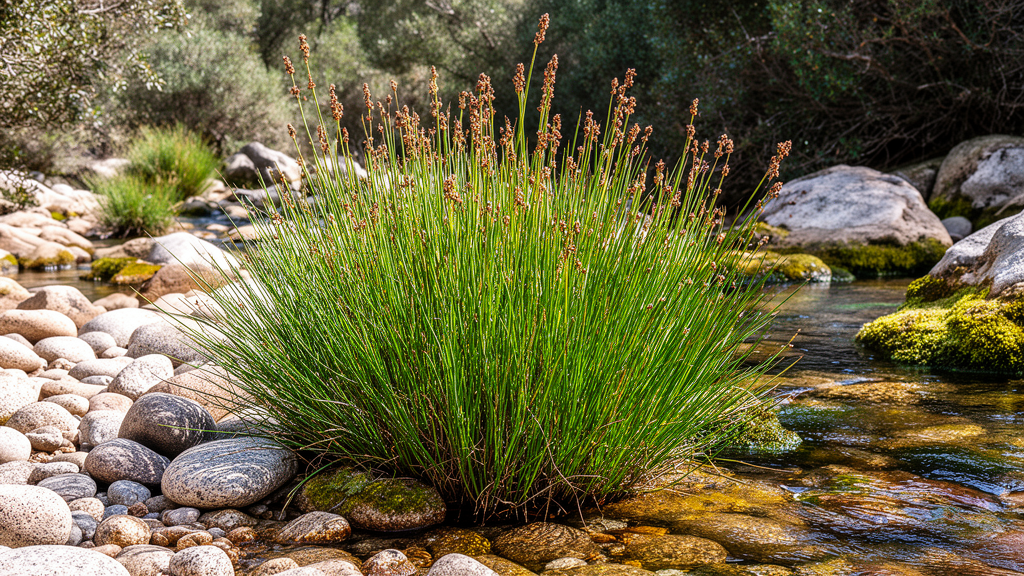
Deep in the rocky streambeds of Sardinia, a rare sedge found almost nowhere else in the world has quietly anchored one of the most detailed vegetation studies the Mediterranean has seen in years. Carex panormitana, an endemic sedge listed as a priority species under the European Habitats Directive, forms distinctive plant communities along temporary watercourses that flash with winter rain and bake under summer sun. A new study published in the journal Vegetation Classification and Survey has now given these communities their first comprehensive numerical classification, and in doing so has formally named two plant associations that are entirely new to science.
The research team, led by Giulio Calvia and colleagues, spent three decades surveying more than 60 streams across Sardinia, from 1995 to 2025, before recording 203 vegetation plots in 26 water bodies where the sedge dominates or co-dominates the herbaceous cover. When combined with 15 published plots from Sicily, the dataset spanned 218 plots and 158 plant species. Using hierarchical clustering based on Bray-Curtis dissimilarity of Hellinger-transformed cover data, non-metric multidimensional scaling, and permutational multivariate analysis of variance, the researchers teased apart the floristic structure of these riparian assemblages with a statistical rigour that phytosociology rarely enjoys.
The results were unambiguous. All Sicilian plots clustered together in a single branch corresponding to Caricetum pendulo-panormitanae, an association described in 2013 and tied to the banks of the Oreto River near Palermo, the type locality of the species itself. The Sardinian plots, by contrast, split cleanly into two independent groups of 98 and 105 plots, each with its own diagnostic species, its own ecological profile, and its own biogeographic signature. PERMANOVA confirmed significant compositional differences between the two Sardinian groups (pseudo-F = 42.628, R² = 0.175, p = 0.001), and betadisper tests showed the groups also differed in the variability of their plots, ruling out the possibility that the separation was an artefact of unequal dispersion.
The first new association, Osmundo regalis-Caricetum panormitanae, is concentrated in northern Sardinia, particularly within the Coghinas hydrographic basin, and is characterised by a rich mixture of mesophilous herbs and low shrubs. Its diagnostic species include the royal fern Osmunda regalis, Dittrichia viscosa, Hypericum hircinum, Erica terminalis, the orchid Spiranthes aestivalis, and the endemic daisy Bellium bellidioides. These communities occupy the middle reaches of intermittent streams flowing over monzogranites and leucogranites, typically between 190 and 750 metres above sea level, occasionally reaching 900 metres on the slopes of Mount Limbara. Tree cover is generally absent, and the vegetation forms dense clumps on moist rocks and stony microsites where nutrient-poor soils and full sunlight prevail.
The second association, Mentho aquaticae-Caricetum panormitanae, is scattered more widely across the island, though it is most frequent in central and southern sectors. Here Carex panormitana grows alongside Mentha aquatica in low herbaceous tussocks on stony banks and streambed islands, often forming bi-specific stands that can be nearly holo-specific. Diagnostic species also include Oenanthe crocata, Cyperus badius, and Nerium oleander, whose presence marks the warmer, lower-elevation variants of the association. This community exhibits a striking bioclimatic gradient, ranging from the cooler foothills of the Gennargentu massif under humid Eu-oceanic conditions down to the Upper Thermo-Mediterranean belt of the southernmost streams, where dry semihyperoceanic climates dominate.
What makes the Sardinian communities ecologically remarkable is their strict calcifuge behaviour. They develop almost exclusively on siliceous substrates, granitoids and Palaeozoic schists, and consistently avoid calcareous outcrops even when limestone massifs rise nearby. They are also strongly heliophilous, thriving in streams that lack riparian tree cover, and they disappear where the invasive giant reed Arundo donax or the common reed Phragmites australis become dominant. This profile contrasts sharply with the Sicilian association, which is basiphilous, more shade-tolerant, and develops under dense gallery forests of Salix pedicellata, Platanus orientalis, and Populus nigra, often beneath thickets of Arundo donax.
The floristic contrast extends to naturalness. The Sicilian Caricetum pendulo-panormitanae hosts a remarkable 18 percent non-native taxa among its recorded species, including Bidens frondosa, Erigeron sumatrensis, Symphyotrichum squamatum, and even Solanum lycopersicum, the cultivated tomato, escaping into streamside vegetation. The Sardinian communities are far more pristine: non-native species are entirely absent from Osmundo-Caricetum, and in Mentho-Caricetum they amount to just six out of 101 taxa, mostly concentrated along a single degraded stream. Meanwhile, the Sardinian plots harbour nine endemic taxa, with Bellium bellidioides the most frequent, underscoring the conservation value of these herb-dominated riparian habitats.
Syntaxonomically, the study resolves a long-standing confusion. Sardinian communities had previously been attributed to the alliance Caricion microcarpae, now synonymised with Osmundo-Alnion glutinosae, or to shrub and forest alliances within Salicetea purpureae. The new classification places both associations firmly within the alliance Magnocaricion elatae, order Magnocaricetalia, class Phragmito-Magnocaricetea, the tall-sedge vegetation of streambanks. The authors argue that these formations are not degraded stages of alder gallery forests but distinct syntaxa that display catenal relationships with riparian forest communities along Mediterranean stream corridors, occupying the rocky, steep-banked reaches where trees cannot establish.
The implications reach beyond taxonomy. Many Carex panormitana communities lie outside protected areas and face mounting pressures from dam construction, channelisation, intense grazing by free-ranging livestock, prolonged droughts intensified by climate change, and the spread of invasive aliens. Because the species is a Habitats Directive priority endemic, restricted to fragmented localities in Sardinia, Sicily, and Tunisia, a robust ecological and syntaxonomic framework is essential for habitat assessment, conservation planning, and monitoring. The study also represents a first step towards understanding the poorly known riparian communities of the order Magnocaricetalia in Sardinia, a gap reflected in recent national checklists.
Phytosociological analyses of the riverine communities formed by Carex panormitana in Tunisia remain entirely lacking, leaving the Kroumirie populations uncharacterised. As Mediterranean watercourses experience increasingly erratic hydrological regimes, from flash floods to intermittent stagnation, the plant communities that depend on them face an uncertain future. The formal recognition of Osmundo regalis-Caricetum panormitanae and Mentho aquaticae-Caricetum panormitanae gives conservationists a precise vocabulary for what they are trying to save, and a scientific baseline against which future change can be measured.
Subject of Research: Numerical classification of Mediterranean riverine vegetation associated with Carex panormitana ( Cyperaceae )
Article Title: Numerical classification of Mediterranean riverine vegetation associated with Carex panormitana ( Cyperaceae )
Article References: Calvia, G., Urbani, M., Mascia, F., Bertotto, G., Genduso, E., & Bonari, G. (2026). Numerical classification of Mediterranean riverine vegetation associated with Carex panormitana (Cyperaceae). Vegetation Classification and Survey, 7, 149-162. https://doi.org/10.3897/vcs.196138
Image Credits: AI Generated
DOI: 10.3897/VCS.196138
Keywords: Numerical, classification, Mediterranean, riverine, vegetation, associated, Carex, panormitana, Cyperaceae, scientific research
Cite Scienmag News
Gavin Prescott. (October 15, 2026). Rare Mediterranean sedge reveals two new plant communities on Sardinian streams. Scienmag. https://scienmag.com/rare-mediterranean-sedge-reveals-two-new-plant-communities-on-sardinian-streams/
Gavin Prescott. "Rare Mediterranean sedge reveals two new plant communities on Sardinian streams." Scienmag, 15 October 2026, https://scienmag.com/rare-mediterranean-sedge-reveals-two-new-plant-communities-on-sardinian-streams/. Accessed 15 October 2026.
Gavin Prescott. "Rare Mediterranean sedge reveals two new plant communities on Sardinian streams." Scienmag. October 15, 2026. https://scienmag.com/rare-mediterranean-sedge-reveals-two-new-plant-communities-on-sardinian-streams/


