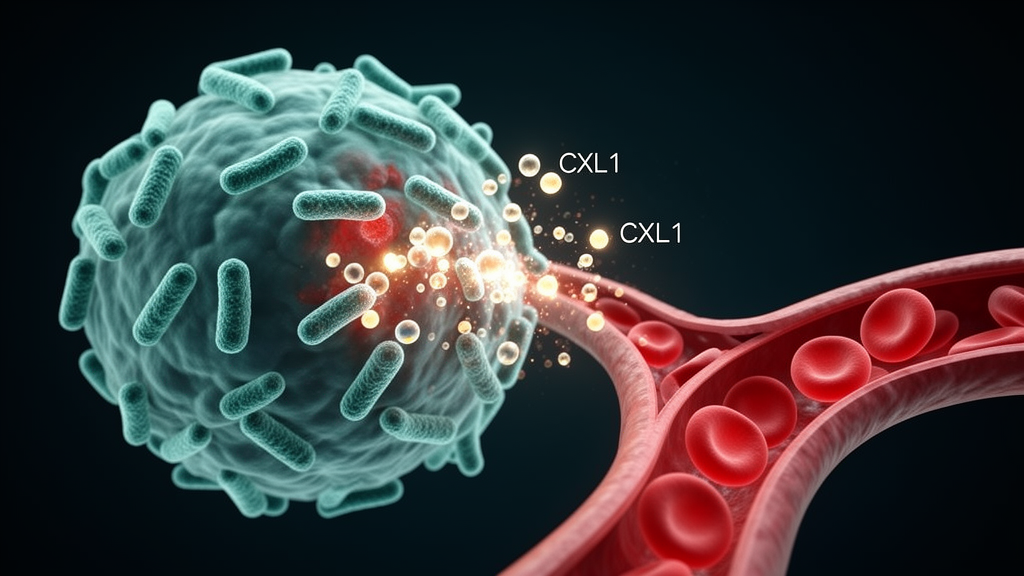
Researchers report that a sustained rise in peripheral blood CXCL1 can serve as a non-invasive, dynamic biomarker for the persistent colonization of attenuated Salmonella in solid tumors. The finding, published in Biomarker Research, addresses a key obstacle for oncolytic bacterial therapy: clinicians currently lack a simple way to monitor whether therapeutic bacteria have successfully established themselves inside a tumor without invasive procedures.
Attenuated oncolytic bacteria are an emerging targeted delivery platform for cancer therapy, but their clinical translation has been hampered by the absence of biomarkers to track intra-tumoral colonization, assess efficacy, and monitor safety. In the new study, the team worked across four orthotopic preclinical models, covering lung cancer, breast cancer, bladder cancer, and melanoma. In all four models, effective bacterial colonization was specifically associated with prolonged systemic elevation of CXCL1 in the blood.
To test whether the signal truly reflected bacteria inside the tumor, the researchers focused on the melanoma model and rapidly eradicated the colonizing bacteria with intratumoral antibiotics. This intervention restored blood CXCL1 to baseline levels, indicating that the chemokine signal tracked the presence of the bacteria rather than a permanent change in the host.
Further support came from comparisons with a colonization-deficient mutant Salmonella strain. These experiments confirmed that CXCL1 elevation depended strictly on intra-tumoral bacterial burden rather than systemic bacterial load, strengthening the case for the chemokine as a colonization-specific readout.
Mechanistically, the team used single-cell RNA sequencing to examine how tumor-colonizing bacteria reshape the tumor microenvironment. The analysis showed that the bacteria directly activate and recruit neutrophils, monocytes, and cancer-associated fibroblasts, and that these cell types act as the primary cellular sources of CXCL1 production and its subsequent leakage into the circulation.
The authors suggest that peripheral blood CXCL1 could serve as a robust and actionable biomarker for real-time monitoring of oncolytic bacterial colonization, potentially guiding dosing optimization and biosafety evaluation as such therapies move toward clinical application. As the work is preclinical, based on animal models, its value in human patients remains to be established.
Subject of Research: A blood chemokine biomarker for monitoring attenuated Salmonella colonization of solid tumors
Article Title: Peripheral blood CXCL1 serves as a non-invasive dynamic biomarker for intratumoral colonization of attenuated Salmonella
Article References: Wu, L., Qiao, L., Qiao, X., Wang, W., Lei, C., Sun, Y., Dong, X., Yu, J., Li, C., Du, Z., Tian, J., Liu, M., Liu, H., & Hua, Z. (2026). Peripheral blood CXCL1 serves as a non-invasive dynamic biomarker for intratumoral colonization of attenuated Salmonella. Biomarker Research, 14(1), Article 141. https://doi.org/10.1186/s40364-026-01017-8
Image Credits: AI Generated
DOI: 10.1186/s40364-026-01017-8
Keywords: CXCL1, attenuated Salmonella, oncolytic bacteria, biomarker, tumor colonization, melanoma, single-cell RNA sequencing, neutrophils, cancer-associated fibroblasts, preclinical models, Peripheral, blood
Cite Scienmag News
Nathaniel Bowman. (October 28, 2026). Blood CXCL1 tracks Salmonella colonization in tumors, study finds. Scienmag. https://scienmag.com/blood-cxcl1-tracks-salmonella-colonization-in-tumors-study-finds/
Nathaniel Bowman. "Blood CXCL1 tracks Salmonella colonization in tumors, study finds." Scienmag, 28 October 2026, https://scienmag.com/blood-cxcl1-tracks-salmonella-colonization-in-tumors-study-finds/. Accessed 28 October 2026.
Nathaniel Bowman. "Blood CXCL1 tracks Salmonella colonization in tumors, study finds." Scienmag. October 28, 2026. https://scienmag.com/blood-cxcl1-tracks-salmonella-colonization-in-tumors-study-finds/