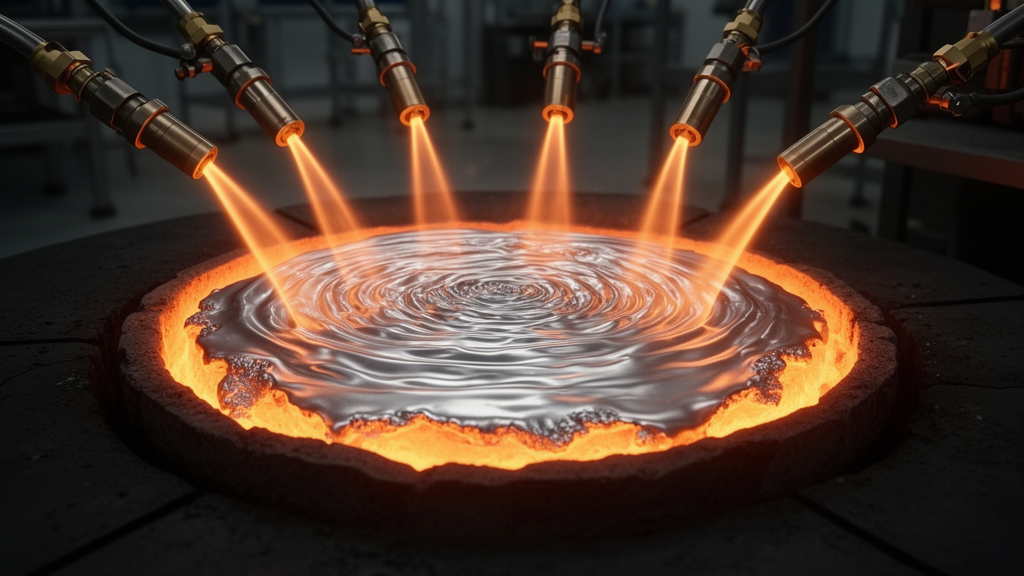
A puff of air across a bath of molten metal sounds unremarkable, but a new study shows that the ripples it leaves behind carry a measurable signature of how close the liquid is to freezing solid. As the metal cooled, both the speed and the spacing of the ripples shrank steadily, and just above the alloy’s freezing point the coherent waves vanished altogether. The team argues that this disappearing act could one day serve as a visual cue for monitoring the state of a melt pool in laser additive manufacturing, where operators currently struggle to see what is happening inside the tiny, violently agitated pool of molten metal.
The motivation comes from a persistent problem in laser-based 3D printing of metals. In laser additive manufacturing, a high-energy-density beam melts metal powder into a small melt pool whose behavior determines the quality of the finished part. The pool is a hostile environment for measurement: the metal vaporizes locally, surface-tension gradients drive Marangoni convection, and thermal convection produces unsteady, sometimes turbulent flow that manifests as vigorous surface agitation, intense ripple propagation, and droplet splashing. Porosity is a particular concern, and prior work cited by the authors found that pores larger than 500 micrometers are primary contributors to crack initiation and propagation, degrading tensile strength and fatigue resistance. Existing monitoring tools have limits. High-speed in-situ X-ray imaging has revealed pore formation and melt flow dynamics, but the technique is limited in practical applicability and struggles to quantitatively characterize melt pool dynamics. Thermocouples, pyrometry, and infrared thermography capture only localized or surface temperature information.
Rather than trying to instrument a real laser melt pool, the team built a simplified physical model based on the similarity principle in fluid mechanics: when the relevant dimensionless parameters of a model and a prototype are equal, the two flows behave in dynamically similar ways. Earlier researchers demonstrated that analogy experiments can reproduce key features of metallic melting behavior using an ice-water system, provided the dominant interfacial evolution and macroscopic transport characteristics are represented. Here the authors chose a low-melting-point metal instead of water-based media, which they argue offers a closer approximation to real metallic melts in free-surface behavior, surface-tension-governed deformation, and solidification response. The alloy was Field’s metal, an indium-based eutectic with the composition In51Bi32.5Sn16.5 by weight and a melting temperature of approximately 333 kelvin, about 60 degrees Celsius. It contains no lead, cadmium, or other toxic elements, and in its solid state it exhibits excellent ductility and superior thermal fatigue resistance.
The experimental platform was deliberately simple. A metal bath held the molten alloy, a parallel light source illuminated the surface from above, and a half-silvered lens directed the reflected image into a CCD camera recording at 1000 frames per second. A lithium-ion-battery-powered air gun blew gas across the center of the liquid surface, and a contact thermometer measured the melt temperature at the edge of the pool. Before each test the alloy was heated to 110 degrees Celsius to ensure complete melting, the heater was switched off, and the melt was allowed to cool to target temperatures of 90, 80, 70, and 60 degrees Celsius. Throughout the experiment the air gun applied a constant pressure of 4.5 kilopascals. The authors are candid about one design limitation: the gas-jet exposure duration was not an independently and precisely controlled variable, so the extracted wave characteristics may reflect not only temperature but also the transient stage of disturbance development and the timing of image acquisition, and the results should be read mainly as trend-level comparisons under consistent operating conditions.
The blowing process itself had a recognizable sequence. In the initial stage the melt surface remained relatively flat with only localized fluctuations and no overall propagating ripple structures. As blowing continued, the shear stress on the surface gradually increased, and once a certain energy threshold was reached the disturbance rapidly amplified into noticeable concentric ring waves, accompanied by metal splashing. The experiments also revealed an activation delay time, a brief temporal gap between the onset of gas blowing and the full response of the liquid surface, with the disturbance intensifying gradually from the edge toward the center.
Temperature left a clear imprint on the wave field. At 90 degrees Celsius the surface showed a relatively uniform and regular concentric ripple pattern with a pronounced central depression, which the authors attribute to low viscosity allowing wave energy to propagate and distribute effectively. At 80 degrees the ripples retained their ring-like morphology but began to show localized fractures and discontinuities, indicating that increased viscous dissipation partially suppresses wave propagation. At 70 degrees the waves became significantly more fragmented, with multiple asymmetric protrusions and cracks and a marked increase in surface roughness, reflecting rapid attenuation of wave energy under higher viscosity. At 60 degrees, close to the alloy’s liquidus temperature of about 59 degrees Celsius, the morphology changed fundamentally: numerous fine granular precipitates and irregular cracks appeared, suggesting the alloy had partially entered a solid-liquid coexistence state in which fluidity is drastically reduced and coherent ripple fronts could no longer be clearly identified.
Quantitatively, the team analyzed image sequences recorded over 10 milliseconds with a 1-millisecond frame interval, calibrating pixel measurements against a ruler-based reference image and processing the frames in ImageJ after verifying that binarization preserved the main concentric ripple structures. Across six independent experiments, the mean wave velocity fell from 0.201 meters per second at 90 degrees Celsius to 0.115 meters per second at 70 degrees, with standard deviations between 0.016 and 0.033 meters per second. The mean wavelength declined from 2.016 millimeters to 1.152 millimeters over the same range, with standard deviations of 0.330, 0.167, and 0.317 millimeters at the three temperatures. Individual experiments varied in absolute values, with one reaching about 0.24 meters per second at 90 degrees and another only about 0.17, but all six datasets showed the same negative correlation between temperature and wave velocity. At 60 degrees no discernible ripple structures were observed, so wave characteristics could not be extracted at all.
A two-dimensional numerical model built in ANSYS Fluent, using the Volume-of-Fluid method to track the gas-liquid interface and solving the incompressible Navier-Stokes equations with gravity and surface tension, qualitatively reproduced the central depression and outward-propagating ring-like ripples. The simulation used a mesh of approximately 80,000 cells with local refinement near the free surface and the gas-impact region. Its predicted wave velocities of 0.532, 0.458, and 0.438 meters per second at 90, 80, and 70 degrees, and wavelengths of 5.324, 4.587, and 4.382 millimeters, were notably higher than the measured values of roughly 0.9 to 2.4 millimeters. The authors attribute this overestimation to idealized assumptions: the model does not include oxide-layer effects, interfacial contamination, local thermal non-uniformity, or actual gas-jet fluctuations, so the simulated surface exhibits lower effective damping than the real one. Despite the quantitative gap, both experiment and simulation showed the same decreasing trend with cooling, which the authors say validates the underlying physical mechanism at a mechanistic level.
The team is careful about what the work does and does not claim. The gas-jet experiment is not intended to fully reproduce the complex multiphysics behavior of a real melt pool; process-specific factors such as laser absorption, vapor-recoil pressure, strong thermal gradients, and thermocapillary flow are not fully represented, and the results should be regarded as concept-level verification rather than a direct equivalent of industrial processes. Within that scope, the authors argue that the most sensitive indicator of the near-solidification state is not the gradual slowing of the waves but the disappearance of coherent ripple fronts near 60 degrees, which shows the free surface can no longer support stable wave propagation. They suggest that the combined features of wave velocity, wavelength, and free-surface morphology under external perturbation may serve as potential observable signals for melt-pool state characterization and process monitoring in additive manufacturing, while emphasizing that further studies under more realistic thermal and geometric conditions are still needed before such a sensing concept could leave the laboratory.
Subject of Research: Gas-jet-excited surface wave behavior of a low-melting-point liquid metal alloy during cooling toward solidification
Article Title: Study on the surface fluctuation characteristics of liquid metal under gas jet excitation
Article References: Liu, D., Shen, Y., Wang, X., Ding, S., Zhai, Z., Lei, Z., Jiang, H., & Guo, Z. (2026). Study on the surface fluctuation characteristics of liquid metal under gas jet excitation. Discover Metals, 59(1), Article 3. https://doi.org/10.1007/s13404-026-00372-6
Image Credits: AI Generated
DOI: 10.1007/s13404-026-00372-6
Keywords: liquid metal, gas jet excitation, surface waves, solidification, Field's metal, high-speed imaging, melt pool monitoring, laser additive manufacturing, wave velocity, wavelength, numerical simulation, VOF method
Cite Scienmag News
Denise Maddox. (October 28, 2026). Gas Jets Stir Liquid Metal Into Ripples That Reveal When Solidification Begins. Scienmag. https://scienmag.com/gas-jets-stir-liquid-metal-into-ripples-that-reveal-when-solidification-begins/
Denise Maddox. "Gas Jets Stir Liquid Metal Into Ripples That Reveal When Solidification Begins." Scienmag, 28 October 2026, https://scienmag.com/gas-jets-stir-liquid-metal-into-ripples-that-reveal-when-solidification-begins/. Accessed 28 October 2026.
Denise Maddox. "Gas Jets Stir Liquid Metal Into Ripples That Reveal When Solidification Begins." Scienmag. October 28, 2026. https://scienmag.com/gas-jets-stir-liquid-metal-into-ripples-that-reveal-when-solidification-begins/