


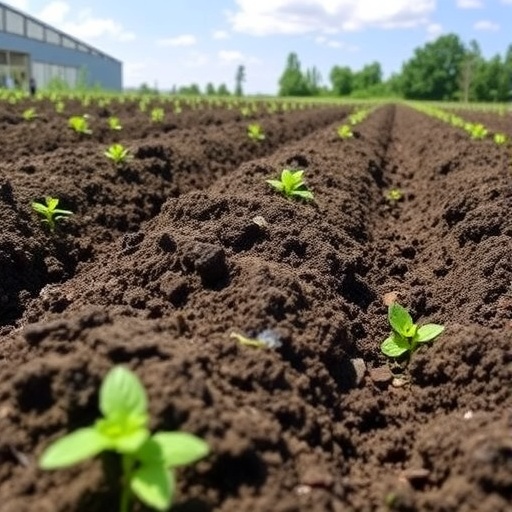
A hidden biological tug-of-war beneath our feet may be weakening one of Earth’s most important natural defenses against climate change. New research reported in Communications Earth & Environment shows that biological nitrification inhibition—a process by which plants and soil organisms suppress the conversion of ammonium into nitrate—can compromise the soil methane sink. The finding reveals that a mechanism often viewed as beneficial because it reduces nitrogen losses may also interfere with the microbes that remove methane from the atmosphere. In a world increasingly focused on cutting greenhouse-gas emissions, the discovery exposes an unexpected climate trade-off operating at the microscopic scale.
Soils are not simply passive surfaces beneath forests, grasslands and croplands. They are dynamic biological reactors containing billions of bacteria, fungi and archaea that constantly transform carbon and nitrogen. Among the most important of these processes is nitrification, in which specialized microorganisms oxidize ammonium, or NH₄⁺, first into nitrite and then into nitrate. This transformation supports plant nutrition, but it can also accelerate nitrogen losses from soil through leaching and the production of nitrous oxide, a greenhouse gas far more potent than carbon dioxide. Plants have evolved a countermeasure known as biological nitrification inhibition, or BNI, releasing chemical compounds from their roots that suppress nitrifying organisms and slow the process.
BNI has attracted intense scientific interest because it could help agriculture retain nitrogen in the soil, improve fertilizer efficiency and reduce environmental pollution. When nitrification is restrained, ammonium remains available for plant uptake for longer, while less nitrate is washed into waterways. The strategy is especially relevant in farming systems where nitrogen fertilizer is applied in large quantities. Yet the new study indicates that the ecological consequences of BNI extend beyond nitrogen cycling. By changing the chemical environment in soil and altering the activity of microbial communities, BNI can affect methane consumption—the process that makes many well-drained soils a net sink for atmospheric methane.
Methane is a powerful greenhouse gas, and its atmospheric concentration has risen sharply in recent decades. Although wetlands, fossil-fuel operations, agriculture and waste facilities release methane, a substantial amount is removed by microbes living in aerobic soils. These organisms, called methanotrophs, use methane as an energy source. Their key biochemical tool is methane monooxygenase, an enzyme that initiates the oxidation of methane and converts it into methanol. In upland soils, forests and grasslands, this microbial filtering system continuously draws methane downward from the atmosphere, meaning that the ground can function as a global-scale biological scrubber.
The relationship between nitrification and methane oxidation is unusually intimate because the organisms involved use chemically related substrates and enzymes. Ammonia-oxidizing microbes convert ammonia into hydroxylamine, while methanotrophs begin methane breakdown through a methane monooxygenase pathway. The enzymes can interact with one another’s substrates, creating competition and chemical interference. Ammonium can inhibit methane oxidation under certain conditions, while products generated during ammonia oxidation may damage or suppress methanotrophs. As a result, a change that reduces nitrification does not necessarily produce a simple environmental benefit. It may alter ammonium availability, microbial competition and the balance of compounds that determine how efficiently soil consumes methane.
Yang, Fahim, Shahi and colleagues examine this previously underappreciated connection and report that BNI can weaken the soil methane sink. The study’s central message is not that biological nitrification inhibition is universally harmful, but that its effects must be evaluated across multiple greenhouse gases rather than through nitrogen efficiency alone. A soil treatment that limits nitrate formation may simultaneously reduce the ability of methanotrophic communities to remove methane. If that response occurs over broad areas of agricultural land or in ecosystems dominated by plants with strong BNI capacity, the resulting loss of methane uptake could carry consequences far beyond the immediate soil environment.
The finding is particularly important because methane has a relatively short atmospheric lifetime compared with carbon dioxide, yet it traps much more heat during that period. Cutting methane emissions and protecting natural methane sinks are therefore among the fastest ways to slow near-term warming. Even a modest decline in the amount of methane absorbed by soils could become climatically meaningful when multiplied across millions of hectares. The study suggests that global models may need to represent the interaction between nitrogen cycling and methane oxidation more realistically, especially in regions where plant-mediated nitrification inhibition is common or where fertilizer practices strongly change ammonium concentrations.
The research also raises practical questions for climate-smart agriculture. BNI traits are being explored in crops and forage plants as a natural alternative or complement to synthetic nitrification inhibitors. Their adoption could reduce fertilizer losses and nitrous oxide emissions, but the new evidence indicates that performance should be assessed using a full greenhouse-gas balance. Measurements of nitrate leaching and nitrous oxide alone would not capture the possible climate cost of a weakened methane sink. Farmers, breeders and policymakers may ultimately need strategies that preserve nitrogen while avoiding excessive disruption of methanotrophs—for example, by matching crop traits, fertilizer rates, soil moisture management and microbial conditions to local environments.
The broader lesson is that climate systems are shaped by networks of microbial interactions rather than by isolated processes. Soil bacteria do not operate in separate compartments labeled “nitrogen” or “methane”; they share substrates, enzymes and chemical by-products in an intensely connected underground economy. Biological nitrification inhibition may remain a valuable tool for improving nitrogen retention, but this study shows why environmental solutions must be tested for unintended effects across the entire greenhouse-gas system. Protecting the soil methane sink will require scientists to look beneath the surface, where a microscopic shift in competition can ripple outward into the atmosphere and reshape the climate value of an otherwise promising biological strategy.
Cite Scienmag News
Violet Maxwell. (August 25, 2026). Biological Nitrification Inhibition Weakens Soil’s Methane-Absorbing Capacity. Scienmag. https://scienmag.com/biological-nitrification-inhibition-weakens-soils-methane-absorbing-capacity/
Violet Maxwell. "Biological Nitrification Inhibition Weakens Soil’s Methane-Absorbing Capacity." Scienmag, 25 August 2026, https://scienmag.com/biological-nitrification-inhibition-weakens-soils-methane-absorbing-capacity/. Accessed 4 September 2026.
Violet Maxwell. "Biological Nitrification Inhibition Weakens Soil’s Methane-Absorbing Capacity." Scienmag. August 25, 2026. https://scienmag.com/biological-nitrification-inhibition-weakens-soils-methane-absorbing-capacity/


