


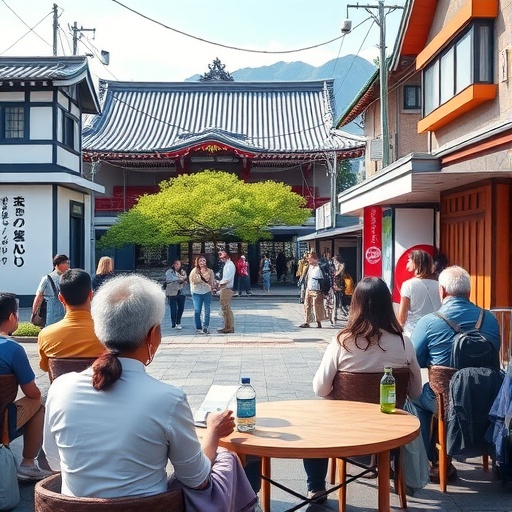
Japan’s cities may have found a missing ingredient in the global effort to build a more sustainable urban future: the people who live there. A new study by Z. Xu, H. Nakajima, M. Wang and colleagues argues that community engagement can help cities connect the many ambitions contained within Sustainable Development Goal 11, the United Nations target focused on making urban areas inclusive, safe, resilient and sustainable. Published in npj Urban Sustainability, the research examines how public participation can move urban policy beyond isolated projects and toward a more integrated system of governance.
The finding arrives at a critical moment. More than half of the world’s population lives in urban areas, and that share is expected to continue rising. Cities are simultaneously confronting climate change, aging infrastructure, housing pressure, disaster risks, social inequality, pollution and demands for economic growth. These challenges are closely linked, yet they are often managed by separate government departments, agencies or planning processes. A transport strategy may reduce emissions but worsen access for vulnerable residents; a redevelopment project may improve efficiency while displacing communities. The central problem is not simply setting sustainability targets, but making those targets work together in real places.
SDG11 contains a broad collection of urban objectives, including affordable housing, sustainable transport, inclusive planning, cultural and natural heritage protection, disaster resilience, reduced environmental impacts and access to public spaces. In practice, however, these targets can remain disconnected. Researchers refer to this problem as policy fragmentation: institutions pursue individual objectives according to their own budgets, expertise and performance indicators, while the relationships among those objectives receive less attention. Xu and colleagues’ study highlights community engagement as a mechanism for overcoming that fragmentation in Japan’s urban governance.
The logic is both political and technical. Residents experience cities as interconnected systems rather than as administrative categories. A new rail station is not only a transport intervention; it can alter land values, housing affordability, local business activity, access to schools and exposure to heat or flooding. Similarly, a park is not merely an environmental amenity. Its location, design and maintenance can influence public health, social cohesion, storm-water management and neighborhood resilience. When communities participate meaningfully in planning, they can identify these cross-connections earlier than a single agency working within a narrow mandate.
The study’s central contribution is its focus on “target integration.” This concept describes the process of coordinating different sustainability targets so that policies reinforce one another rather than operate as separate checklists. Integration can occur through shared planning frameworks, joint decision-making, common indicators and institutional arrangements that connect local knowledge with technical analysis. Community engagement strengthens this process by bringing lived experience into policy design. Residents can reveal barriers that official statistics may overlook, such as whether a supposedly accessible facility is difficult to reach, whether a flood-warning system is trusted or whether a public space feels safe to different groups.
Japan offers a particularly important setting for this investigation. Its cities combine advanced infrastructure and sophisticated administrative systems with demographic aging, population decline in some regions, intense exposure to earthquakes and other natural hazards, and major differences between metropolitan centers and smaller communities. These conditions place pressure on local governments to make difficult decisions about land use, public services and infrastructure investment. They also make local participation potentially valuable, because communities often possess detailed knowledge of changing neighborhood conditions and long-standing experience with collective responses to risk.
The research does not present participation as a simple public-relations exercise. In sustainability governance, there is a significant difference between informing residents, consulting them and sharing decision-making power with them. Information campaigns communicate completed or nearly completed plans. Consultation gathers opinions, but authorities may remain free to disregard them. More substantive engagement allows communities to help define problems, compare alternatives, monitor implementation and evaluate outcomes. For such participation to influence SDG11 governance, it must be connected to formal planning and accountability mechanisms rather than treated as an optional meeting held after key decisions have already been made.
That distinction matters because poorly designed engagement can deepen distrust. Meetings held at inaccessible times, technical documents written for specialists, or procedures that repeatedly favor the most vocal participants can leave marginalized residents unheard. Effective community engagement therefore requires institutional capacity: clear channels for feedback, transparent explanations of how input affects decisions, accessible data, multilingual or inclusive communication where necessary, and methods for resolving conflicts among competing interests. The study’s message is not that local voices automatically produce consensus, but that governance becomes more capable of integrating competing urban priorities when those voices are systematically included.
The implications extend beyond Japan. Cities around the world are searching for ways to translate the SDGs from an international framework into practical local action. The Japanese experience described by Xu and colleagues suggests that progress may depend less on adding more targets than on improving the relationships among existing ones. A city that connects housing, mobility, climate adaptation, public health and social inclusion can potentially achieve more than one that measures each area separately. Community engagement provides a social infrastructure for that connection, helping governments understand how policies interact on the ground and giving residents a role in shaping the urban systems they depend on.
The study also points toward a broader transformation in how urban success is measured. Traditional indicators often count outputs—kilometers of transit built, homes constructed, trees planted or facilities opened. Integrated governance asks additional questions: Who benefits? Which groups remain excluded? Does an intervention reduce vulnerability in one neighborhood while increasing it in another? Are environmental gains compatible with affordability and cultural continuity? By linking community knowledge to formal indicators and long-term evaluation, cities can move closer to measuring sustainability as a lived, interconnected outcome rather than a collection of isolated achievements. In that sense, the research presents participation not as a soft supplement to urban planning, but as a practical technology for making complex governance work.
Cite Scienmag News
Courtney Benton. (August 25, 2026). Community Engagement Integrates SDG11 Targets into Japan’s Governance. Scienmag. https://scienmag.com/community-engagement-integrates-sdg11-targets-into-japans-governance/
Courtney Benton. "Community Engagement Integrates SDG11 Targets into Japan’s Governance." Scienmag, 25 August 2026, https://scienmag.com/community-engagement-integrates-sdg11-targets-into-japans-governance/. Accessed 3 September 2026.
Courtney Benton. "Community Engagement Integrates SDG11 Targets into Japan’s Governance." Scienmag. August 25, 2026. https://scienmag.com/community-engagement-integrates-sdg11-targets-into-japans-governance/


