


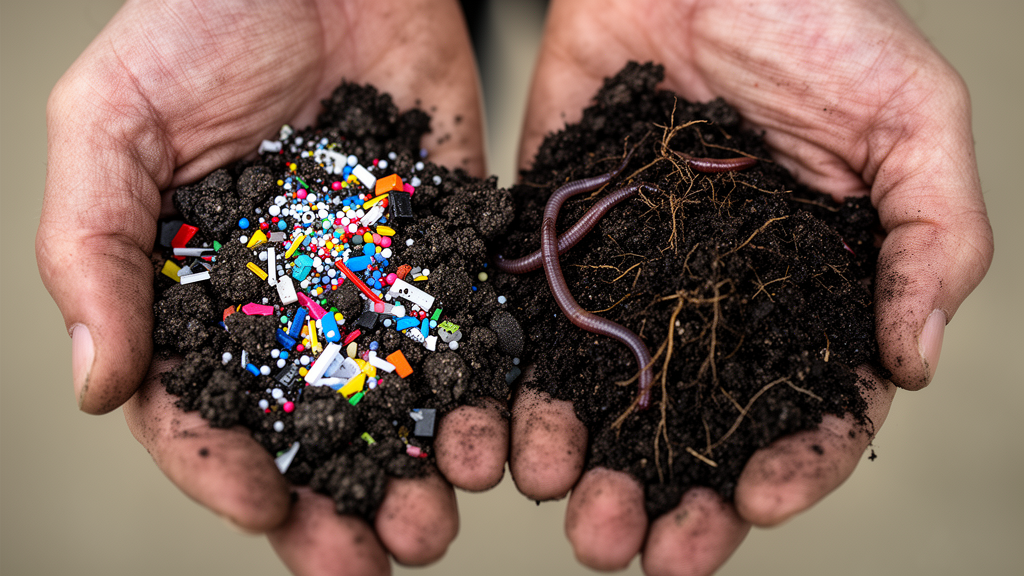
A new synthesis of more than a decade of research concludes that biodegradable microplastics should be viewed as both carbon inputs and ecological stressors in soil–plant systems, rather than as uniformly benign substitutes for conventional plastics. The review, published in Environmental Geochemistry and Health by Kaiyang Han and Xinyu Li, combined a bibliometric analysis of the scientific literature with a structured evidence assessment of experimental studies on biodegradable microplastics, or Bio-MPs, in soil–plant systems. Its central message is that the consequences of these particles depend strongly on environmental context, complicating simple generalizations about their safety in agriculture.
The team searched the Web of Science database covering publications from 2010 through 9 June 2026. Of 1,513 records retrieved, 1,392 remained after 121 documented exclusions and were analyzed bibliometrically. Applying predefined eligibility criteria to those records narrowed the field to 121 studies for detailed evidence assessment, of which 105 were unique original experimental studies suitable for structured synthesis. The analysis showed that research on the topic expanded rapidly after 2020, with growing attention to rhizosphere processes, microbial communities, carbon cycling and greenhouse-gas emissions. One striking finding concerns which polymers dominate the literature: polylactic acid (PLA) appeared in 69 of the experimental studies, or 65.7 percent, while PBAT featured in 30 studies, or 28.6 percent. Yet only six studies, just 5.7 percent, were conducted under field conditions, meaning the vast majority of what scientists know comes from laboratory and greenhouse experiments rather than real agricultural settings.
The synthesis found that the effects of Bio-MPs vary with polymer identity, dose, aging state, soil properties and plant–rhizosphere conditions. In other words, the same material can produce different outcomes depending on the environment in which it degrades. Soil carbon responses proved particularly nuanced. The review concluded that they reflect competing processes: release of polymer-derived carbon, microbial assimilation of that carbon, stimulation of native soil organic matter turnover, respiratory losses, and carbon stabilization within the soil matrix. Because these processes pull in different directions, the evidence does not support a consistent increase or decrease in soil carbon following Bio-MP addition.
Plants did not fare uniformly well either. Across the experimental studies, plant responses commonly involved altered nutrient acquisition, changes in oxidative balance, effects on photosynthesis and modifications of root development. Among the studies that reported extractable response directions, negative or decreasing plant or root effects occurred in 17 of 31 studies, a proportion that challenges any assumption that biodegradable particles are harmless to crops. Below ground, the picture was dominated by variability. Microbiome responses were predominantly mixed or context dependent, a pattern seen in 36 of 49 studies. The authors also noted an important methodological gap: taxonomic shifts in microbial communities were reported far more frequently than direct functional validation, meaning researchers often observed which microbes changed in abundance without confirming what those changes meant for soil processes.
The review’s overall conclusion is that Bio-MPs should not be viewed as uniformly benign substitutes for conventional plastics. Their dual role as carbon sources and stressors means that agricultural applications could reshape soil carbon dynamics and rhizosphere ecology in ways that depend on polymer type, application rate, environmental aging and soil conditions. The authors emphasize that major uncertainties remain: field-scale studies, time-resolved measurements, investigations of carbon fate and functionally validated microbiome research are all still limited in the existing literature. For farmers, policymakers and researchers, the message is one of caution rather than alarm. Biodegradable microplastics are increasingly used in agriculture, and the rapid growth of research since 2020 reflects that trend. But the evidence assembled by Han and Li indicates that these particles interact with soils, microbes and plants in measurable ways, and understanding those interactions will require moving from laboratory experiments to fields and from cataloging microbial species to testing what they actually do.
Subject of Research: Effects of biodegradable microplastics on soil carbon cycling, rhizosphere microbiomes and plant responses
Article Title: Biodegradable microplastics in soil-plant systems: bibliometric analysis and structured evidence synthesis of carbon cycling, rhizosphere microbiomes and plant responses
Article References: Han, K., & Li, X. (2026). Biodegradable microplastics in soil-plant systems: bibliometric analysis and structured evidence synthesis of carbon cycling, rhizosphere microbiomes and plant responses. Environmental Geochemistry and Health, 48(16), Article 659. https://doi.org/10.1007/s10653-026-03546-5
Image Credits: AI Generated
DOI: 10.1007/s10653-026-03546-5
Keywords: biodegradable microplastics, soil carbon, rhizosphere, microbiome, PLA, PBAT, plant responses, bibliometric analysis, agriculture, evidence synthesis, Biodegradable, microplastics
Cite Scienmag News
Morgan Morrow. (October 24, 2026). Biodegradable Microplastics Are Not Benign: Soil Review Reveals Context-Dependent Effects. Scienmag. https://scienmag.com/biodegradable-microplastics-are-not-benign-soil-review-reveals-context-dependent-effects/
Morgan Morrow. "Biodegradable Microplastics Are Not Benign: Soil Review Reveals Context-Dependent Effects." Scienmag, 24 October 2026, https://scienmag.com/biodegradable-microplastics-are-not-benign-soil-review-reveals-context-dependent-effects/. Accessed 24 October 2026.
Morgan Morrow. "Biodegradable Microplastics Are Not Benign: Soil Review Reveals Context-Dependent Effects." Scienmag. October 24, 2026. https://scienmag.com/biodegradable-microplastics-are-not-benign-soil-review-reveals-context-dependent-effects/


