


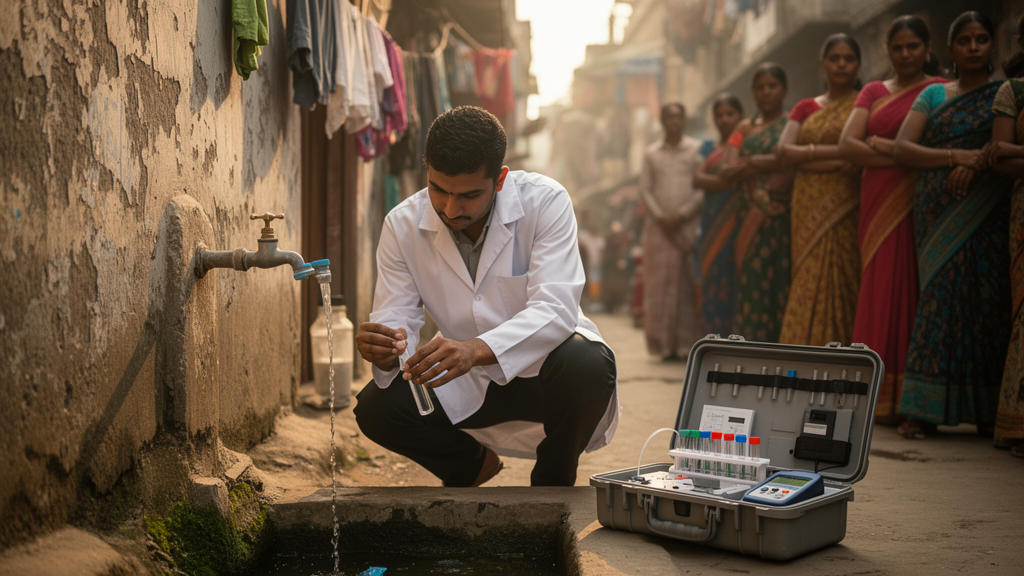
Drinking water supplied to low-income neighbourhoods of Gajuwaka, an industrial suburb south of Visakhapatnam in Andhra Pradesh, India, fails basic safety benchmarks, according to a field study that sampled 90 water portions from municipal, household and groundwater sources during winter 2023. The researchers found faecal coliform indicator bacteria in every category of water source, with most probable number (MPN) index values reaching 1,600 per 100 millilitres in untreated municipal water and 910 per 100 millilitres in groundwater. These figures stand far above the World Health Organization benchmark of fewer than 2.2 coliforms per 100 millilitres, a threshold that none of the sampled sources met.
The study also documented bacteria resistant to multiple antibiotic classes, including ceftazidime and imipenem, raising concerns about the intersection of water contamination and antimicrobial resistance in communities with limited healthcare access. The research team selected three neighbourhoods within Gajuwaka, an area that grew into an industrial hub hosting steel plants, pharmaceutical factories and dairy companies. Residents there depend entirely on municipality taps and groundwater from open wells and hand pumps for their daily drinking water.
Because municipal taps run only for limited hours in the morning, households must capture enough water to last a full day, and taps are often shared between properties and located outside homes beside roads. When power outages or technical failures interrupt the supply, residents fall back on untreated groundwater. The municipal supply originates from the Meghadrigedda reservoir and is managed by the Greater Visakhapatnam Municipal Corporation.
Sampling followed WHO guidelines: triplicate 3-litre samples were collected aseptically in sterile bottles, stored on ice and analysed within two hours. Of the 90 samples, 60 came from household taps at 20 sites, 18 from groundwater at six sites comprising three wells and three borewells, and 12 from pre-supply municipal water at four sites, covering raw water, post-chlorination water and two overhead tanks. Winter was deliberately chosen to assess water quality outside the principal southwest monsoon period, although the authors note that northeast monsoon rainfall and Bay of Bengal depressions can still influence coastal Andhra Pradesh during this season.
A structured survey of 60 households and municipal officials, completed by 55 respondents, preceded the sampling. The survey revealed troubling patterns in household behaviour and infrastructure. Only 33 percent of surveyed residents reported boiling or filtering their water before drinking, largely because packaged water is economically out of reach.
Residents described water quality that deteriorated after weather events such as rain and cyclones, and some reported reddish-coloured water on certain days, which could indicate soil or other contaminants entering through corroded or poorly maintained pipelines. These observations point to weaknesses both in the distribution network and in treatment at the plant level, though the study did not directly trace contamination sources. Physicochemical testing focused on four WHO priority parameters: pH, electrical conductivity, total dissolved solids and chlorides.
Mean pH values of 8.25 for municipal water, 7.75 for groundwater and 8.18 for household water remained mostly within the Bureau of Indian Standards range of 6.5 to 8.5, with only 10 percent of samples exceeding it. Total dissolved solids told a different story. The acceptable limit is 500 milligrams per litre, and while municipal water averaged 374.7 milligrams per litre and household water 285.15, every single groundwater sample exceeded the threshold, ranging from 678.23 to 1,984.96 milligrams per litre, with a mean of 862.69.
Electrical conductivity, preferred below 0.4 millisiemens per centimetre, was higher in roughly 73 percent of all samples, with groundwater averaging 1.289 millisiemens per centimetre. Mean chloride levels stayed within the 250 milligram per litre limit across all categories, though groundwater reached 181.4 milligrams per litre on average. Microbiological analysis using selective and differential culture media, Gram staining and an expanded biochemical panel including IMViC tests, triple sugar iron agar, oxidase, motility and urease reactions assigned the isolates to five presumptive bacterial groups: Escherichia, Pseudomonas, Salmonella, Proteus and Enterobacter species.
All isolates were Gram-negative. Escherichia and Pseudomonas species were detected in all municipal and groundwater samples and in 95 percent of household samples. Presumptive Salmonella species appeared in 83.33 percent of groundwater samples and half of both municipal and household samples, while Proteus and Enterobacter species were found less frequently.
The MPN index, a probabilistic estimate of viable coliform bacteria, ranged from 9 to 1,600 per 100 millilitres overall. In the municipal treatment train, the index dropped from 1,600 in raw water to 38 after chlorination, demonstrating that treatment works, yet household tap values ranging from 9 to 540, with 35 percent at 110 or above, suggest contamination persists or is reintroduced within the distribution system or at the point of use. Statistical analysis uncovered significant relationships between water chemistry and microbial populations.
Spearman rank correlations revealed a strong negative association between pH and both electrical conductivity and chlorides, and a strong positive association between conductivity and chlorides, all at p less than 0.001. Bacterial load measured by the MPN index correlated positively with electrical conductivity and total dissolved solids. Among the bacteria themselves, Escherichia and Pseudomonas species showed a highly significant positive correlation, a pattern the authors suggest could reflect biofilm formation inside pipelines, since both genera are known biofilm formers.
They emphasise this remains a hypothesis, as no direct biofilm sampling was performed. Proteus and Enterobacter species correlated positively with pH but negatively with chloride levels and conductivity, possibly reflecting osmotic stress effects on bacterial growth. Antimicrobial susceptibility testing using the Kirby-Bauer disk-diffusion method on Mueller-Hinton agar, following CLSI M100 standards, was performed on one representative isolate from each of the five bacterial groups, each tested in triplicate against eight antibiotics spanning six classes.
The results showed concerning resistance patterns. The Pseudomonas and Escherichia isolates resisted ceftazidime, a third-generation cephalosporin. The Enterobacter isolate resisted imipenem, amoxiclav, ampicillin, aztreonam and cefoxitin, while the Salmonella isolate resisted ceftazidime, ampicillin, meropenem, linezolid and cefoxitin.
Carbapenem resistance is a particular concern, as reports of carbapenem-resistant Enterobacteriaceae have emerged in many countries and could significantly threaten public health. To explore whether resistance phenotypes could distinguish bacterial groups, the researchers built two machine-learning classifiers in MATLAB using the eight binary resistance variables as predictors. A neural network pattern recognition model with a single hidden layer of 20 neurons achieved a mean cross-validated accuracy of 0.43, a macro-F1 score of 0.38 and an area under the ROC curve of 0.76.
A decision tree using Gini impurity performed better on accuracy and AUROC, at 0.56 and 0.86 respectively, though with a lower macro-F1 of 0.33. Shapley-value analysis identified cefoxitin, linezolid, meropenem and ampicillin as the most influential features for classification. The authors stress these models are exploratory: the dataset of 80 occurrence-level records was small and severely imbalanced, with only three Proteus and two Enterobacter entries, and the records inherited phenotypes from representative isolates rather than representing independent measurements.
Neither model constitutes a clinically validated diagnostic tool. The study carries clear limitations that frame its conclusions. Bacterial identifications remain presumptive at the genus level without molecular or proteomic confirmation, heavy metals, residual antibiotics and free chlorine were not measured, and the work covers a single industrial locality during one winter season, so findings are context-specific rather than nationally generalizable.
Potential contamination pathways, such as infiltration from polluted surface sources, are offered as plausible interpretations rather than verified sources, since no hydrogeological evaluation or microbial source-tracking was undertaken. Even so, the combined evidence of widespread coliform contamination, physicochemical degradation of groundwater, post-treatment recontamination at household taps and multidrug-resistant isolates establishes a sobering benchmark. The authors call for regular microbiological and physicochemical monitoring of wells and handpumps, inspection and maintenance of municipal distribution networks, and promotion of accessible household water treatment, noting that with only a third of households currently boiling or filtering their water, the communities studied remain highly exposed to waterborne disease and the growing burden of antimicrobial resistance.
Subject of Research: Assessing drinking water quality in marginalised Indian communities of urban Visakhapatnam
Article Title: Assessing drinking water quality in marginalised Indian communities of urban Visakhapatnam
Article References: Singh, V., Asthana, R., & Reddy, M. K. (2026). Assessing drinking water quality in marginalised Indian communities of urban Visakhapatnam. Environmental Challenges, 25, Article 101692. https://doi.org/10.1016/j.envc.2026.101692
Image Credits: AI Generated
DOI: 10.1016/j.envc.2026.101692
Keywords: Assessing, drinking, water, quality, marginalised, Indian, communities, urban, Visakhapatnam, scientific research
Cite Scienmag News
Sloane Callahan. (October 23, 2026). Research report: Assessing drinking water quality in marginalised Indian communities of urban Visakhapatnam. Scienmag. https://scienmag.com/research-report-assessing-drinking-water-quality-in-marginalised-indian-communities-of-urban-visakhapatnam/
Sloane Callahan. "Research report: Assessing drinking water quality in marginalised Indian communities of urban Visakhapatnam." Scienmag, 23 October 2026, https://scienmag.com/research-report-assessing-drinking-water-quality-in-marginalised-indian-communities-of-urban-visakhapatnam/. Accessed 23 October 2026.
Sloane Callahan. "Research report: Assessing drinking water quality in marginalised Indian communities of urban Visakhapatnam." Scienmag. October 23, 2026. https://scienmag.com/research-report-assessing-drinking-water-quality-in-marginalised-indian-communities-of-urban-visakhapatnam/


