


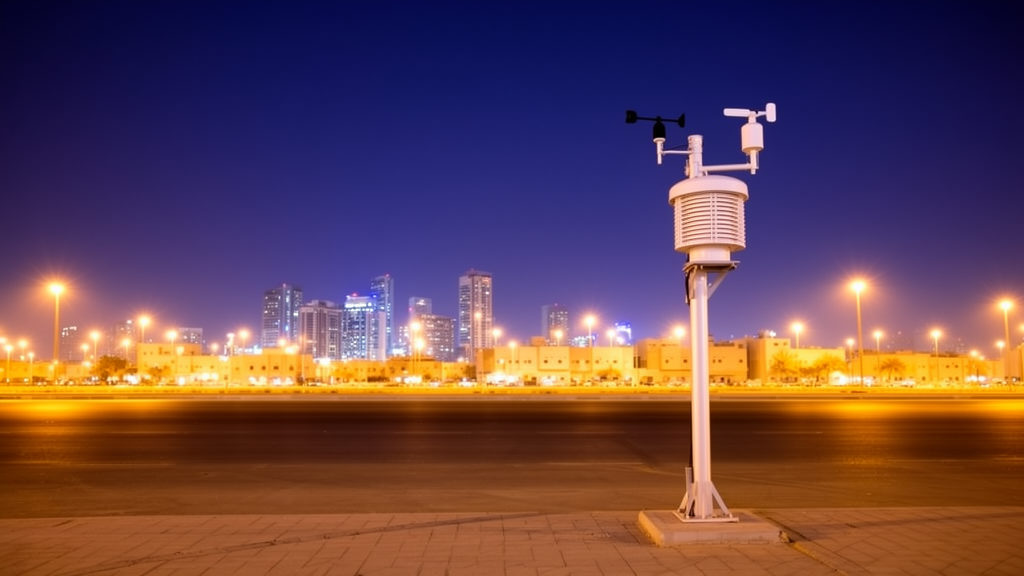
Night-time temperatures are rising faster than daytime temperatures in Saudi Arabia’s largest cities, and cold nights are vanishing, according to a new multi-city analysis of climate extremes covering 1981 to 2022. The study, which examined Riyadh, Jeddah, Dammam, Makkah and Madinah using homogeneity-tested station records, satellite-derived precipitation and statistically corrected trend tests, found that the frequency of cold nights fell at all five stations by 3.1 to 4.9 percent per decade, while mean minimum temperatures climbed by 0.51 to 0.95 degrees Celsius per decade. The researchers report that annual maximum daily temperatures also rose at four of the five cities, with the fastest rate of 0.74 degrees Celsius per decade recorded at Makkah.
The analysis applied the internationally standardised Expert Team on Climate Change Detection and Indices framework, computing measures such as the annual hottest day, the share of days above the 90th-percentile warm threshold, and the Warm Spell Duration Index, which counts days in spells of at least six consecutive unusually hot days. To ensure the detected trends were genuine rather than statistical artefacts, the team used the Mann–Kendall non-parametric test with the Hamed–Rao correction for serial dependence, quantified trend magnitudes with Sen’s slope estimator, and applied false discovery rate control across all 50 simultaneous tests. Of the 50 tests, 22 reached the 5 percent significance level after the serial-dependence correction, and 16 survived the multiple-testing filter.
The most robust signal in the entire dataset was the disappearance of cold nights. Cold-night frequency, defined as the share of days with minimum temperatures below the calendar-day 10th percentile, declined at every station, with corrected test statistics between −5.24 and −6.61. In practical terms, cold nights fell from 12.4 to 18.0 percent of the year in the first decade of the record to just 1.1 to 4.0 percent in 2011–2022. Annual minimum temperatures rose most steeply at the coastal and Hejaz stations, by 1.05 degrees Celsius per decade at Jeddah and 1.11 degrees Celsius per decade at Makkah, both retained after false discovery rate control, while Riyadh recorded an increase of 0.55 degrees Celsius per decade.
Daytime extremes told a more geographically varied story. The annual maximum daily temperature increased significantly at Riyadh, Dammam, Makkah and Madinah, with Sen’s slopes ranging from 0.31 to 0.74 degrees Celsius per decade, but the trend at Jeddah did not reach the 5 percent level. The hottest days in the records reached 52.0 degrees Celsius at Jeddah in 2010, 51.4 degrees Celsius at Makkah in 2012 and 51.0 degrees Celsius at Dammam in 2007. The share of warm days rose from 5 to 6 percent of the year in 1981–1990 to 10.4 to 15.9 percent in 2011–2022 at the four inland and Gulf stations, with the exceptional year 2010 pushing warm-day fractions to 21.7 to 31.2 percent.
Days with maximum temperatures of at least 45 degrees Celsius, a threshold with direct consequences for outdoor labour and energy demand, increased by 5.6 to 9.9 days per decade at Riyadh, Dammam, Makkah and Madinah, reaching 24.8 to 39.7 days per year in the most recent decade. Jeddah, moderated by the Red Sea, averaged only 1.0 to 3.2 such days per year. However, dry-bulb temperature alone understates the danger at humid coastal sites. Using a simplified wet-bulb globe temperature that accounts for humidity, the researchers found that Jeddah experienced 199 to 232 days per year and Makkah 230 to 264 days per year at or above 32 degrees Celsius on this index, compared with only 9 to 42 days at Riyadh and Madinah. Summer wet-bulb globe temperature rose significantly at Riyadh and Makkah, by 0.44 and 0.49 degrees Celsius per decade respectively.
In sharp contrast to the temperature findings, precipitation and drought indices showed no coherent change across the five cities. Only Makkah recorded a detectable increase in total annual precipitation, of 7.48 millimetres per decade, alongside a weakening of 12-month droughts. No station showed a trend in maximum one-day or five-day rainfall that survived false discovery rate control, and none showed a systematic trend in drought severity measured by the Standardised Precipitation Index. The most severe 12-month droughts reached index values of −2.27 at Riyadh in March 2000, −2.60 at Jeddah in March 2012 and −2.20 at Dammam in November 2021, but the share of drought months did not shift consistently in any direction. The data, the authors conclude, do not support a systematic drying of these five cities over the study period.
Perhaps the most surprising result concerns compound hazards, the simultaneous or closely sequenced occurrence of two extremes whose combined impacts can exceed those of each hazard alone. Using an explicit daily definition, the team counted heatwave days coinciding with three-month drought conditions, and heatwave days falling within seven days of extreme rainfall. Compound heatwave and drought days remained infrequent and peaked in 2001–2010 rather than in the latest decade, with the highest decadal count of 37.0 days per decade at Makkah, before falling to zero at three of the five stations in 2011–2022. Heatwave and extreme-precipitation coincidences occurred on only four days in the entire record, all at Madinah. The resulting Compound Hazard Index, which expresses the mean conditional probability of drought or extreme rainfall on a heatwave day, ranged from 0.09 to 0.15 across the full record, indicating that 9 to 15 percent of heatwave-day weight coincided with a second hazard.
This finding challenges expectations drawn from regional-scale studies that had identified the Arabian Peninsula as showing among the highest rates of heat–drought co-occurrence increase globally. The authors note a structural reason for the discrepancy: summer heatwaves in these cities fall in the driest months, when three-month precipitation indices cannot signal an anomaly and rainfall is near zero, which inherently limits both compound modes. Correlation analysis reinforced the picture of independence, with warm-spell duration and annual moisture deficits showing only weak associations at four of the five cities, and a modest negative rank correlation only at Riyadh. The growth of heat hazard in these cities, the study concludes, stems from hotter days and warmer nights rather than from more frequent compounding with drought.
The methodology included several safeguards that strengthen confidence in the results. Missing daily values were never interpolated, avoiding artificial rainfall days, and years entered the analysis only if they met World Meteorological Organization completeness criteria. Percentile-based indices used a bootstrap procedure to prevent artificial trend inflation at the period boundaries. A step change in temperature series in 1998, appearing simultaneously at all five stations 400 to 1200 kilometres apart and in the independent ERA5 reanalysis, pointed to a regional climate shift rather than an instrument problem. Comparison with ERA5 also revealed local effects: minimum temperatures at Jeddah and Makkah warmed faster than the reanalysis, and a comparison of Riyadh’s old city-centre airport with its outer international airport quantified a nocturnal urban heat island of 2.43 degrees Celsius, a direct measurement of how urban surfaces retain heat after dark.
The authors are careful about limitations. Each city is represented by a single airport station, so the trends mix regional background warming with local site and urban effects. Relative homogeneity testing flagged breaks in eight of the ten temperature series, although the main conclusions held when affected periods were excluded. The Makkah temperature record covers only 1984 to 2017, and the satellite-derived CHIRPS precipitation product represents cell averages that understate point extremes, notably capturing far less rainfall than local gauges recorded during Jeddah’s devastating 2009 and 2011 flash floods. With only five stations, no interpolation to unsampled regions was attempted, and the study made no formal attribution to anthropogenic forcing. Even so, the city-level risk rankings that emerge, placing Dammam first and Riyadh second in a composite of heat, drought and flood scores, offer concrete guidance: humidity-based heat-stress thresholds for pilgrimage planning in Makkah, urban cooling and building standards for the cities where 45-degree days are multiplying, and drainage design in Jeddah that does not assume a stationary rainfall climate.
Subject of Research: Trends in temperature extremes, precipitation extremes and compound heat hazards across five major Saudi Arabian cities from 1981 to 2022
Article Title: Spatiotemporal patterns of climate extremes and compound hazards: A case study of Saudi Arabia
Article References: Alkhawlani, Q., Algburi, S., Sabeeh, S., Al-Oran, O., & Almazroui, M. (2026). Spatiotemporal patterns of climate extremes and compound hazards: A case study of Saudi Arabia. Environmental Challenges, 25, Article 101690. https://doi.org/10.1016/j.envc.2026.101690
Image Credits: AI Generated
DOI: 10.1016/j.envc.2026.101690
Keywords: Saudi Arabia, climate extremes, heatwaves, urban heat island, drought, compound hazards, ETCCDI indices, Mann-Kendall trend test, CHIRPS precipitation, night-time warming, wet-bulb globe temperature, Makkah
Cite Scienmag News
Sloane Callahan. (October 23, 2026). Saudi Arabia’s Cities Are Warming Fastest at Night, Four-Decade Station Analysis Shows. Scienmag. https://scienmag.com/saudi-arabias-cities-are-warming-fastest-at-night-four-decade-station-analysis-shows/
Sloane Callahan. "Saudi Arabia’s Cities Are Warming Fastest at Night, Four-Decade Station Analysis Shows." Scienmag, 23 October 2026, https://scienmag.com/saudi-arabias-cities-are-warming-fastest-at-night-four-decade-station-analysis-shows/. Accessed 23 October 2026.
Sloane Callahan. "Saudi Arabia’s Cities Are Warming Fastest at Night, Four-Decade Station Analysis Shows." Scienmag. October 23, 2026. https://scienmag.com/saudi-arabias-cities-are-warming-fastest-at-night-four-decade-station-analysis-shows/


