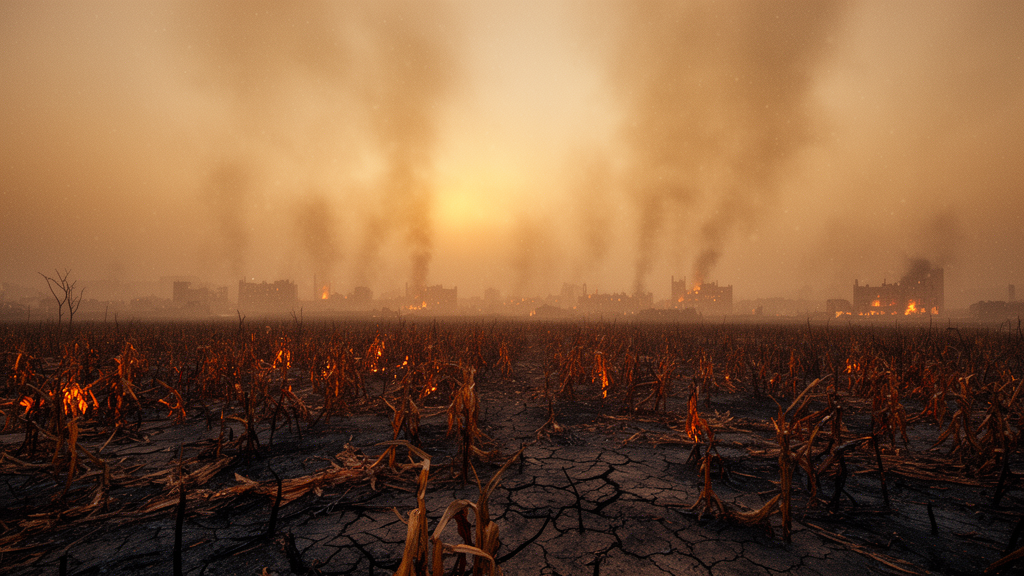
A nuclear war between the United States and Russia would not need to involve the full arsenals of both nations to scramble the global climate in unexpected ways. A new modeling study using the Canadian Earth System Model version 5.1 (CanESM5) finds that a relatively limited exchange, injecting between 12 and 24 teragrams of black carbon into the upper troposphere and lower stratosphere, produces not only the prolonged surface cooling long associated with nuclear winter but also a previously undocumented transient warming in the first boreal summer after the smoke goes up. The finding, published in Earth System Dynamics by Anson Ka Hei Cheung of the University of Toronto and colleagues, suggests that even modest nuclear conflicts could deliver a whiplash of climate extremes within a single year.
The scenarios examined represent roughly one-tenth to one-fifth of the 150 teragrams of black carbon typically assumed for a full-scale US-Russia exchange in earlier modeling work. Yet they remain extreme by any natural standard: the 2019 Australian wildfires, among the most significant stratospheric smoke events ever recorded, injected only about 0.9 teragrams of smoke into the stratosphere, of which a mere 2.5 percent was black carbon. Urban firestorms triggered by nuclear detonations would loft smoke with a much higher black-carbon fraction, because large-scale fires burning in oxygen-poor conditions produce proportionally more of the strongly light-absorbing soot than wildfires do.
The research team ran ensemble simulations with injections of 12, 16, 20, and 24 teragrams of black carbon, spread uniformly between the 300 and 150 hectopascal pressure levels over the United States and Russia at a constant rate over one week beginning on 1 January. Ensemble members were started from different years of a 100-year pre-industrial control simulation, all selected at neutral states of the El Niño-Southern Oscillation to avoid contaminating the response with that climate mode’s imprint. Each simulation ran for 20 years, and responses were calculated by subtracting the control climatology from the ensemble average. CanESM5 had never before been applied to nuclear war smoke scenarios, and its independent development from the models used in previous studies offers a fresh perspective on model uncertainty, even though its stratosphere is coarsely represented and it lacks interactive stratospheric chemistry and aerosol microphysics. The model does include the snow-darkening effect of deposited black carbon and a parameterization of the semi-direct radiative effect of soot on liquid cloud optical properties.
In the first two months, the results follow the familiar script. Absorption of sunlight by the soot layer cuts the downwelling shortwave radiation reaching the surface by 14.80 watts per square meter globally for the 12-teragram case and 26.52 watts per square meter for the 24-teragram case in January and February of the first year. Global mean surface temperature drops by 0.38 and 0.59 degrees Celsius respectively, with continental regions of the Northern Hemisphere cooling by as much as 8 degrees Celsius in the January-February mean. The pattern also bears the fingerprint of a positive Arctic Oscillation-like circulation response, with cooling around Greenland and warming north of Siberia, a dynamical signature previously reported for a smaller 5-teragram India-Pakistan scenario.
Then comes the surprise. Instead of a gradual recovery, the global mean surface temperature response reverses sign and climbs through the first boreal summer, peaking at +0.39 degrees Celsius for the 12-teragram case and −0.06 degrees Celsius for the 24-teragram case, an increase of more than 0.7 degrees Celsius within months for the weakest forcing. The warming is strongest over arid land regions: up to 3 to 5 degrees Celsius around Tibet, 2 to 3 degrees Celsius in southern Greenland and western North America, and 1 to 2 degrees Celsius in northern Africa. Notably, the transient warming is most pronounced for the lowest forcing cases, the opposite of what the shortwave cooling alone would predict.
The mechanism lies in the balance of surface energy fluxes. While sunlight is dimmed, the black carbon heats the air aloft, and this warmed atmosphere radiates more longwave energy back down to the surface. The global mean downwelling longwave flux peaks at +7.33 watts per square meter in August of the first year, and the enhancement per unit of aerosol burden is larger for the weaker forcing scenarios, in contrast to the approximately linear scaling of the shortwave response. The team shows that the warming land regions are clear and arid, that the clear-sky longwave response mirrors the all-sky response, and that column water vapor increases over the same regions, indicating that a water vapor feedback amplifies longwave emission from the smoke-laden atmosphere above. Relative humidity decreases in the upper troposphere and lower stratosphere over these regions but rises in the middle to lower troposphere, consistent with that feedback. The effect is also consistent with a stronger increase in nighttime minimum temperatures, which rules out surface darkening from deposited soot as the primary driver, since albedo changes could not explain nighttime warming.
Turbulent heat exchange adds to the story. As the upper troposphere warms more than the surface, the atmosphere becomes more stable, which suppresses the convective mixing and evaporation that normally cool the land surface. The surface net energy imbalance, combining net shortwave and longwave radiation with sensible and latent heat fluxes, reaches +2 to +5 watts per square meter across most Northern Hemisphere land areas in the first summer, while ocean surfaces, buffered by their enormous heat capacity, mostly show a negative imbalance. The localized land warming, redistributed by atmospheric advection, is enough to push the global mean surface temperature positive for a season before the deepening shortwave deficit takes over.
Precipitation, meanwhile, never gets the memo. Global mean rainfall declines from the start of the simulations and stays negative even during the warm first summer, because the top-heavy heating profile stabilizes the troposphere and inhibits convection. The vertical temperature gradient between 100 and 500 hectopascals is strongest in the first year but retains its sign throughout the 20-year simulation, indicating a persistently more stable troposphere. This decoupling of temperature and precipitation responses underscores that the hydrological consequences of even a limited nuclear exchange would be unrelenting.
The long-term picture is nonlinear in a way that matters. Doubling the injection from 12 to 24 teragrams more than doubles the amount of black carbon lofted into the stratospheric overworld above the 380 kelvin potential temperature surface, from 2.0 to 5.2 teragrams at the first-year maximum in June, because stronger heating drives more vigorous self-lofting of the buoyant smoke. Aerosols that reach the overworld persist far longer, with e-folding times of roughly three and a half years compared with three months in the lower atmosphere. As a result, the long-term cooling in years 6 to 15 scales more than linearly with injection mass: the 12-teragram case settles at −0.14 degrees Celsius globally while the 24-teragram case reaches −0.57 degrees Celsius, with significant winter cooling of 2 to 3 degrees Celsius in Europe and about 1.5 degrees Celsius in southern Canada and the United States in the later years, accompanied by expanded sea ice. The heating aloft is itself dramatic: in the best-sampled 20-teragram ensemble, the global mean air temperature response exceeds 40 degrees Celsius at 70 hectopascals by the first April and peaks at 45 degrees Celsius in June.
The authors caution that their model removes black carbon faster than previous studies, with more than two-thirds of the injected mass lost within the first year, and that its coarse stratospheric treatment and lack of aerosol coagulation and organic carbon emissions limit direct comparability with earlier work. The first-year warming also occurs mainly over arid, non-cropland regions, so it is unlikely to boost harvests; instead, warmer and drier surface conditions there could heighten wildfire risk, while the persistent high-latitude cooling and reduced precipitation could still depress agricultural productivity. Given that a nuclear conflict need not consume entire arsenals, and that the transient warming and nonlinear aerosol lifetime emerged even at these modest forcings, the team argues that multi-model assessment of limited-exchange scenarios is warranted before the full range of plausible outcomes can be trusted.
Subject of Research: Climate modeling of black carbon injection from a hypothetical limited US-Russia nuclear war
Article Title: Unexpected land-surface warming following a relatively limited-forcing hypothetical nuclear war
Article References: Cheung, A. K. H., Kushner, P. J., Pausata, F. S. R., Zhuo, Z., & Brown, M. L. (2026). Unexpected land-surface warming following a relatively limited-forcing hypothetical nuclear war. Earth System Dynamics, 17(5), 1573-1588. https://doi.org/10.5194/esd-17-1573-2026
Image Credits: AI Generated
Keywords: nuclear winter, black carbon, climate modeling, CanESM5, stratospheric aerosol, surface warming, precipitation, water vapor feedback, self-lofting, Earth System Dynamics, nuclear conflict, aerosol radiative forcing
Cite Scienmag News
Sloane Callahan. (October 23, 2026). Limited nuclear war could trigger surprising first-year land warming before nuclear winter sets in. Scienmag. https://scienmag.com/limited-nuclear-war-could-trigger-surprising-first-year-land-warming-before-nuclear-winter-sets-in/
Sloane Callahan. "Limited nuclear war could trigger surprising first-year land warming before nuclear winter sets in." Scienmag, 23 October 2026, https://scienmag.com/limited-nuclear-war-could-trigger-surprising-first-year-land-warming-before-nuclear-winter-sets-in/. Accessed 23 October 2026.
Sloane Callahan. "Limited nuclear war could trigger surprising first-year land warming before nuclear winter sets in." Scienmag. October 23, 2026. https://scienmag.com/limited-nuclear-war-could-trigger-surprising-first-year-land-warming-before-nuclear-winter-sets-in/