


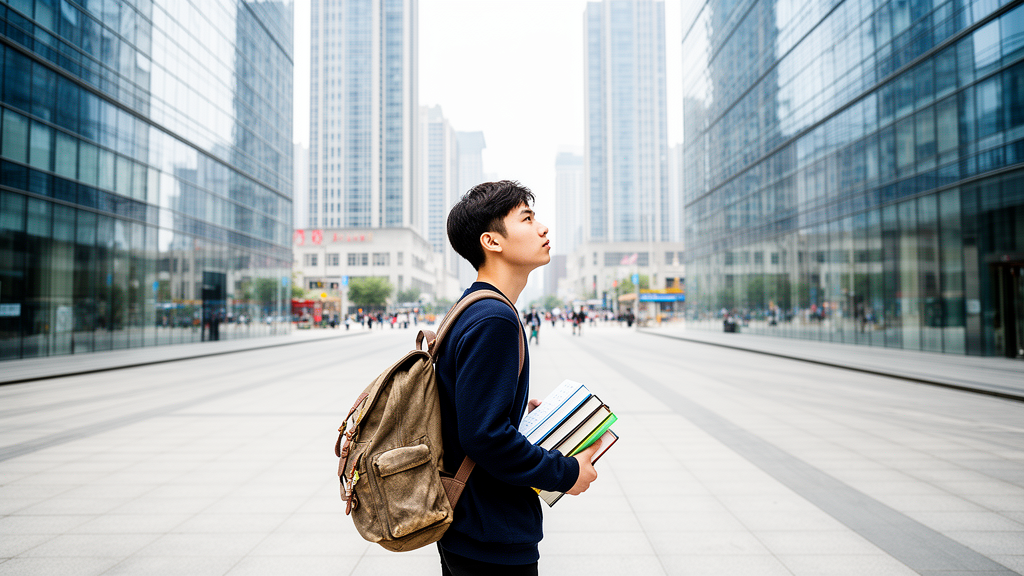
Students who move to a more economically advantaged city for university do not find their first year easier, according to a study of first-year undergraduates in China. Instead, relocating to a more developed city is associated with greater academic adaptation difficulty, a pattern the researchers interpret as developmental mobility generating pressure before it yields advantage.
The study, published in Higher Education, draws on survey data from 6,787 first-year students across China. The researchers linked students’ home cities and university cities to indicators covering 34 provincial-level units and 320 prefecture-level cities, allowing them to measure the gap between each student’s origin and destination in terms of development opportunities, city support, and living environment.
The central finding is that the development opportunity differential between origin and destination city was the most consistent correlate of adaptation difficulty. By contrast, differentials in city support and living environment showed weaker and less stable associations. In other words, it was not general differences in amenities or services that tracked how hard students found the first year, but the size of the developmental jump they had made.
That relationship ran against a simple expectation that moving somewhere more developed would ease the transition. Students who entered more developmentally advantaged cities reported greater difficulty with academic adaptation. The authors characterize this as developmental mobility generating pressure before it yields advantage, noting that moving into a more developmentally advantaged city does not make the first year easier.
The study also found that the university’s own context mattered, with heterogeneity by university type appearing more clearly for social and overall adaptation difficulty than for academic adaptation. This suggests that academic struggles tracked the city-level opportunity gap most strongly, while social and overall adaptation varied more across the specific institutional settings students entered.
The broader implication offered by the authors is that first-year adaptation is shaped not only by adjustment processes inside institutions, but also by unequal city contexts at the moment of entry. They argue that this extends established frameworks of student adaptation and development beyond the campus itself, bringing the spatial unevenness of higher education in China into the analysis of the transition to university.
Because the findings come from a survey linked to city indicators, they capture associations rather than experimentally demonstrated causal effects, and the measures of adaptation reflect first-year students’ own reported difficulty. Even so, the scale of the dataset across 320 prefecture-level cities gives the result unusual geographic reach, and the consistency of the development opportunity differential across analyses marks it out from the weaker signals for support and living-environment differentials.
For researchers, the study adds a spatial dimension to transition work: where a student comes from, and the developmental distance between origin and destination, appears alongside institutional adjustment as a correlate of how students experience the first year of university in China.
Subject of Research: How origin–destination differences in city opportunity structures relate to first-year university adaptation in China
Article Title: University entry as city transition: origin–destination differentials and first-year adaptation in China
Article References: Chen, W., Fang, F., & Zhang, J. (2026). University entry as city transition: origin–destination differentials and first-year adaptation in China. Higher Education. https://doi.org/10.1007/s10734-026-01805-z
Image Credits: AI Generated
DOI: 10.1007/s10734-026-01805-z
Keywords: higher education, student adaptation, first-year transition, urban opportunity structure, China, internal migration, academic adaptation, social adaptation, spatial inequality, survey research, University, entry
Cite Scienmag News
Courtney Benton. (October 23, 2026). Moving to a More Developed City Linked to Harder First Year at University in China. Scienmag. https://scienmag.com/moving-to-a-more-developed-city-linked-to-harder-first-year-at-university-in-china/
Courtney Benton. "Moving to a More Developed City Linked to Harder First Year at University in China." Scienmag, 23 October 2026, https://scienmag.com/moving-to-a-more-developed-city-linked-to-harder-first-year-at-university-in-china/. Accessed 23 October 2026.
Courtney Benton. "Moving to a More Developed City Linked to Harder First Year at University in China." Scienmag. October 23, 2026. https://scienmag.com/moving-to-a-more-developed-city-linked-to-harder-first-year-at-university-in-china/


