


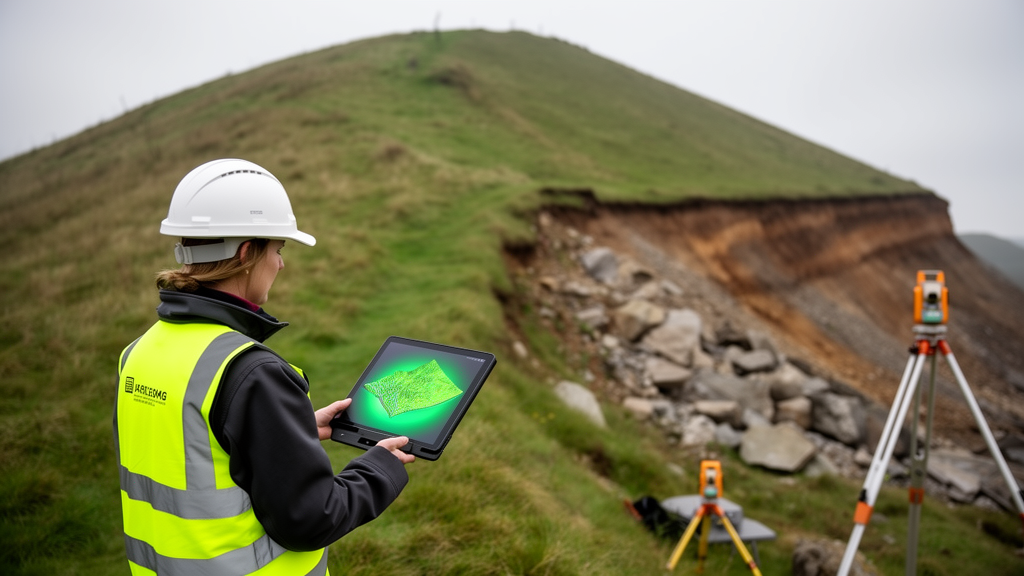
A new hybrid deep learning framework promises faster and more accurate predictions of slope stability, one of the most persistent computational challenges in geotechnical engineering. The framework, described in Neural Computing and Applications by Ali Biglarifadafan and Jong-Min Kim, combines unsupervised and supervised learning in a single pipeline designed to estimate the Factor of Safety (FS), the standard measure engineers use to judge whether a slope is likely to remain stable or fail.
Conventional slope stability analysis relies on iterative hard computing techniques, which the authors say often fail to capture the complex, non-linear relationships among soil parameters, hydrogeological conditions, and slope geometry that ultimately determine whether a slope holds or slides. Machine learning offers an alternative, but a standard neural network fed raw geotechnical data may converge slowly and generalize poorly.
The authors’ solution is to split the learning task into two stages. The unsupervised component acts as a feature engineering engine, extracting enriched representations from raw inputs describing soil properties and slope geometry. The model learns useful internal descriptions of the data on its own, then passes these processed representations downstream.
The second stage is a supervised deep learning model that regresses the Factor of Safety directly from the enriched features. According to the authors, this preprocessing step significantly enhances both the convergence rate and the predictive performance of the supervised model, meaning the network trains faster and produces more reliable estimates than it would from raw inputs alone.
To test the framework, the team validated it on a comprehensive dataset of 210 series and benchmarked the results against a standard Multi-Layer Perceptron (MLP) and conventional regression models. The comparison focused on three widely used performance metrics: the coefficient of determination (R-squared), Mean Absolute Error (MAE), and Root Mean Squared Error (RMSE).
The hybrid model demonstrated superior accuracy across these benchmarks, achieving a high R-squared value while reducing both MAE and RMSE relative to the standard MLP and the conventional regression baselines. In practical terms, the model’s predictions of the safety factor deviated less from the reference values, and its average errors were smaller.
The authors argue that the framework establishes a new computational paradigm for slope stability assessment, one that is both efficient and robust. Because the unsupervised stage automates feature engineering, the approach reduces the need for manually derived input variables, while the supervised stage delivers the FS estimates that the pipeline is designed to produce.
The study is a computational validation on a single dataset rather than a field deployment, so its findings concern model performance on that data. Even so, the results suggest that pairing unsupervised representation learning with supervised regression can outperform either conventional regression or a plain neural network when the underlying relationships between soil conditions, geometry, and stability are strongly non-linear.
The published work, appearing in Volume 38 of Neural Computing and Applications as article number 833, was released on 23 October 2026 and sits within the journal’s special issue on classifier learning from difficult data, a fitting home for a method built to learn from complex geotechnical inputs.
Subject of Research: A hybrid deep learning framework for predicting slope stability safety factors in geotechnical engineering
Article Title: A hybrid deep learning framework for enhanced prediction of slope safety factor in geotechnical engineering
Article References: Biglarifadafan, A., & Kim, J.-M. (2026). A hybrid deep learning framework for enhanced prediction of slope safety factor in geotechnical engineering. Neural Computing and Applications, 38(20), Article 833. https://doi.org/10.1007/s00521-026-12506-0
Image Credits: AI Generated
DOI: 10.1007/s00521-026-12506-0
Keywords: deep learning, slope stability, geotechnical engineering, factor of safety, unsupervised learning, supervised learning, neural networks, feature engineering, regression, soil mechanics, hybrid, deep
Cite Scienmag News
Blake Davidson. (October 24, 2026). Hybrid Deep Learning Model Boosts Prediction of Slope Stability Safety Factor. Scienmag. https://scienmag.com/hybrid-deep-learning-model-boosts-prediction-of-slope-stability-safety-factor/
Blake Davidson. "Hybrid Deep Learning Model Boosts Prediction of Slope Stability Safety Factor." Scienmag, 24 October 2026, https://scienmag.com/hybrid-deep-learning-model-boosts-prediction-of-slope-stability-safety-factor/. Accessed 24 October 2026.
Blake Davidson. "Hybrid Deep Learning Model Boosts Prediction of Slope Stability Safety Factor." Scienmag. October 24, 2026. https://scienmag.com/hybrid-deep-learning-model-boosts-prediction-of-slope-stability-safety-factor/


