


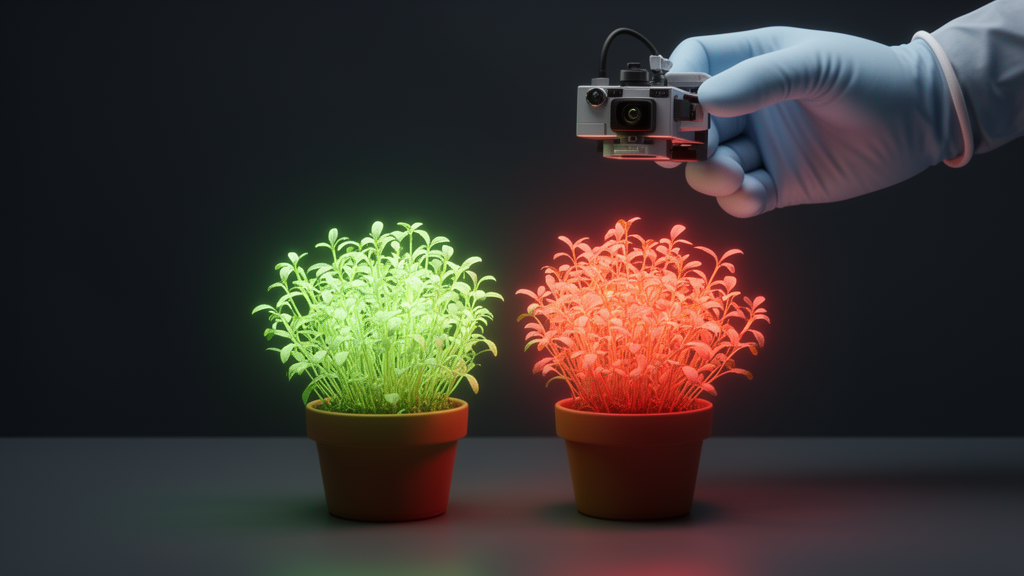
Researchers at the MRC Laboratory of Medical Sciences have developed a way to make self-glowing biological reporters far more accurate, demonstrated in plants and published in Nature Plants on 23 October 2026. Autoluminescence allows organisms to generate their own light without added chemicals or specialised equipment, but it has long suffered from a critical flaw: light output depends not only on gene activity but also on shifts in metabolism, temperature, oxygen levels and other physiological factors. This makes it difficult to tell whether a change in brightness truly reflects biological activity or simply a change in the organism’s internal state. The new study, led by scientists in Karen Sarkisyan’s group with collaborators from Light Bio and international partner institutions, addresses that variability head-on by engineering a red-shifted version of a fungal luciferase and pairing it with a green luminescent reporter.
The key innovation is ratiometric measurement. Instead of relying on overall brightness, the system measures the ratio between the two emitted colours, which remains reliable even when metabolism fluctuates. Because the red-shifted luciferase serves as an internal reference, metabolic effects that influence light emission can be corrected for, allowing the colour change itself to report gene activity. This effectively transforms autoluminescence from a qualitative indicator into a quantitative measurement tool, providing a more accurate picture of molecular processes inside living organisms. The approach worked across both fungal and bacterial bioluminescence pathways, suggesting it could be adapted for a wide range of biological applications beyond the plant systems used in the demonstration.
The team demonstrated the technique by tracking key defence and immune signalling pathways in plants. Using the new dual-colour reporters, they monitored hormone-driven responses over extended periods and detected localised immune activity around sites of infection, even when differences in metabolism caused large variations in overall brightness. This capability means researchers can potentially track gene activity in living plants over days, weeks and potentially even months and years, studying how plants respond to disease, pests and environmental stress simply by taking photographs in the dark, without expensive equipment or invasive treatments. The ability to monitor biological processes continuously and non-invasively could support the development of sentinel plants that quantitatively report nutrient levels, environmental conditions or disease through changes in the colour of their light emission, and may help researchers study plant-pathogen interactions and crop health under more realistic field conditions.
While the study focused on plants, the researchers believe the underlying technology has much broader potential. The team is exploring ways to adapt similar approaches for use in animal tissues and disease models, which could eventually enable researchers to monitor hormone activity, gene regulation and disease-related processes over extended periods using simple imaging methods. The work was highlighted by Nature Plants in an accompanying Research Briefing, in which Senior Editor Guillaume Tena noted that the new red-shifted luciferase provides an internal control allowing researchers to distinguish genuine biological signals from metabolic fluctuations, describing the ratiometric reporter system as a solution to the variability that has previously limited quantitative applications of fungal bioluminescence. Karen Sarkisyan, Group Head at the LMS and co-corresponding author of the study, explained that one of the biggest limitations of self-sustained luminescence has been that signal brightness depends on both gene expression and metabolism, and that by introducing a second colour as an internal reference those effects can be separated to obtain a much more reliable readout of what is happening inside a living organism. He added that in practice this means researchers can monitor molecular processes over long periods simply by taking photographs in the dark. The paper, titled Metabolically robust ratiometric autoluminescent reporters, carries the DOI 10.1038/s41477-026-02437-y. A declared conflict of interest notes that Karen Sarkisyan is a co-founder of Light Bio.
Subject of Research: Ratiometric autoluminescent reporters for quantitative gene activity imaging in living plants
Article Title: Breakthrough makes glow-in-the-dark biology a powerful new measurement tool
Article References: Breakthrough makes glow-in-the-dark biology a powerful new measurement tool. Original publication (Bibliographic details unavailable.)
Image Credits: AI Generated
DOI: Not provided
Keywords: autoluminescence, luciferase, ratiometric reporter, plant immunity, gene expression, bioluminescence imaging, Nature Plants, synthetic biology, Breakthrough, makes, glow-in-the-dark, biology
Cite Scienmag News
Juliet Wilcox. (October 24, 2026). Dual-colour glow turns autoluminescent plants into quantitative gene reporters. Scienmag. https://scienmag.com/dual-colour-glow-turns-autoluminescent-plants-into-quantitative-gene-reporters/
Juliet Wilcox. "Dual-colour glow turns autoluminescent plants into quantitative gene reporters." Scienmag, 24 October 2026, https://scienmag.com/dual-colour-glow-turns-autoluminescent-plants-into-quantitative-gene-reporters/. Accessed 24 October 2026.
Juliet Wilcox. "Dual-colour glow turns autoluminescent plants into quantitative gene reporters." Scienmag. October 24, 2026. https://scienmag.com/dual-colour-glow-turns-autoluminescent-plants-into-quantitative-gene-reporters/


