


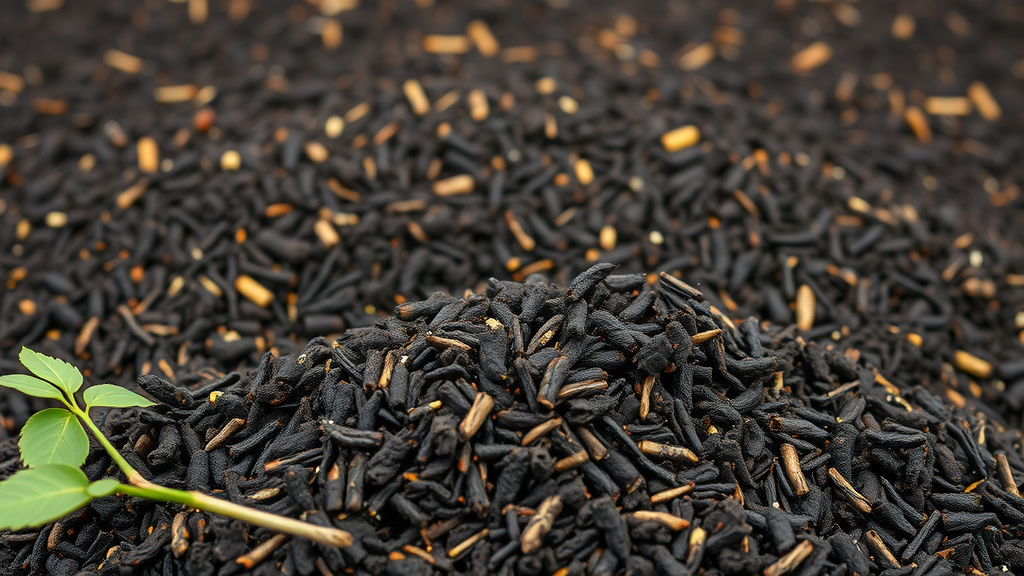
A sweeping synthesis of more than a quarter-century of research has concluded that biochar, the charcoal-like material produced by heating organic waste in the absence of oxygen, could become one of the most powerful tools available to Mediterranean farmers facing a warming, drying climate. The review, published in the journal Crop Health, pulls together peer-reviewed studies from 1999 to 2025 and offers the first comprehensive assessment of how biochar performs specifically within the Mediterranean basin, a region where rising temperatures of roughly 0.45 degrees Celsius per decade, declining rainfall, and soil organic matter depletion are converging to threaten the viability of traditional farming systems.
The analysis began with the Scopus database, where an initial search for biochar literature returned more than 50,000 documents. After filtering for work connected to carbon farming and the Mediterranean basin, the researchers retained 112 publications for detailed evaluation, mapping the field’s networks with VOSviewer software and adopting a structured narrative review approach. Their central finding is both encouraging and cautionary: biochar consistently builds soil carbon stocks and generally reduces nitrous oxide emissions, but its benefits for crops appear only when it relieves a genuine limitation, such as drought, salinity, or degraded soil structure. Applied indiscriminately to healthy, non-stressed fields, it may deliver little gain, or even cause harm.
The technical foundation of biochar’s appeal lies in pyrolysis, a thermal decomposition process conducted under oxygen-limited conditions at temperatures ranging from 300 to 1000 degrees Celsius. Slow pyrolysis, fast pyrolysis, and gasification each yield materials with distinct physicochemical properties. Higher-temperature biochars, produced at or above 600 to 700 degrees Celsius, are richer in aromatic carbon, more structurally stable, and more porous, making them exceptional long-term carbon vaults. Lower-temperature biochars retain more labile compounds and oxygen-containing functional groups that boost short-term nutrient availability and cation exchange capacity. Feedstock matters too: manure-derived biochars carry higher nutrient and ash content, while lignocellulosic materials from straw and wood produce denser, more porous, more persistent carbon structures.
Unlike compost or other conventional organic amendments, which soil microbes decompose within seasons, biochar’s pyrogenic carbon resists breakdown for centuries, with estimated mean residence times ranging from several hundred years to more than a millennium. Global meta-analyses cited in the review indicate that biochar application raises soil organic carbon stocks by an average of roughly 39 percent, and Mediterranean field studies confirm consistent accumulation even under the region’s punishing wet-dry cycles. Notably, one cited study demonstrated that biochar-induced increases in soil organic matter pools were not significantly altered by simulated climate change scenarios, suggesting that the stored carbon would survive the hotter, drier Mediterranean of the coming decades. Biochar can also slow the decomposition of existing soil organic matter through negative priming, adding a second layer of protection to carbon already in the ground.
On greenhouse gases, the picture is nuanced and, in one respect, troubling. Mediterranean field experiments generally report neutral or reduced carbon dioxide emissions after biochar application, confirming that the amended carbon is not being rapidly re-released, and reductions in nitrous oxide, a greenhouse gas nearly 300 times more potent than carbon dioxide, of 30 to 70 percent have been documented. The mechanism involves adsorption of ammonium and nitrate ions, which starves nitrifying and denitrifying microbes of substrate, alongside improved soil aeration that suppresses the anaerobic microsites where denitrification thrives. Mitigation is particularly pronounced when biochar is paired with organic fertilizers or digestates, stabilizing labile carbon inputs that would otherwise fuel microbial activity.
Methane, however, is the review’s warning flag. Several long-term Mediterranean field studies recorded increased methane emissions following biochar application, especially during warm, moist autumn and winter conditions. The culprit is the formation of biologically induced anaerobic microsites within biochar’s pore network when soils become water-saturated, creating localized oxygen-free pockets that favor methanogenic archaea. Emissions rose in proportion to application rate in at least one study, exposing a stark trade-off between maximizing carbon sequestration and minimizing greenhouse gas losses. The authors conclude that moderate application rates, generally 10 to 30 megagrams per hectare, represent the sweet spot, and that net climate assessments excluding methane risk seriously overestimating biochar’s mitigation value, particularly in fine-textured or poorly drained soils.
Crop responses vary sharply by species and growing condition. Among cereals, durum wheat has benefited from biochar through improved water retention during grain filling and enhanced nitrogen and phosphorus availability, though some controlled studies found reduced early shoot growth when biochar was applied without complementary nutrients. Rice shows consistent gains when biochar is combined with sprinkler or deficit irrigation, boosting yields, photosynthesis, and water-use efficiency while easing the transition away from flooded production. Maize responds strongly in saline soils, where biochar curbs sodium uptake and preserves potassium, but medium-term trials under non-stress conditions reported negligible yield gains despite measurable soil improvements, reinforcing the principle that soil chemistry alone does not guarantee agronomic return.
Legumes and perennial woody crops emerge as the stars of the analysis. Fenugreek, faba bean, and cowpea all showed improved yields, chlorophyll content, antioxidant activity, and stress tolerance, likely because biochar enhances phosphorus availability and rhizosphere conditions that support biological nitrogen fixation. In vineyards, a single biochar application improved vine water status, stomatal conductance, and drought resilience for more than a decade, a persistence that dramatically improves cost-effectiveness. Super-intensive olive groves treated with biochar from olive residues showed higher soil moisture, net photosynthesis, water-use efficiency, and fruit yield even under deficit irrigation. Vegetables tell a more mixed story: tomato and pepper respond reliably well, melon and zucchini benefit when biochar is combined with digestate or compost, while lettuce and onion have suffered yield losses in volcanic Mediterranean soils, apparently due to nutrient imbalances and phytotoxic compounds. Peach trees showed reduced survivability despite normal yields among surviving plants, underscoring the need for species-specific testing before large-scale deployment.
The review’s authors argue that biochar should be deployed selectively, targeting degraded or coarse-textured soils, water-limited or saline fields, and long-lived perennial systems such as orchards and vineyards, rather than applied uniformly across the landscape. They call for long-term, crop-centered field experiments to validate yield persistence and net greenhouse gas balances, with particular attention to methane mitigation strategies and underexplored systems like legumes and diversified rotations. Beyond the agronomy, economics will decide adoption: feedstock collection, pyrolysis processing, transport, and field application are costly in a region marked by fragmented landownership and limited infrastructure, while carbon credit markets remain uncertain and unevenly supported across Mediterranean countries. If pricing frameworks mature and decision-support tools reach farmers, the researchers conclude, biochar could convert the Mediterranean’s agricultural waste streams into a durable bridge between food production and climate stabilization, provided the methane caveat is heeded every step of the way.
Subject of Research: The role of biochar in carbon farming and climate-smart Mediterranean agroecosystems
Article Title: Carbon farming strategies for mediterranean agriculture: the role of biochar in climate-smart agroecosystems
Article References: Borgatti, D., Radicetti, E., Mancinelli, R., Coluccia, L., Allam, M., Jamal, A., Abideen, Z., Ahsan, M., & Hassine, M. B. (2026). Carbon farming strategies for mediterranean agriculture: the role of biochar in climate-smart agroecosystems. Crop Health, 4(1), Article 19. https://doi.org/10.1007/s44297-026-00081-8
Image Credits: AI Generated
DOI: 10.1007/s44297-026-00081-8
Keywords: biochar, carbon farming, Mediterranean agriculture, carbon sequestration, greenhouse gas emissions, nitrous oxide, methane, soil health, climate-smart agriculture, crop productivity, pyrolysis, sustainable agriculture
Cite Scienmag News
Alan Morgan. (September 12, 2026). Biochar Emerges as a Selective Climate Tool for Mediterranean Agriculture. Scienmag. https://scienmag.com/biochar-emerges-as-a-selective-climate-tool-for-mediterranean-agriculture/
Alan Morgan. "Biochar Emerges as a Selective Climate Tool for Mediterranean Agriculture." Scienmag, 12 September 2026, https://scienmag.com/biochar-emerges-as-a-selective-climate-tool-for-mediterranean-agriculture/. Accessed 17 October 2026.
Alan Morgan. "Biochar Emerges as a Selective Climate Tool for Mediterranean Agriculture." Scienmag. September 12, 2026. https://scienmag.com/biochar-emerges-as-a-selective-climate-tool-for-mediterranean-agriculture/


